











“Nuts.” – Brigadier General Anthony McAuliffe during the Battle of the Bulge
By Marc C. Johnson
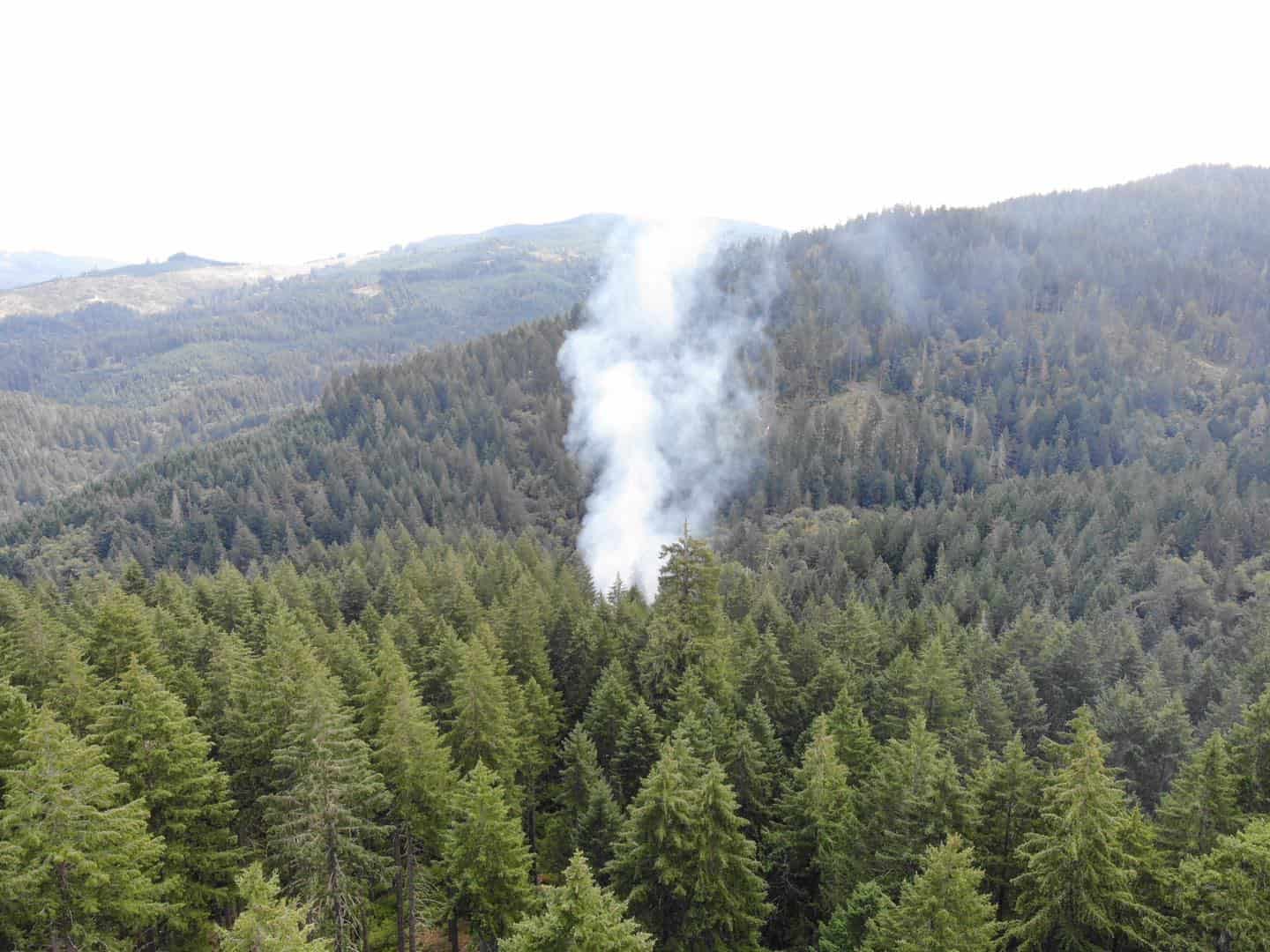
I’ve read the history, studied the maps, watched “Band of Brothers,” but nothing quite prepared me to see and walk the ground around Bastogne in southeastern Belgium last week.
This is the area where some of the most brutal fighting took place during the Battle of the Bulge between December 16, 1944 and January 25, 1945.
You have to see the dense Ardennes to appreciate the complexity, indeed the unreality of the massive German surprise attack that began just before Christmas 1944. The sector around Bastogne was thought by many Allied commanders to be quiet enough, safe enough to serve as a rest area for exhausted American soldiers.
How wrong that assessment was. The Ardennes became one of the great killing grounds of World War II.
Imagine the above photo at 15 below zero and covered with snow.
As the National World War II Museum describes it:
The German objective was to fight through the dense Ardennes Forest, cross the Meuse River into Belgium, and capture the critical supply center of Antwerp. Hitler believed that this would split the British and American Allies by physically dividing their armies and creating rifts over military strategy. The ultimate goal was to convince the Allies to negotiate with Germany, allowing Hitler to focus his forces on fighting the Soviets on the Eastern Front.
The start of the offensive on December 16 took the Allies by surprise. The Germans deliberately chose to attack in bad weather to neutralize Allied air forces. The plan initially achieved success, and the Germans inflicted heavy casualties as they pushed forward. The Germans created a bulge in the Allied front, giving the battle its iconic name.
The battle, the last effort by Adolf Hitler to return to the offensive, was both the largest and costliest fought by the U.S. Army in Europe.
Here’s how the National Archives describes the cost:
The United States suffered 19,276 fatalities in the Battle of the Bulge, more than in any other battle in the war, such as those in the Pacific, including Okinawa, Guadalcanal, and Iwo Jima. Overall, the United States had 75,000 casualties, while the Germans had 80,000 to 100,000 casualties, according to the Army Center of Military History.
“The Ardennes campaign of 1944–45 was only one in a series of difficult engagements in the battle for Europe,” wrote John S.D. Eisenhower, son of the supreme allied commander, in his 1969 book, The Bitter Woods, noting that there were other campaigns in the war against the Nazis that required extraordinary efforts from commanders and their troops.
“Nevertheless, it can be said that the Ardennes campaign epitomized them all,” he added. “For it was here that American and German combat soldiers met in the decisive struggle that broke the back of the Nazi war machine.
Bastogne and it’s citizens certainly remember the battle and celebrate the American role in stopping the German offensive. It is clear that the battle’s impact on civilians was truly awful.
The principal square in the town is named for Brigadier General Anthony McAuliffe who was in command of the 101st Airborne Division during the battle. McAuliffe’s paratroopers and glider infantry formed a defensive line around Bastogne and refused through utter determination and unbelievable bravery to be overrun.
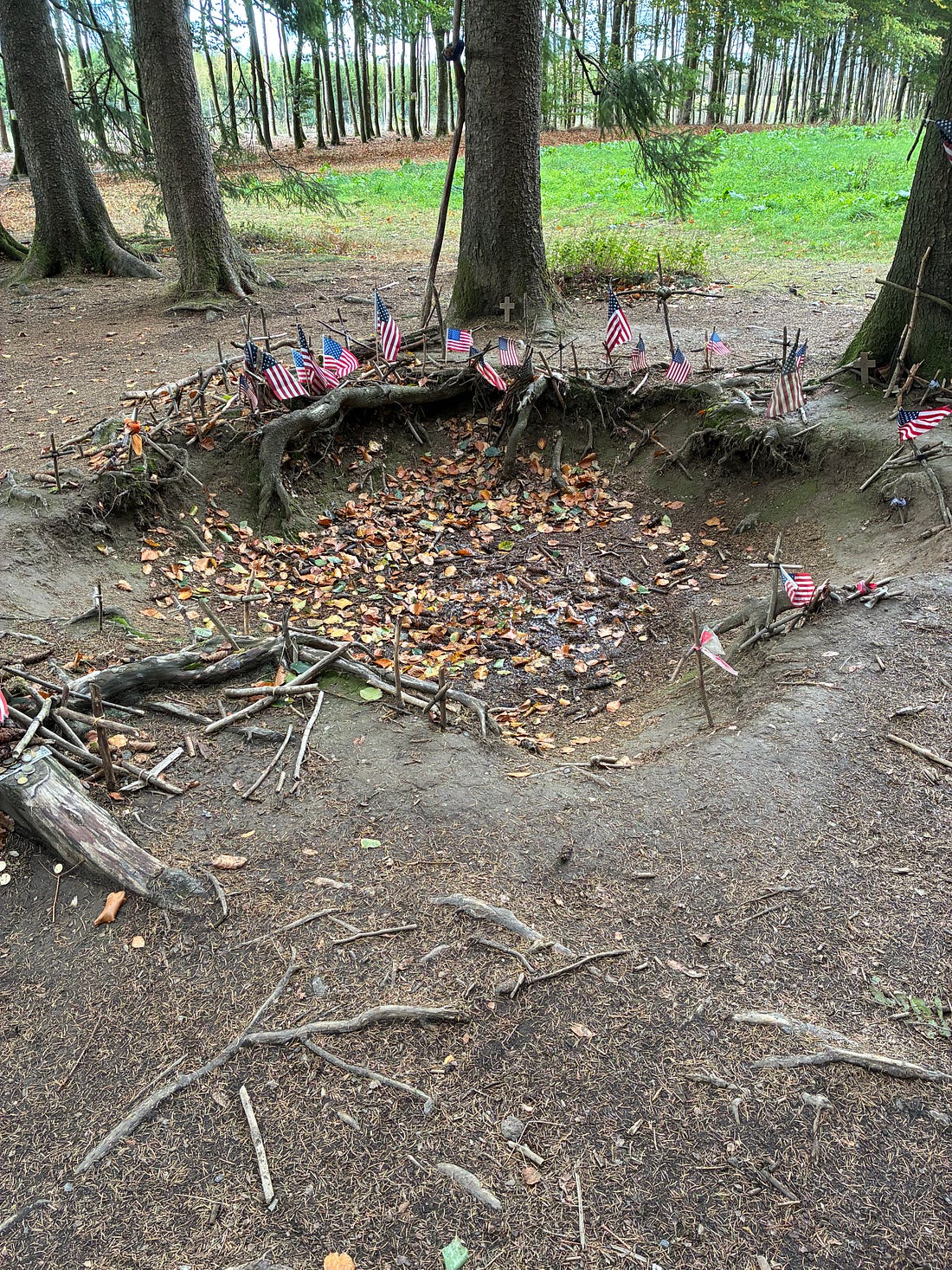 |
The fox holes of Easy Company of the 506th Parachute Infantry Regiment are still visible near Bastogne
The conditions were brutal – below zero temperatures, ammunition, food and medical supplies running low, and casualties mounting. The awful weather prevented superior Allied air forces from attacking the advancing German tanks and infantry.
Amid such conditions the Nazi commander in the Bastogne sector sent a message to McAuliffe demanding surrender.
McAuliffe issued his famous one word response – “Nuts!”
Apparently the American officer who formally delivered the general’s response added his own elaboration: “Go to hell …”
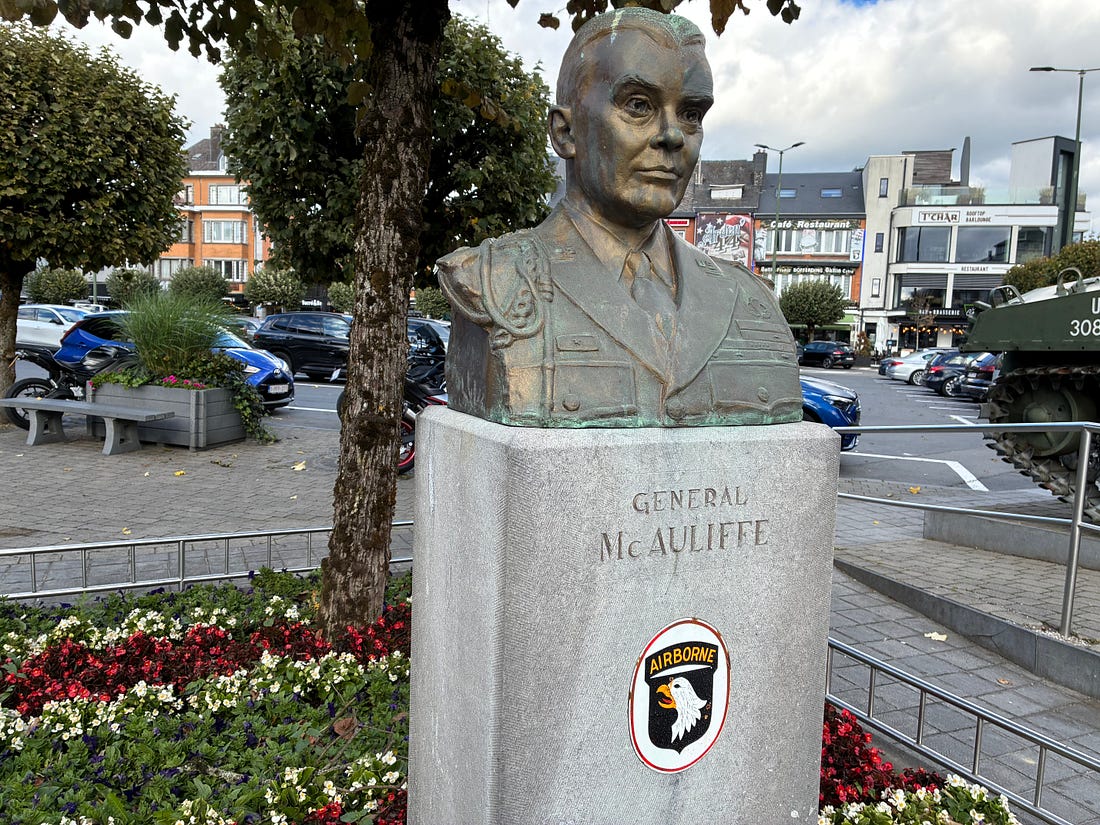 |
General McAuliffe is remembered with a monument in Bastogne’s town square
A visit to Bastogne and other Battle of the Bulge sites – the Bastogne museum is truly amazing – would be memorable and emotional for almost anyone at any time, but to visit as we did last week as the American president was siding with the brutal Russian regime in its war of aggression against democratic Ukraine was, well, stunning to contemplate.
Donald Trump aligning with Vladimir Putin should not, by now, be any great surprise to anyone, but this alignment should be characterized for what it is: an embrace by the American president of a murderous, dictatorial Russian regime that comes as close as anything in recent history to mimicking the Nazi regime of the 1930’s and 1940’s.
The rot is deep
And it’s not just the fascist-adjacent White House and its abandonment of the entirety of post-war ideas of collective security and support for allies that is our frightful worry. Members of the president’s party and millions of Americans either embrace this dangerous nonsense or refuse to condemn it.
Americans were fighting Hitlerism 82 years ago – and dying by the thousands in the woods of Belgium – to preserve democracy at home and around the world, yet a United States senator in Georgia, Jon Ossoff, has correctly blistered his Republican opponent, Rep. Mike Collins, for hiring “half the Third Reich” to work in his congressional office. That is an absolutely true reference to, as the Times too gently put it, the “congressman’s history of hiring aides who have espoused white nationalist and antisemitic views.”
Collins didn’t bother to deny the charge.
The New York Times’ Jamelle Bouie recounted chapter and verse the GOP “neo-Nazi” problem in a column in September. Here’s just part of his case:
Senator Jon Husted, an Ohio Republican running to retain the seat to which he was appointed after Vice President JD Vance left for the White House, recently fired his 25-year-old political director after learning that he had used a photograph of Nazi soldiers as a social media profile picture.
You’ll notice that most of these people are in their 20s and 30s. That is no coincidence; it is clear that among the young staffer and operative class of the Republican Party are people with neo-Nazi sympathies and white supremacist views. Last year, for example, leaked messages from a group chat of Young Republicans from chapters across the country — who ranged in age from 18 to 40 — included racial slurs, support for Nazi ideas and a declaration of admiration for the leader of the Third Reich, all framed as jokes. “I love Hitler,” wrote Peter Giunta, then the chief of staff to a New York State assemblyman. Asked if he was watching an N.B.A. playoff game, Giunta, who was also the chairman of the New York State Young Republicans at the time, replied, “I’d go to the zoo if I wanted to watch monkey play ball.” If these were jokes, they revealed a taste for both cruelty and casual bigotry.
The University of Florida’s College Republicans chapter was disbanded after two members were seen performing a Nazi salute on social media. Elsewhere in the state, 34-year-old Marshall Rawson is favored to take a seat in Florida’s House of Representatives nearly 10 years after marching alongside neo-Nazis at the Unite the Right rally in Charlottesville, Va.
In March, 30-year-old Brandon Herrera won the Republican primary for Texas’ 23rd Congressional District. A far-right YouTube personality, Herrera has published videos that feature Nazi imagery and Nazi military anthems, joke about the Holocaust and showcase Nazi weapons. He can even be seen goose-stepping. And one of the most prominent neo-Nazis in the country is 28-year-old Nick Fuentes, a far-right provocateur and political commentator whose supporters are known as “Groypers.” Fuentes dined with President Trump between his two terms and in the past year sat for a friendly interview with Tucker Carlson, still arguably the most important figure in the right-wing media ecosystem.
The Atlantic’s Tom Nichols (a conservative), in an article entitled “The Republican Party Has a Nazi Problem,” wrote earlier this year:
Even federal agencies are modeling Nazi phrasing. The Department of Homeland Security used an anthem beloved by neo-Nazi groups, “By God We’ll Have Our Home Again,” in a recruitment ad. The Labor Department hung a giant banner of Donald Trump’s face from its headquarters, as if Washington were Berlin in 1936, and posted expressions on social media such as “America is for Americans”—an obvious riff on the Nazi slogan “Germany for the Germans”—and “Americanism Will Prevail,” in a font reminiscent of Third Reich documents.
Trump, of course, openly pines to be a dictator. In his first term, he reportedly told his chief of staff, General John Kelly, that he wished he had generals who were as loyal as Hitler’s military leaders. (The president was perhaps unaware of how often the führer’s officers tried to kill him.) More recently, the White House’s official X account supported Trump’s pursuit of Greenland by posting a meme with the caption “Which way, Greenland man?” That is not merely a clunky turn of phrase; it’s an echo of Which Way Western Man?, the title of a 1978 book by the American neo-Nazi William Gayley Simpson, a former Presbyterian minister who called for America to expel its Jewish citizens.
Nichols flatly rejected the frequent objection of Trump-aligned Republicans that it’s objectionable to call people who hold such views as exhibiting “Nazi-like behavior,” but that it precisely what they deserve:
What can Americans do in the face of moral rot in a major political party? The only short-term answers are shaming, shunning, and mockery—and punishment at the polls. Decent citizens must ostracize those among them who toy with Hitlerism. Americans—especially journalists—should resist becoming inured to fascist rhetoric. No one should rely on euphemisms about “extreme” comments or “fiery” speeches. Call it what it is: Nazi-like behavior.
Whatever their intentions, some Americans are expressing or abetting ancient hatreds, smirking at the mention of Hitler, and plastering public spaces with images that Allied soldiers once tore from the walls of destroyed German cities. Political leaders who encourage or tolerate such scoundrels should be driven from office.
The Republicans have a Nazi problem, yes. But this means that the United States also has a Nazi problem. The responsibility for defeating it in the 21st century falls, as it did in the 20th, to everyone—of any party or creed—who still believes in the American idea.
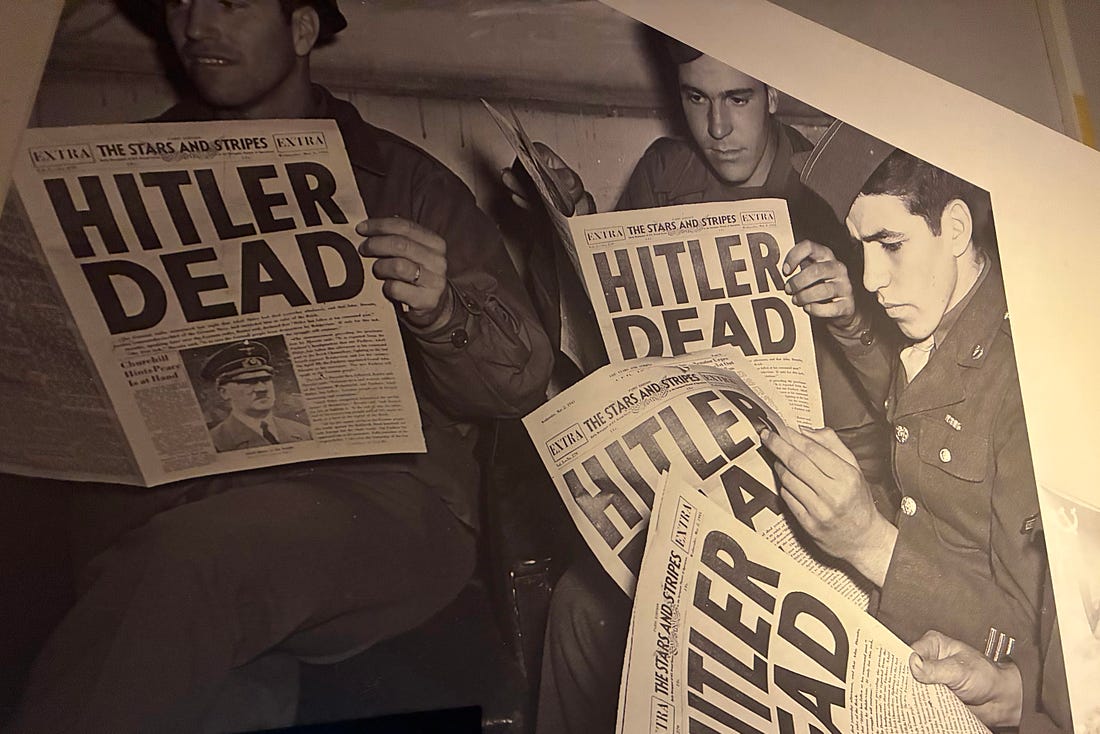
I was moved by many things in the museum at Bastogne, including the generally young age of the very large and mostly European crowd visiting last Sunday, but also by this photo on display – American GI’s reading the news of Hitler’s death in April 1945.
 |
I don’t believe I’m naive about American politics.
There have always been radical, fringe movements as part of our politics. But what we are seeing with many young “conservatives,” and their enabling elders is of a vastly different order. The embrace of Nazi-like language, images, slogans and even out-and-out expressions of admiration for Adolf Hitler is beyond all possible understanding.
And it simply must be, as Tom Nichols writes, shamed, shunned and mocked – and most of all defeated at the ballot box.
I don’t know about you, but I haven’t lived this long and come to revere the sacrifice of Americans who fought and defeated fascism to now sit by and watch my country go farther in the direction of lawless authoritarianism. This must stop.
The paratroopers and tank crews who defeated the fascists in Belgium in 1945 had it really, really tough. And many of them died fighting for ideas and institutions that too many of us have taken for granted all these years later.
Right now all we have to do is be smart enough to vote and send as many as possible of the current apologists for fascism packing on November 3.
Tell ‘em what General McAuliffe told the Nazis – “Nuts!”
Or better yet, “Go to Hell.”
We can beat them at the ballot box – we really can and we must.
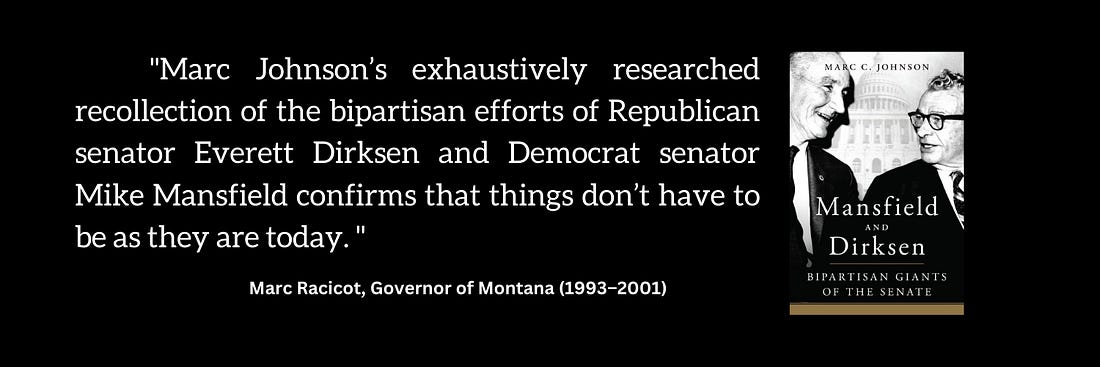
About me: I am a Nebraska native, grew up in South Dakota and migrated in Idaho after college to work in broadcast journalism. In 1986, I joined the “comeback” campaign of a legendary Idaho political figure – Cecil D. Andrus – who eventually served four terms as governor and four years as Secretary of the Interior, not bad for a Democrat in a very conservative state. I had a small role in helping Cece Andrus win his last two gubernatorial terms. I did communication and crisis consulting work, and since “retiring” to the beautiful north coast of Oregon have written three books on U.S. Senate history. I’m working on a new book on another legend – this one a legend in journalism.
You can find my books here:
I write this Substack to scratch my itch to connect history with current politics. I hope, in some small way, to contribute to understanding of this perilous moment for our democracy, for free speech and facts. Subscribe here for more.
