










“There is something plainly dysfunctional about this place, but something hard to pinpoint.” – Stephen Lyons writing in High Country News in 1998
In 2004 Thomas Frank, a journalist and historian, made waves with his book entitled What’s the Matter with Kansas?
Frank set out to try and understand why rural, conservative voters in his home state had for decades seemingly voted against their own interests by consistently voting for Republicans.
Frank concluded that Kansas politics had shifted over time from white “working class” voters primarily focused on economic concerns to voters choosing candidates based on cultural issues, including abortion, gay rights and the teaching of evolution.
While some political scientists have questioned that conclusion there is little doubt that in most parts of the country the Democratic Party has lost ground with many voters that if not once Democrats were at least open to voting for a Democrat some of the time.
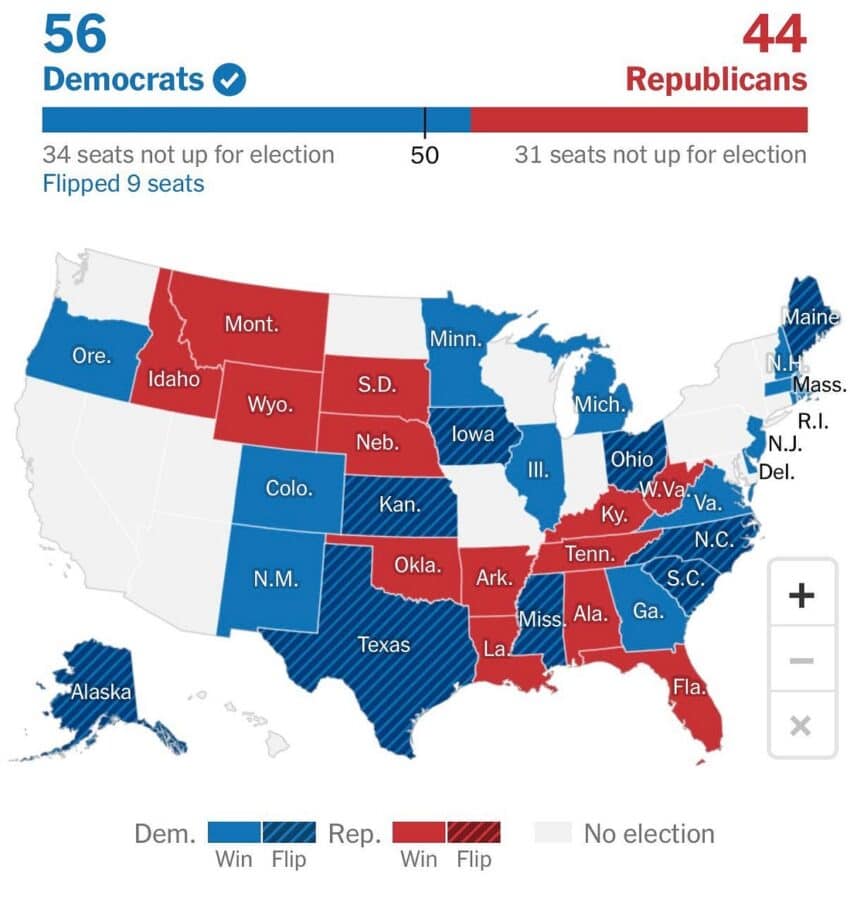
Yet, this year Kansas, not to mention Texas, North Carolina, Alaska, Georgia and several other places not considered liberal strongholds, flipped the old political script.
Democrats are going to the Senate, the House, the statehouse and legislatures in places where that hasn’t happened in years, or ever.
We’ll be debating the causes of the “blue tsunami” for a long time, but there is little doubt it happened, but still not in Idaho.
While Democrats made modest, yet arguably important gains in the state legislature the big mid-term wave largely missed Idaho.
Instead Idaho voters decided, along with voters in Wyoming, North and South Dakota and Nebraska to effectively embrace the politics of the states of the old Confederacy even as Texas, Mississippi and South Carolina were signaling a break with that backward looking political past.
In Kansas, a state that last elected a Democratic senator ten years before Idaho’s 83-year old Senator James Risch was born, elected one this year.
This Kansas shocker prompted the BBC to note that when Kansas last had a Democratic senator Judy Garland was busy filming “The Wizard of Oz.”
The Kansas winner is Adam Hamilton, a Methodist minister, who ran a campaign based on the issues most voters found relevant – high prices, tariff impacts on farmers, and how safety net program cuts have really hurt people – white working class people. ¹
But Hamilton stressed something else, as well – basic human decency. As columnist E.J. Dionne wrote in the New York Times, Hamilton’s “stump speech always returns to a friendlier kind of politics.”
“I’m pretty sure in this room we have Republicans and we have Democrats and independents,” Hamilton told one group.” But then immediately stressed that the election was not about the Red Team or the Blue Team.
“It’s about decency. It’s about humanity,” he said. “And what’s happening in Washington, D.C., is not normal. It’s not how things work. I’ve never seen it before.”
Perhaps “normal” and “decency” in politics is just what most of the country wants right now.
Back to Idaho, the new state in the old Confederacy. While Donald Trump’s approval has slumped and while most Idaho Republicans, ever so subtly, put some distance between themselves and the aging demagogue who took over their party, the state remains ultra friendly to the GOP.
Why?
Part of the explanation is in migration from states like California where one guesses older, white Americans have grown sour about taxes they think are too high, crime they think is too widespread and where mostly Democrats get elected.
Governor Brad Little brags about Idaho’s lack of regulation and the tax cuts the GOP has delivered. Fair enough, but as always there is more to the story.
Including the question of just what does Idaho actually get, particularly now, by becoming a major political outlier, like an Arkansas, Alabama or a Washington, D.C. dominated by a hateful Donald Trump?
Migrants to Idaho have relocated to one of the few states that still taxes groceries and tragically underfunds its education system, handing millions to wealthy parents to spend on private schools where their kids were already enrolled.
The state almost gleefully punishes some of its most vulnerable and marginalized citizens, while ignoring or enabling resident white nationalists who would deny women the vote.
Idaho’s rural-urban divide is growing. The cities are growing, the small towns aren’t, and more and more the kind of traffic you see in Los Angeles or Phoenix exists in the sprawling Boise metro area.
No Idaho Republican talk any more of the state’s “quality of life” even as the notion of “livability” takes on meaning beyond the price of gas and a ribeye. The “freedom” Idaho’s leaders regularly invoke doesn’t really enhance your commute.
Idaho voters, with a big push from lots of money and advocacy from the state’s two major religions – LDS and Catholic – opted to keep the most restrictive abortion regulations in the nation. This will almost certainly result in a further exodus of obstetricians and gynecologists with more Idaho women forced to leave the state for life saving medical care. ²
The state’s congressional delegation refused to use what influence it had in the majority to resist Trump’s inflationary tariffs, his threats to public ownership of public lands and his disastrous forever war in the Middle East, and the delegation is now without influence, not to mention power.
What is Trumpism good for?
And what has Trumpism brought to Idaho, a state where the doddering and increasingly incoherent president remains more popular than most anywhere else in the country?
Short answer: not much, but a more coherent governing class would be aghast at the threats confronting the state.
The Trump Administration is suing Idaho over long established state supremacy over its water, the biggest threat to Idaho’s “life blood” since the federal government and California came for Snake River water in the 1950’s and 1960’s.
As former Idaho Republican attorney general Jim Jones has correctly noted, “In years past, such a bald-faced federal intrusion into Idaho’s natural resource affairs would have been met with outrage by our state leaders.” Now, only muted indifference that invites more Trumpian overreach.
By stealthy cooperating with a plan to turn eastern Idaho’s Department of Energy site into a Nuclear Lifecycle Campus – read waste disposal site – the state’s Republican leadership has hung out a nuke waste welcome sign, while receiving nothing in return beyond vague promises of future economic benefits.
And, of course, the Trump challenge to Idaho’s water is deeply embedded in this administration’s desire to find a welcoming site for commercial high level nuclear waste, in part surely because the president and his billionaire pals have big financial stakes in nuclear energy’s future.
The administration wants, again, to sell or lease public land to big tech companies to facilitate energy and water gobbling data farms.
Idaho’s tired and aging political leadership won’t stop any of this from happening. They are tired and aging and out of ideas beyond cutting taxes.
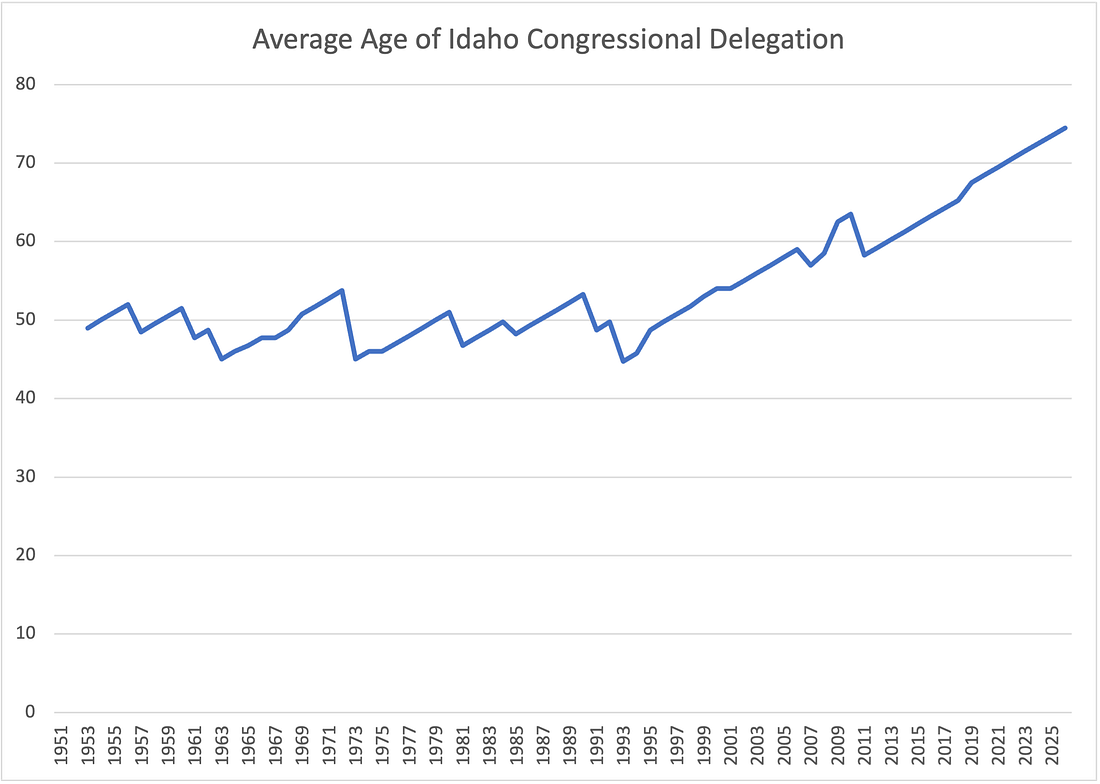 |
Idaho’s congressional delegation has grown older as the state has become more insular and conservative
While they style themselves as rugged, independent westerners they more closely resemble the completely repudiated Republican leadership in, of all places, Texas where Republicans thought they were invincible until they weren’t.
Trump’s approval, now in the low 30’s, will surely go lower over the next two years, and a sinking president will sink more Republicans. As political scientist Jonathan Bernstein has noted, “I wouldn’t want to be a Republican on the ballot should that happen. In any state.”
“It’s time for the next thing,” Utah Republican Governor Spencer Cox said recently about his party moving on from Trump, but Idaho Republicans won’t.
They live in their increasingly insular “private Idaho,” pretending that a politics without decency or humanity or care about the future will sustain them. It won’t.
And a generational change is upon the state’s Republican political elite, and it’s likely to break out in open and historically nasty intraparty warfare as 2028 approaches.
Big change will take more time, but the hubristic, backward looking, not normal and not decent days of Idaho’s GOP are numbered.
Just ask Kansas and Texas.
1) – In one of his many tone deaf moments during the run up to the mid-term election Vice President JD Vance, a guy who has lectured the Pope about theology, attacked Hamilton’s religion.
“He really went after you,” Jonathan Karl said to Hamilton on ABC. “He called your views ‘left-wing radicalism dressed in the skin suit of our religion.’ Saying that of your beliefs: ‘That is not Christianity.’ This was the vice president of the United States taking aim at your religious practice.”
“Well, I thought it was a sign of desperation and I thought it was really sad,” Hamilton replied. “It was pathetic. He doesn’t know me, doesn’t know anything about my faith. He came in attacking –– when do we start attacking people’s faith?”
2) – The Idaho vote to retain the state’s severely restrictive anti-abortion statue was a major national outlier in the mid-terms. As State’s Newsroom reported:
“Idaho’s outcome stood in stark contrast to the other three ballot questions, with 56% voting against the approval of Proposition 1 and 44% voting in favor, nearly the inverse of Missouri’s outcome, where 55% of voters struck down an amendment that would have reinstated the ban that was overturned through a ballot initiative in 2024.
“Other abortion-related measures were on the ballot in Nevada and Virginia, two states where abortion is already accessible until 24 weeks and 26 weeks of pregnancy, respectively. Voters in both of those states passed constitutional amendments ensuring the right to abortion.”
About me: I am a Nebraska native, grew up in South Dakota and migrated in Idaho after college to work in broadcast journalism. In 1986, I joined the “comeback” campaign of a legendary Idaho political figure – Cecil D. Andrus – who eventually served four terms as governor and four years as Secretary of the Interior, not bad for a Democrat in a very conservative state. I had a small role in helping Cece Andrus win his last two gubernatorial terms. I did communication and crisis consulting work, and since “retiring” to the beautiful north coast of Oregon have written three books on U.S. Senate history. I’m working on a new book on another legend – this one a legend in journalism.
You can find my books here:
I write this Substack to scratch my itch to connect history with current politics. I hope, in some small way, to contribute to understanding of this perilous moment for our democracy, for free speech and facts.
Thanks.
Marc’s Substack is a reader-supported publication. To receive new posts and support my work, consider becoming a free or paid subscriber.
Subscribe here for more
