Tillamook County Pioneer

News & People of Tillamook County. Every Day.

Menu
  • Home
  • Feature
    • Breaking News
    • Arts
    • Astrology
    • Business
    • Community
    • Employment
    • Event Stories
    • From the Pioneer
    • Government
    • Letters to the Editor
    • Non Profit News
    • Obituary
    • Public Safety
    • Podcast Interview Articles
    • Pioneer Pulse Podcast: Politics, Palette, and Planet – the Playlist
  • Guest Column
    • Perspectives
    • Don Backman Photos
    • Ardent Gourmet
    • Kitchen Maven
    • I’ve been thinking
    • Jim Heffernan
    • The Littoral Life
    • Neal Lemery
    • View From Here
    • Virginia Carrell Prowell
    • Words of Wisdom
    • Chuck McLaughlin – 1928 to 2025
  • Weather
  • Post Submission
  • Things to do
    • Calendar
    • Tillamook County Parks
    • Tillamook County Hikes
    • Whale Watching
    • Tillamook County Library
    • SOS Community Calendar
  • About
    • Contribute
    • Advertise
    • Subscribe
    • Opt-out preferences
  • Search...
Menu

NEWS UPDATE FROM STATE REPRESENTATIVE DAVID GOMBERG: Labor Day Jobs and Opportunities

Posted on September 7, 2026 by Editor


By Representative David Gomberg, House District 10

Dear Neighbors and Friends,

Today is Labor Day. It is that long and wistful weekend where we contemplate the looming end of summer and celebrate the daily contributions of working men and women.

Jobs in our seven coastal counties are spread among our traditional natural resource industries of fishing, farming and timber, the burgeoning tourism sector, and the often underappreciated or misunderstood senior “industry” that brings retirees to the coast together with their sustained pension and investment income and local year-round spending. But there is something else going on in Western Oregon that presents significant opportunities and a meaningful glimpse at our future. Cutting across fisheries, tourism, and even retirement is the emerging “Blue Economy.”

At its core, the Blue Economy refers to the “business sectors that rely on the sustainable use of ocean resources for economic health, improved livelihoods, jobs, or ecosystem health.” It encompasses a wide range of economic activities that depend on the ocean and coastal resources, including traditional sectors such as ports, shipbuilding and repair, commercial fishing and maritime transport, as well as newer industries like offshore energy, aquaculture, and marine research.

A successful blue economy will include statewide ocean and coastal strategies, funding for resilient infrastructure, support for workforce development, and incentives for sustainable innovation. What does that mean and how does it work?


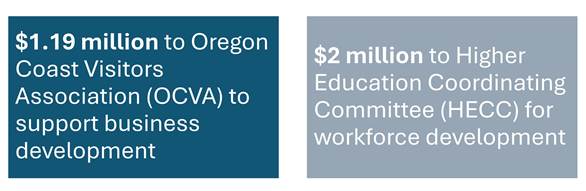
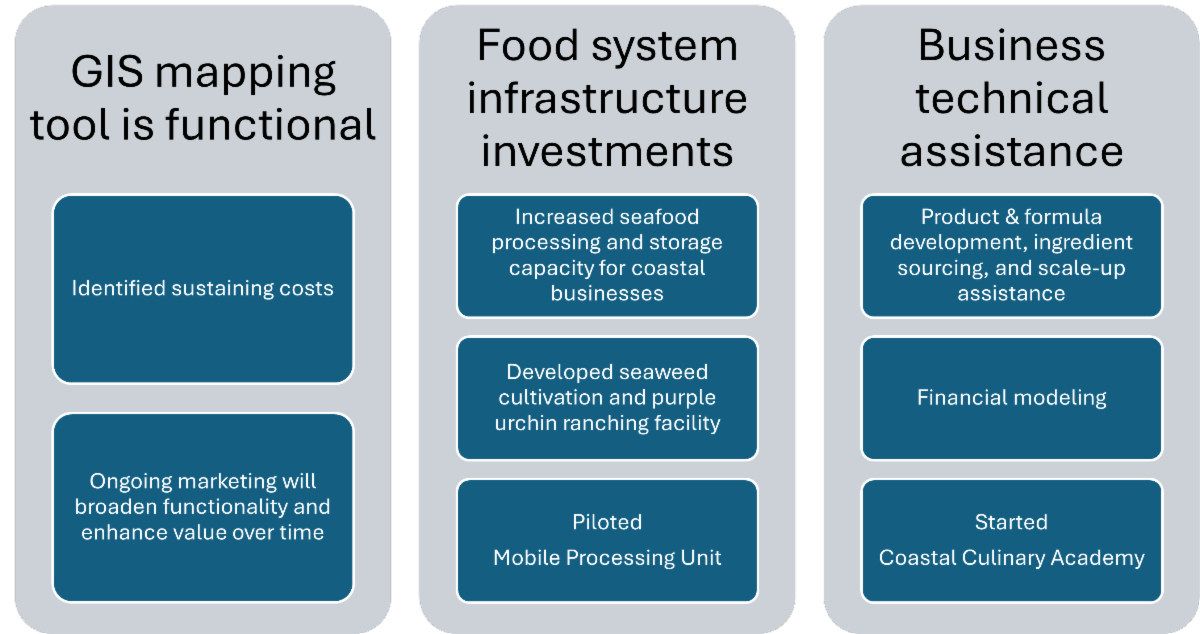
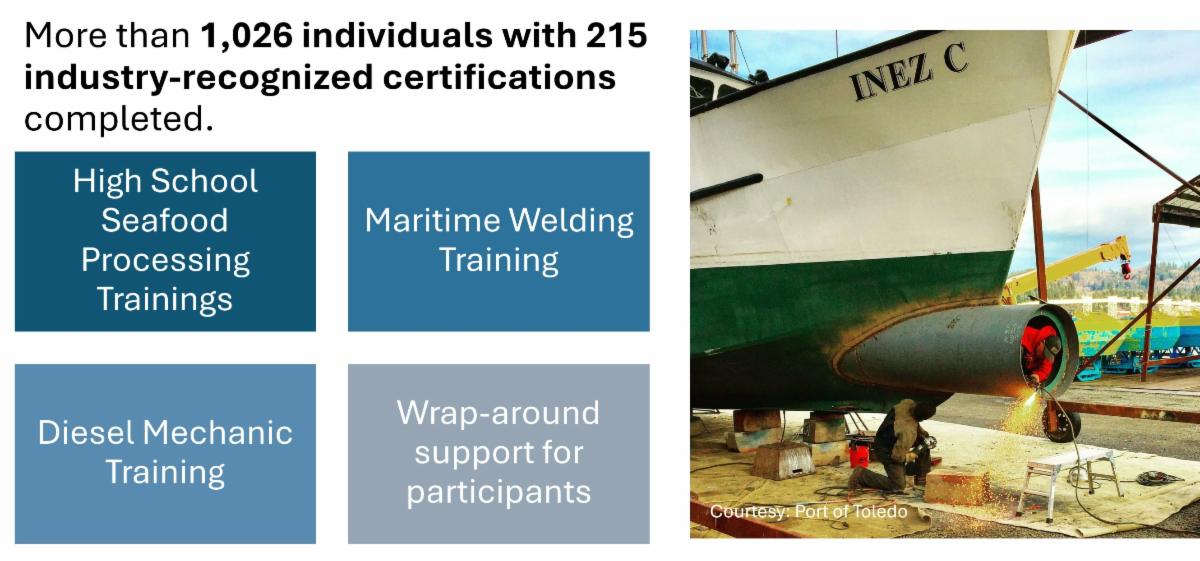
Back in 2023, I authored and led the passage of House Bill 3410, a statewide economic development bill which appropriated General Fund money to various entities in support of Oregon’s rural business, jobs, and workforce capacity. Two appropriations in the bill most relevant to Oregon’s maritime or Blue Economy were $1.19 million to the Oregon Coast Visitors Association (OCVA) to improve sales of Oregon seafood to Oregon restaurants and $2 million to the Higher Education Coordination Commission (HECC) to make targeted investments in maritime training programs, identify workforce needs in specific maritime sectors, and develop new education and job skills programs.

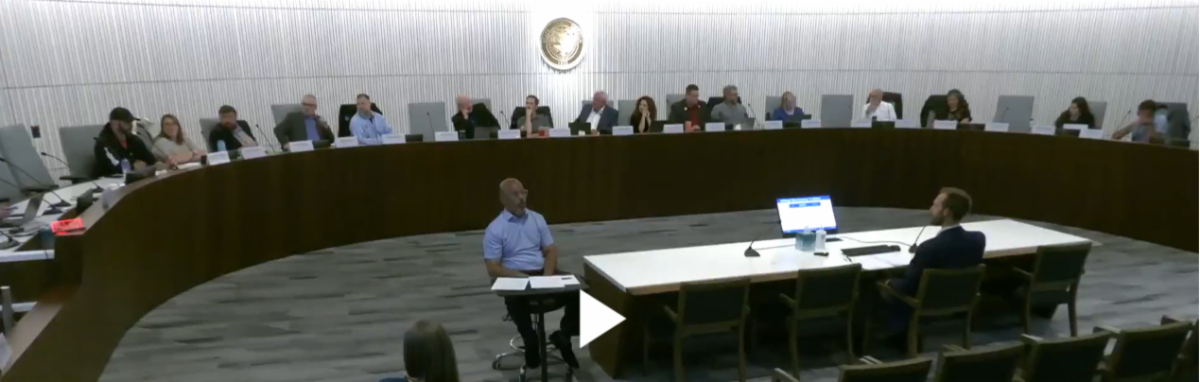
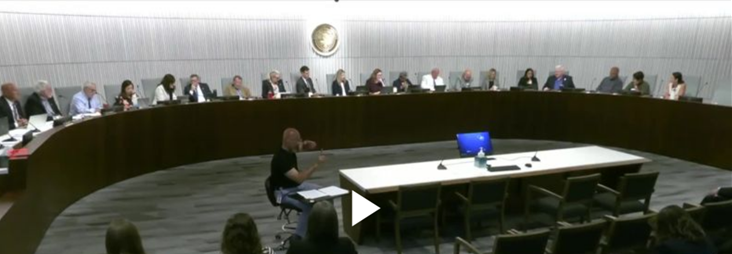
Tuesday afternoon, I will report to the House Rules Committee on how well these investments have worked. In a process called “outcome reviews,” I’ll detail our success and our disappointments. I’m pleased with this daunting opportunity. Too often we pass bills and move on. Not often enough do we follow-up on the results.

I’ll talk about the business support and job trainings the bill supported. You can watch the hearing here.

The Blue Economy already generates $3.1 billion annually in Oregon. What distinguishes the Blue Economy is its emphasis on sustainability—economic growth while protecting the long-term health of ocean and coastal ecosystems. Investing in ocean and coastal industries is a key part of building resilient local economies, attracting private investment, preserving maritime heritage, and preparing for the impacts of sea-level rise and extreme weather.

Over the course of the next year, I’ll be able to expand our focus on the Blue Economy. Senate Bill 1525, passed earlier this year, created the Blue Economy Task Force, with 18 members representing commercial and non-commercial fishing, labor, tourism, the Tribes, and research and environmental organizations. I have been asked to chair the effort.

The Blue Economy Task force held our first meeting last week.
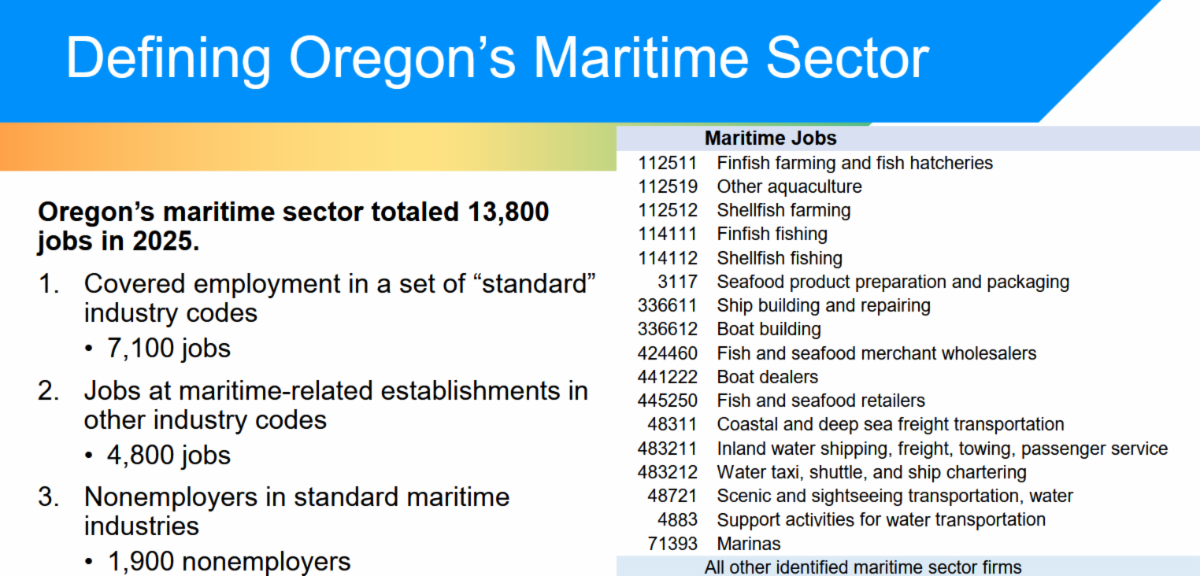
The Task Force held our first meeting last week and heard presentations from the Oregon Employment Department and the National Caucus of Environmental Legislators. Those presentations included details on current employment.
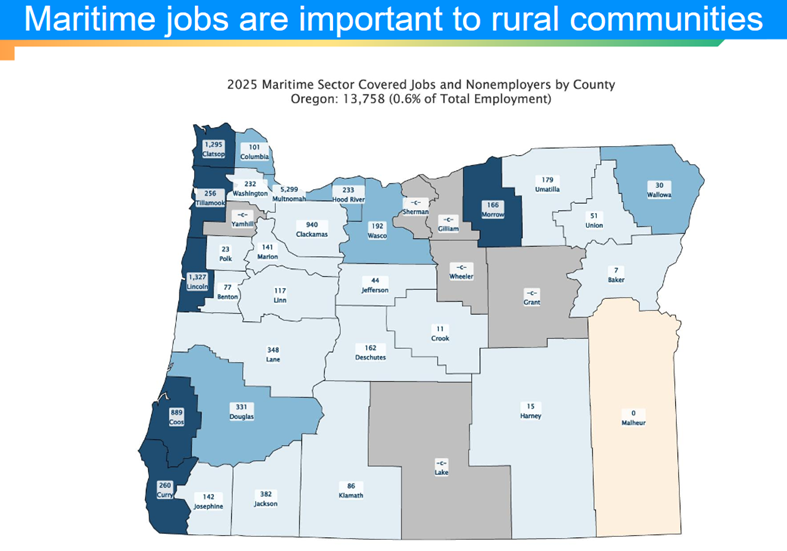
Significantly, those statistics did not include tourism impacts. Under current definitions, workers selling seafood from seafood markets were counted as Blue Economy jobs while grocery stores and restaurants do not. Similarly, it was interesting to note there are more maritime jobs in urban counties than rural ones. For example, Multnomah County has 5,300 jobs while Lincoln County has 1,300. Those numbers may be skewed by employment at the Port of Portland (not including airport jobs).
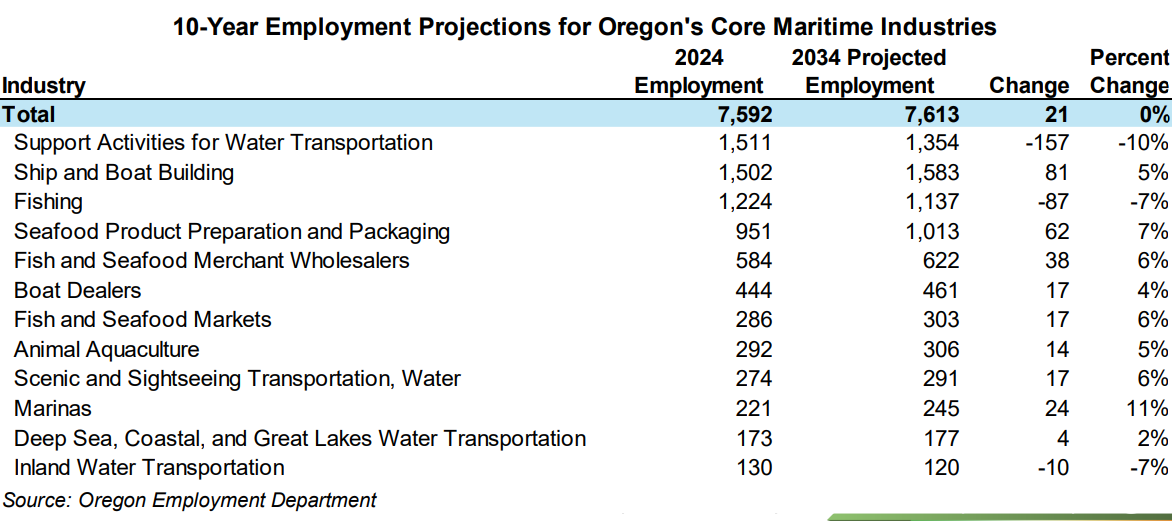
Oregon’s maritime industry faces an aging workforce, with many mariners approaching retirement, as well as aging infrastructure that may constrain industry growth. The Oregon Workforce Partnership tells us maritime employment is projected to grow 8 percent between 2021 and 2031, with more than 9,500 job openings expected during that period. The Employment Department is less optimistic, expecting job losses and job gains to balance out in the next ten years. (Their projections do not include possible development of container operations at the Port of Coos Bay.)

Whether we grow or remain stagnant is largely up to us.

Working waterfronts are a vital part of a sustainable Blue Economy. These are the physical spaces that support water-dependent industries: ports, shipyards, seafood processing facilities, and public and private access points. They are not only essential for the functioning of Blue Economy sectors but also face increasing threats from coastal development, degrading infrastructure, environmental degradation, and rising property values.

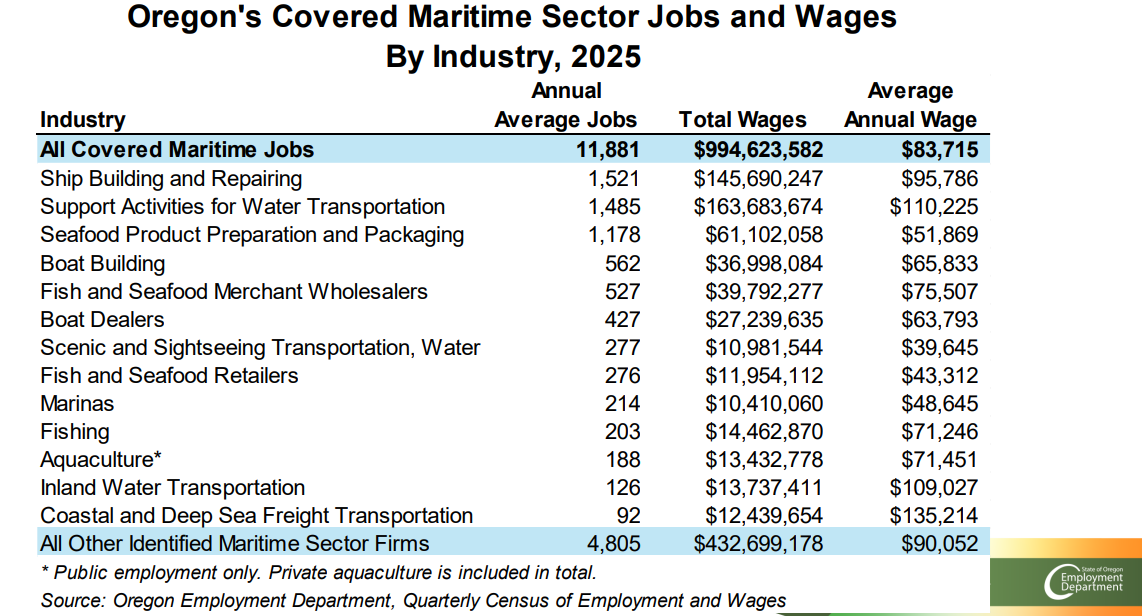
As I often opine, our greatest export from the Coast is talented young people looking for good jobs and good pay elsewhere. Blue Economy jobs pay well above the median family income of $65,000 in Lincoln County.

There is a lot to digest here and plenty of numbing numbers. Our challenge is to improve aging or inadequate infrastructure, sustain tradition jobs in fisheries, and provide training and education for a new workforce of welders, diesel mechanics, and in-water transportation.
Oregon has long been considered a state friendly to workers and the unions that represent them—and history may back up that claim. In 1887 the state became the first to pass a law declaring Labor Day a holiday.

This year’s holiday comes with opportunities for the Oregon economy, which has struggled to fully recover from the pandemic downturn in 2020. The state’s unemployment rate sits at a relatively low 5.2%, but it has steadily ticked upward over the last year. Meanwhile, the state’s workforce has shrunk by more than 10,000 people in the last year to around 1.97 million.

The data from Oregon’s Third Quarter Revenue Forecast is in. Oregon’s economy remains relatively stable, and some key metrics are improving. Specifically, our economic growth is catching up to national levels, but there is more work to be done.

More people are working, and more people are earning higher wages. Oregon’s relatively stagnant employment rate indicates we are seeing more wage growth than job growth.

The latest revenue forecast was released at a joint meeting of the Senate and House interim Revenue committees by the Oregon Office of Economic Analysis. A growing economy is a good sign, but there are also signs that gains are flowing primarily to workers with better jobs, leaving too many still struggling. Families are hanging on under incredible pressure with gas and utility prices too high, and 35,000 families are already losing food assistance because of federal cuts. Our strongest future is one where every Oregonian shares in our state’s prosperity.

Other news from the forecast:

  • Kicker Outlook – There is no personal or corporate kicker projected for the 2027-29 biennium.
  • Economic Outlook – The overall economic forecast reflects a resilient economy nationally and in Oregon. Economic growth in the state has typically lagged national trends but looks to have largely caught up to the rest of the United States. Oregon’s unemployment rate is relatively stable, at 5.2 percent. This is a slight increase from the 4.7 percent unemployment rate shown in the March 2026 forecast. A “low hire-low fire” economy appears to remain the status quo. Population growth is expected to have a slow positive increase in the future, averaging 0.4 percent through 2035.
  • Corporate Activity Tax (CAT) Projections – Anticipated revenues for the current biennium (2025-27) are $2.98 billion, down $94.6 million from the June 2026 forecast. For 2027-29, projected revenue is now $3.42 billion, down $25.7 million from the June 2026 forecast.

Despite inflation running between 3% and 4% throughout the year, consumer spending is up in the U.S. and in Oregon. Individuals are saving less and racking up debt to maintain spending levels. There are promising indicators in this week’s forecast, but too many Oregonians are struggling to make ends meet. Oregon families continue to face rising prices and that’s likely to continue as tariffs drive up costs for everyday goods and the war in Iran keeps gas prices high.

In early August, state economists released a report that shows the steep price Oregonians paid because of new tariffs. Oregon importers paid nearly $3 billion in federal tariff taxes between March and December 2025. Exports fell 17.3% in 2025, a roughly $5.8 billion decline. And the state missed out on an estimated $442 million in tax revenue. The report coincided with the state filing a third lawsuit against the president over increased import taxes.

  • Oregon paid nearly $3 billion in tariffs, hit harder than other states, according to new report.
  • Tariffs didn’t start Oregon’s economic slowdown, but they exacerbated it, report finds.

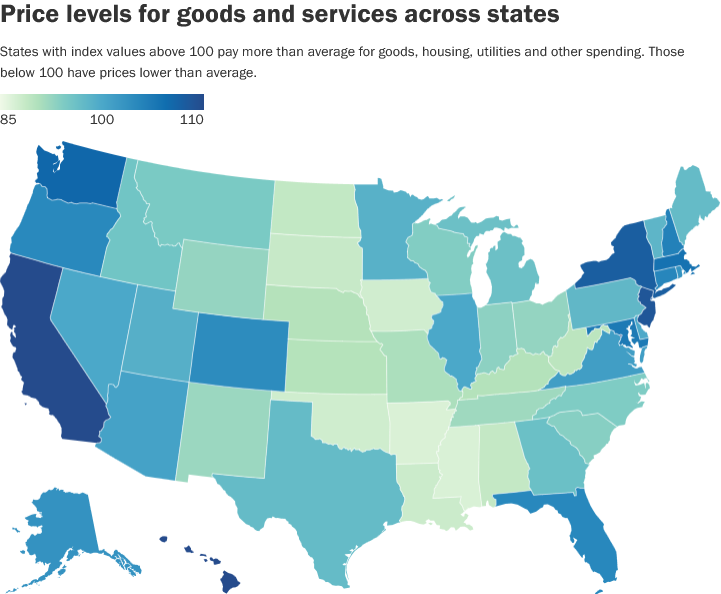
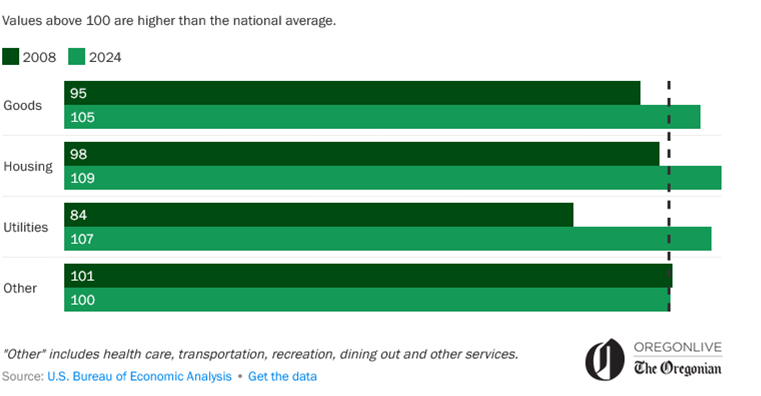
Oregon used to be something of a bargain. The state was a rare find on the West Coast, a place where homes were cheap by national standards, household products like groceries were relatively inexpensive, and utility rates were the envy of many other parts of the country.

No longer. Oregon is now the nation’s 12th most expensive state, according to an annual federal survey that tallies the cost of housing, utilities, and retail goods. Portland, Corvallis, and Bend all rank among the most expensive metro areas in the U.S.

That’s a big issue for families all over the state who are trying to stretch their dollars to cover rents, mortgages, power bills and put food on the table. It’s also a big issue for Oregon itself, which is struggling to overcome years of stagnant population growth and can no longer cast itself as a good buy relative to other states.

Costs began climbing in the middle of the last decade and were 3% above the national average by 2024, according to the latest data.

What changed? Two things, primarily.

The first is housing costs. Oregon homes were a little cheaper than average back in 2008. Now they’re 9% more expensive and a lot more expensive in some places. Housing costs in the Portland area, for example, are 25% higher than the national average. The dramatic surge in the cost of housing resulted from the state’s failure to add new homes as the population grew during the 2010s, creating a chronic shortfall Oregon hasn’t made significant progress in addressing.

The second big change is utility prices. Oregon utility rates were far below the national average back in 2010. Today, utility customers pay 7% more than the national average—an 18-point jump in little more than a decade. Electricity rates have soared over the past decade as utilities have spent heavily on upgrading transmission lines and other parts of their aging systems and invested in wildfire mitigation. The utilities ultimately pass those costs on to customers.

The effect has been dramatic—particularly in investor owned utilities. For example, Portland General Electric’s rates are up 65% in the past decade, climbing twice as fast as inflation.

Your cost of living, affordability, and the economy will be on Legislators minds next week when we return to Salem for a week of interim committee hearings. Here are a few committees and agenda items you might find interesting:

  • The House Interim Committee on Commerce and Consumer Protection will discuss the growing trend of corporations using algorithmic models to set prices for goods and services and its impact on consumers and independent contractors. They’ll also get an update on the insurance landscape across Oregon, which will inform legislators’ work to rein in rate hikes that are straining Oregonian families and small businesses.
  • The House Interim Committee on Labor and Workforce Development will receive a presentation on the state of Oregon’s workforce development systems. Implementing strategies to reinvigorate Oregon’s economy will be a big focus in the 2027 session—to do that, we must have systems in place to grow our workforce, particularly in high-demand jobs.
  • The House Interim Committee on Economic Development, Small Business, and Trade will receive an update on the effect of tariffs on Oregon’s economy and a new grant program the Legislature created to help offset their impact on small businesses.
  • The House Interim Committee on Climate, Energy and Environment will focus on the growing trend of data centers operating or being developed across the state. They’ll hear from experts on strategies to increase transparency and accountability and will discuss potential guardrails we might consider in the 2027 legislative session to protect Oregon communities, the environment, and our economy.
  • The House Interim Committee on Housing and Homelessness will receive a progress report on the state’s housing and homelessness numbers. The Legislature has made significant investments over the last several years in rental assistance, shelter funding, and housing production. This report will provide the committee with data about how those investments are boosting housing production and reducing unsheltered homelessness.
  • The House Interim Committee on Human Services will hear updates from the Interagency Council for Immigrant and Refugee Coordination, which was established by Executive Order 26-04, to strengthen how Oregon supports our communities during a time of heightened federal immigration activities enforcement.
  • The House Interim Committee on Early Childhood is examining how many families live in childcare deserts across the state. The report highlights how Oregon has made progress on access to childcare for preschool-age children; however, there is more work to do to increase access to infant and toddler care.
  • The Joint Emergency Board where I serve will consider funding requests to support wildfire response and other urgent priorities that cannot wait until our 2027 session. The Emergency Board is the interim committee tasked with emergency spending measures and budget adjustments when the Legislature is out of session.

After an early start to the fire season and sustained fire activity throughout summer, our top priority will be ensuring that the state agencies managing Oregon’s response have the resources they need to close out the fire season. We plan to release funding we set aside specifically for the purpose of responding to wildfire and natural disasters, and we will review a request from the Oregon Department of Forestry (ODF) to secure a loan of up to $150 million from the Oregon State Treasury. This new lending mechanism was made possible by a bill we passed in 2025. It acts as a safeguard to protect agencies from cash flow issues during especially challenging fire seasons when the legislature might otherwise need to call a special session to allocate extra funding.

Much of the price tag is likely to be reimbursed by the federal government, but that money can be slow to arrive. Until it does, Oregon is responsible for paying the firefighting crews on the ground. In 2024, the state let wildfire bills go unpaid for months, ultimately forcing the Legislature to meet in special session to approve extra funding.

Use any of the links above to watch committee meetings live or later.
I’ll be in Salem most of the week but plan to make up for it by the weekend.

Friday, I’ll stop by the annual Newport Chamber BBQ and then head to Toledo for the opening of our Community College east campus. From there, I head to Benton County and Monroe’s First Responders’ Appreciation Event.

Saturday, Susie and I will relish the Alsea Blackberry Blast and hope to visit the Alsea Community Action Collaborative clinic open house. We’ll lunch at one of our favorite wineries. And then, we return to the Coast to celebrate North Lincoln Sanitary Service’s 60th Anniversary.

I also facilitated a series of meetings last week with our fisheries, fish processors, ports, and marine researchers with several federal offices including the new federal USDA Office of Seafood.

Finally, let me mention that we are 60 days from the November election. Legislative rules prohibit me from using state resources for mass mailings, emails, or social media posts during this formal “blackout period.” I want to stay in touch! And, I want to keep you informed. So we’re shifting these weekly reports out of the office and paying for them with campaign resources. I will not use my newsletter to promote any candidates or measures. But neither will I use my state office or staff during this sensitive time.

Thanks for your understanding.

Please consider supporting the Pioneer with a contribution. Independent journalism stays alive on the Coast. Click here to contribute!

Ads

Keep the News Free to Read

Featured Video

Tillamook Weather

Tides

Tillamook Church Search

Cloverdale Baptist Church
Nestucca Valley Presbyterian
Tillamook Ecumenical Service

Tillamook County Pioneer Podcast Series

Archives

  • Home
  • EULA Privacy Policy
  • Contact
  • Opt-out preferences
  • Search...
Share on facebook
Facebook
Share on pinterest
Pinterest
Share on twitter
Twitter
Share on linkedin
Linkedin
Catherine

Recent Posts

  • Tillamook County Pioneer - Taking a Break

    September 7, 2026
  • NEWS UPDATE FROM STATE REPRESENTATIVE DAVID GOMBERG: Labor Day Jobs and Opportunities

    September 7, 2026
  • United Paws Kittens of the Week: Meet Siobhan & Brigid

    September 6, 2026
©2026 Tillamook County Pioneer | Theme by SuperbThemes
Manage Cookie Consent
To provide the best experiences, we use technologies like cookies to store and/or access device information. Consenting to these technologies will allow us to process data such as browsing behavior or unique IDs on this site. Not consenting or withdrawing consent, may adversely affect certain features and functions.
Functional Always active
The technical storage or access is strictly necessary for the legitimate purpose of enabling the use of a specific service explicitly requested by the subscriber or user, or for the sole purpose of carrying out the transmission of a communication over an electronic communications network.
Preferences
The technical storage or access is necessary for the legitimate purpose of storing preferences that are not requested by the subscriber or user.
Statistics
The technical storage or access that is used exclusively for statistical purposes. The technical storage or access that is used exclusively for anonymous statistical purposes. Without a subpoena, voluntary compliance on the part of your Internet Service Provider, or additional records from a third party, information stored or retrieved for this purpose alone cannot usually be used to identify you.
Marketing
The technical storage or access is required to create user profiles to send advertising, or to track the user on a website or across several websites for similar marketing purposes.
  • Manage options
  • Manage services
  • Manage {vendor_count} vendors
  • Read more about these purposes
View preferences
  • {title}
  • {title}
  • {title}