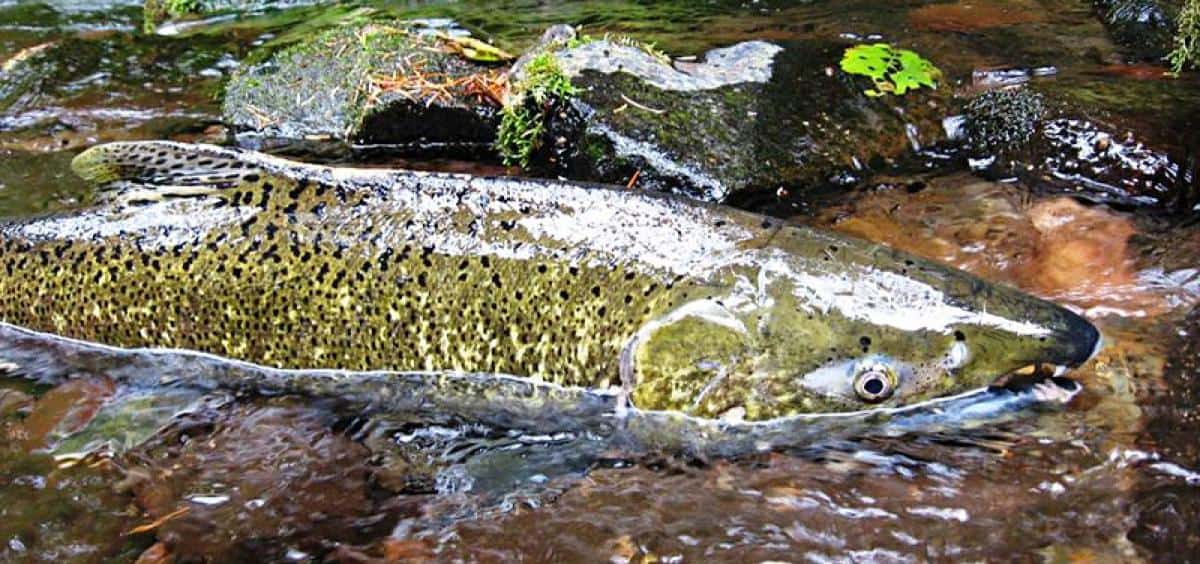



REDMOND, Ore. — Anglers have a lot to look forward to this fall: many coastal basins will see expanded opportunity for wild fall Chinook harvest compared to last year, and wild coho fisheries will continue across much of the coast, offering a strong season ahead.
For fall Chinook, wild Chinook retention will be open in 18 coastal basins, with increased bag limits in the Necanicum, Nehalem, Tillamook, Siuslaw, and Umpqua basins—providing more opportunity than in 2025. The Nestucca Basin will see a decrease, and the Coquille and Elk rivers will remain open only for hatchery Chinook retention due to conservation considerations. Anglers can also continue to target hatchery Chinook and hatchery coho in many basins, with those seasons set separately in the Oregon Sport Fishing Regulations.
Wild coho opportunity also remains strong. In 2026, retention will be open in 10 coastal basins, along with the Siltcoos, Tahkenitch, and Tenmile lake populations. Nearly all basins open to wild coho retention last year are proposed to remain open in 2026, with the exception of the Alsea Basin, which did not meet the criteria this year. The opportunity for wild coho harvest is thanks to decades long effort to address limiting factors paired with a world class monitoring program.
Overall, the 2026 seasons offer more wild fall Chinook opportunity than last year and maintain broad access to wild coho fisheries where sustainable—great news for anglers gearing up for the fall salmon season.
After hearing testimony during today’s meeting, Commissioners also directed staff to ask NFMS to approve an Alsea basin wild coho fishery designed to remain below the exploitation limit (ideally with a minimum 30-day season and 1/3 bag limit).
Visit the Fall Coastal Salmon Management Page for more details on proposed bag limits and season dates and subscribe to the page for updates.
The Commission also adopted ODFW’s 2027–29 Agency Request Budget (ARB), marking a historic and transformative investment in wildlife conservation. Thanks to the passage of HB 4134 during the 2026 legislative session, Oregon is now positioned to make its largest-ever investment in conserving at-risk species and improving habitat statewide.
This bipartisan legislation increases the state’s transient lodging tax by 1.25 percent beginning Jan. 1, 2027, directing a portion of the new revenue to implementing the State Wildlife Action Plan. In addition to supporting at-risk species recovery, these new funds will advance wildlife connectivity projects, Oregon Conservation and Recreation Fund (OCRF) grants, and urban wildlife stewardship efforts, helping ensure that conservation benefits reach communities across Oregon.
“This is a comprehensive investment in statewide capacity to implement Oregon’s State Wildlife Action Plan,” said Commissioner Dave Moldal. “These long overdue investments in department capacity will lead to critical knowledge, planning and partnering and tangible, measurable improvements for wildlife and the habitats they depend upon.”
Part of the new lodging tax funding will support additional staff dedicated to on‑the‑ground conservation work for at‑risk species. These positions will expand the Department’s ability to conduct critical population monitoring, develop and carry out targeted conservation actions, and implement large‑scale habitat and restoration projects that benefit at‑risk species and many others across Oregon’s ecosystems. “Staff capacity translates to more conservation work on the ground,” noted Commissioner Hall-Defrees.
Much of the public testimony supported the budget. One area of disagreement centered on a staff proposal to invest in hatchery infrastructure to sustain and strengthen production in the Umpqua Basin following the destruction of Rock Creek Hatchery during the Archie Creek Fire in 2020. The proposal is still under development with the Cow Creek People and other partners and includes installing modular infrastructure at Rock Creek Hatchery to maintain spring Chinook and trout production; continuing to produce a portion of spring Chinook at Cole Rivers Hatchery; constructing a new South Umpqua facility to rear winter steelhead and coho within the basin; and continuing fall Chinook production at the Gardiner Reedsport STEP facility as well as at Elk River Hatchery. This multi-site approach is designed to address climate related risks identified in the Department’s recent review of the state’s hatchery system. A motion to remove the proposal from the Agency’s Budget did not pass.
ODFW Deputy Director Shaun Clements described the Rock Creek package as a placeholder allowing more conversation. “Leaving it in allows the department to continue the conversation with the Cow Creek Umpqua People, FEMA, the Governor and the Legislature as to what investments to make [in Umpqua River hatchery production],” he said.
The ARB will go to the Governor by Aug. 31 for her consideration. The Governor will then submit her recommended budget to the 2027 Oregon State Legislature, which has final authority to adopt ODFW’s budget.
2026-28 Furbearer regulations: The Commission adopted regulations with changes that implement HB 3932 passed by the 2025 Oregon State Legislature. The bill prohibited recreational or commercial harvest of beaver within areas classified by the Oregon Department of Environmental Quality as Category 4 or Category 5 waters under the federal Clean Water Act, when those waters occur on, flow through, or adjoin public land.
The department is required to identify these areas in statewide maps, which will be updated every two years in consultation with DEQ. The first such publication is the 2025–2027 Oregon Beaver Harvest Closure Map.
Copies of the 2026-28 Furbearer Regulations will be available in coming weeks.
Commercial coastal pelagic species: Adopted proposed rule amendments to ensure that state regulations are consistent with federally adopted limits and management measures for Pacific sardine. The federal regulations will maintain the primary directed fishery closure and continue very low bycatch allowances across other West Coast fisheries due to the depressed stock status.
Oregon Conservation and Recreation Fund (OCRF) funding: Approved OCRF Advisory Committee’s recommendations to fund 19 projects that protect and enhance the species and habitats identified in the State Wildlife Action Plan and create new opportunities for wildlife watching, urban conservation, community science, and other wildlife-associated recreation.
Restoration & Enhancement funding: Approved funding for projects recommended by the R&E board including a large wood placement project to improve fish habitat and an egg counter for a STEP facility.
Access & Habitat funding, chair appointment, and raffle allocations: Approved funding for projects recommended by the A&H Board including renewal of several access areas that provide hunters access to private land. The Commission appointed Nicholas Callero as A&H Board Chair and allocated 2027 auction and raffle tags. Host organizations receive 10 percent of the sales price for the tag sold at auction, which they can use to fund their own grant programs benefiting wildlife.
A recording of the meeting is available at ODFW’s YouTube Channel.
