




EDITOR’S NOTE: A quick scroll through social media this morning finds multiple posts about all the dead birds washing ashore from Gearhart to Netarts and on down the coast. Oregon Dept. of Fish & Wildlife wants to hear from beachgoers about where and how many dead birds they are seeing.
Here’s more information about the annual die-off:
Have you noticed more dead birds washing up on Oregon Coast beaches lately?
If so, you’re not alone.
Marine scientists say an ongoing marine heat wave, combined with the developing El Niño, is disrupting the ocean’s food chain. Warmer ocean water causes many of the small fish seabirds depend on to move deeper or farther offshore, making it much harder for birds to find enough food. As a result, many become weak from starvation, and ocean currents eventually carry them onto our beaches.
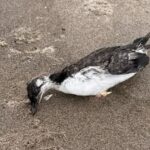 While it’s heartbreaking to see, it doesn’t necessarily mean the birds died where they washed ashore. Many may have died miles offshore days earlier before being carried in by tides and currents.
If you come across a dead bird:
 Please don’t touch it or allow your pets to investigate it.
 Keep dogs on a leash and away from the carcass.
 If you notice several dead birds in one area, report them to the Oregon Department of Fish and Wildlife so biologists can monitor what’s happening.
Our seabirds are an important indicator of ocean health, and these recent sightings are a reminder of how changes in the ocean can ripple through the entire ecosystem.
Have you noticed more dead birds on the beach this summer? If so, where along the Oregon Coast have you seen them?
From Seaside Aquarium:
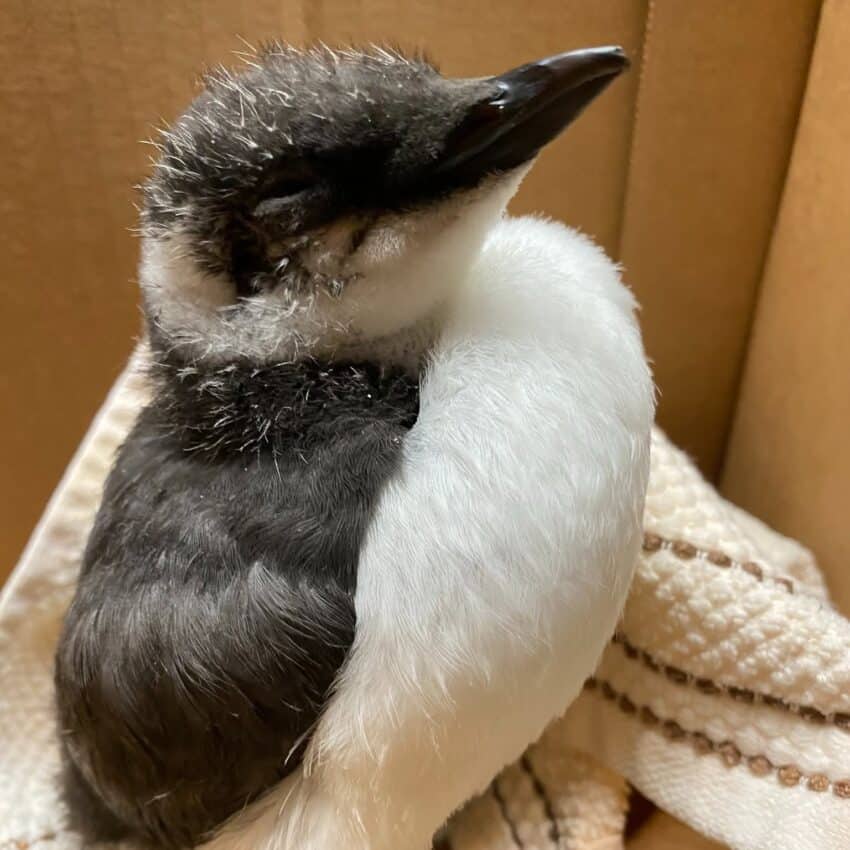
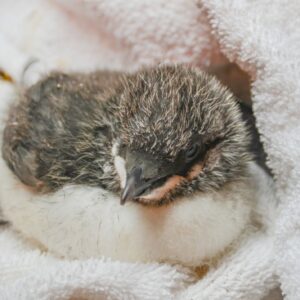 It is the time of year when the adorable common murre chicks are jumping/stumbling off of the rocks they were born on. Some are found on the beach alone and abandoned.
Visitors to the Oregon Coast often mistake common murres for baby penguins! Their tuxedo plumage and upright posture make them seem like they could be the penguin’s Northwest cousin, but the common murre belongs to a different family of birds: the Auk family.
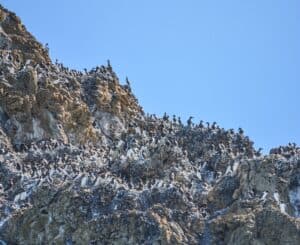 Starting in April, common murres congregate on near and offshore rocks such as Haystack Rock in Cannon Beach. They don’t build nests like many of the other birds you’ll see, instead each female chooses a bare ledge or cliff edge and lays upon it a single teardrop-shaped egg. The unique shape of the egg ensures it doesn’t fall off the rock when disturbed because rather than rolling, it’s apt to spin in circles.
Breeding murre colonies can be so dense that incubating parents are often touching one another. Both parents share duties of the incubation process and rearing of the chick for the first 2-4 weeks, at which point the father takes over completely. He leaves the rock for the surf below and calls to his young chick to join him. Fluttering its wings to help ease the fall, the chick leaps to its father and the true parenting begins. For the next two months the father will help teach the young fledgling how to fend for itself.
Besides coming ashore to breed, the common murre spends the rest of its life at sea. It can fly short distances, but its wings are adapted more suitably for diving and swimming. It feeds on small fish and is only able to catch one at a time in its small beak. Here on the Oregon Coast, juvenile murres are prone to wash ashore during the Fall and Winter seasons. When this happens, it’s usually just because they’re tired, hungry and unable to compete with rough ocean conditions.
“Our clinic has gotten in over 90 Common Murre just in the past few weeks and we can always use more volunteers to help drive them out to us,” says the Wildlife Center. “We are especially thankful to Seaside Aquarium for being a drop-off site for injured wildlife. We couldn’t do it without you
The Wildlife Center of the North Coast is always looking for new volunteers.”
For more information on how to get involved in helping our local wildlife, visit https://www.coastwildlife.org
