










(YACHATS, OR) —Two Purple Martins from the Oregon coast have traveled over 1,500 miles toward their wintering grounds in southeastern Brazil. Despite leaving Oregon one day apart, they have now turned up within just a few miles of each other in Mexico.
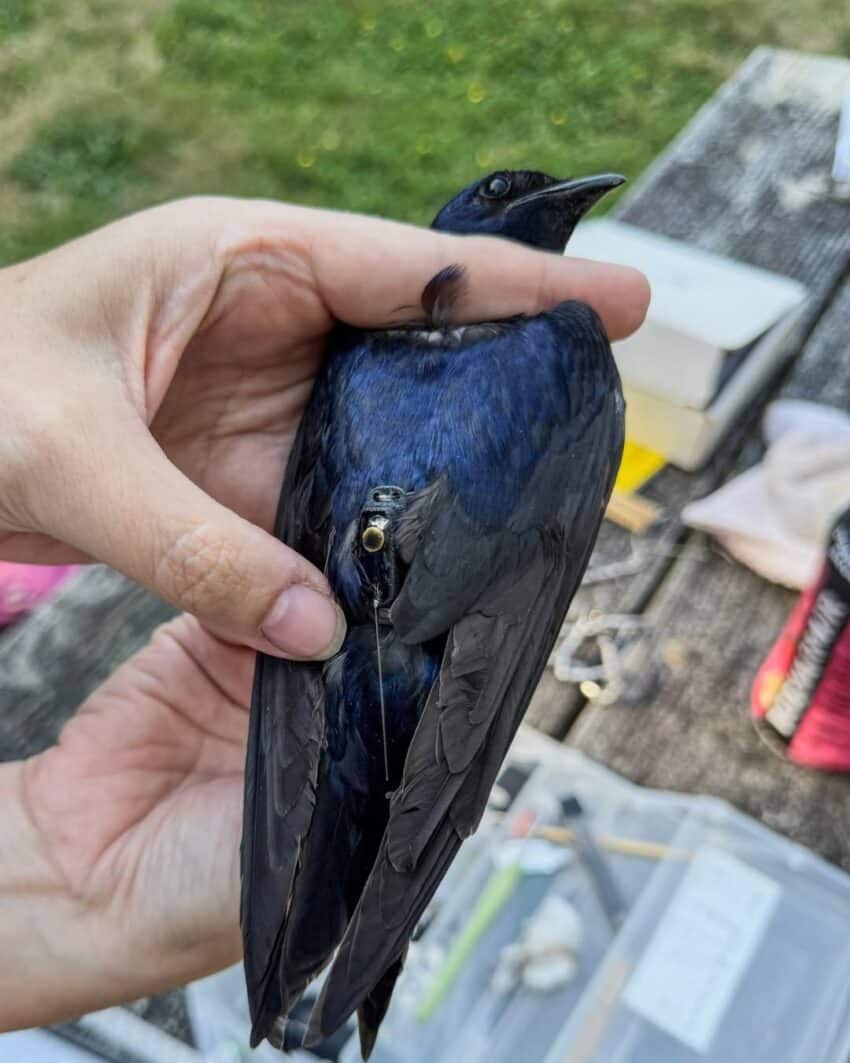
The birds, named Finn and Elise, are being followed using tiny solar-powered Cellular Tracking Technology (CTT) BlūBird tracking tags, developed last year. This is the first time this type of tag has been used to track Purple Martins of the western subspecies.
The bird tracking is a cooperative effort of Seven Capes Bird Alliance’s SWIFTY (Swallows in Flight to Yachats) program, and Klamath Bird Observatory’s Purple Martin project. SWIFTY, a group of retired volunteers who build and maintain nesting boxes for swallows, obtained funding for four of the new tags. Weighing a gram—less than 2% of a Purple Martin’s weight—the backpack-style device allows researchers to receive location information close to real time as the birds migrate.
 BlūBird tags transmit a unique digital identification signal using low-power radio rather than GPS. The signal can be detected by compatible receiving stations and by participating smartphones via Bluetooth, which use the phone’s location information to record approximately where and when the tagged bird was detected. These detections are transmitted to CTT’s tracking system, allowing researchers to follow the birds’ movements.
Finn, a male tagged near Florence, Oregon, on July 22, began his migration on August 19. Elise, a female tagged near Waldport, Oregon, on July 21, left a day later on August 20. The two birds initially followed routes south along the eastern Sierra Nevada.
On August 21, Finn was recorded east of Reno, Nevada. A day later Elise was in the Lake Tahoe area 60 miles away. The only data after this point and before Mexico were from Finn, who was recorded high in the San Bernardino Mountains above Los Angeles, and Elise, who was detected near Bishop, California.
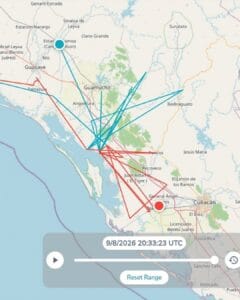
Elise was recorded in Mexico at about 6 a.m. Pacific time on August 23. About 11 hours later, Finn was detected farther south than Elise. By August 24, both had reached the Guaymas area along Mexico’s Sea of Cortez. Then came a surprise: on August 27, Finn and Elise were detected within just a few miles of each other near Guasave, north of Culiacan.
Elise flew 1,517 miles from Oregon in exactly six days, averaging just under 11 miles per hour. Considering she had to feed, rest, and continuously adjust her route for weather and other obstacles, her real flying speed was greater than 20 mph! The Purple Martin pair have now completed one-fifth of an 8,000-mile migration from Oregon to their wintering grounds in southeastern Brazil.
For the coastal Oregon birding community, this project provides a remarkable opportunity to see where birds go after the nesting season ends and highlights how conserving migratory birds connects habitats thousands of miles apart.
Finn and Elise still have more than 6,000 miles to go. SWIFTY will provide updates on the birds’ progress to Brazil as this remarkable journey unfolds; updates will be posted to the Seven Capes website at https://sevencapes.org/purple-martin-tracking and at https://swiftyswallows.weebly.com/puma-migration-202627.html. Seven Capes’ SWIFTY program thanks Oregon Birding Association for the grant that helped make this project a reality.
___________________________________________________________________________________________
 Seven Capes Bird Alliance was founded as Audubon Society of Lincoln City in 2005. A nonprofit membership organization and chapter of the National Audubon Society, Seven Capes is active in education and advocacy for protection of birds, other wildlife, and their habitats in Lincoln and Tillamook Counties.
Instagram: @sevencapesbirds
Facebook: https://www.facebook.com/sevencapesbirds
