



Today, God spoke to me through poetry
By Lynnee Jacks
Today, God spoke to me through poetry.
When Genesis was running dry, when words were swirling history in my head, I began to pray instead.
This is a ritual order of operations.
I read, I pray, I write.
Sometimes, God speaks to me between the lines.
But before I could write anything today, I recalled the shelf beside me, full of books unpacked from a year in storage.
When God is quiet, does he not speak through the poets?
Has he not spoken through me, after all?
I began in the Dictionary of Obscure Sorrows, which I’d picked up because of the name and my love for language.
As I was reaching for it, I thought of the number fifty-five, and I decided this was as good a page as any to start, so I cracked open the little book and wouldn’t you know, the bookstore bookmark was tucked inside, separating page fifty-four from fifty-five.
The sort of non-coincidence that makes my heart flutter, that lets me know he is going to take me somewhere unexpected.
Page fifty-five was a story about Icarus and self-doubt, and it felt all-too-pointed in the beginning, but because I know God and because I write poetry, I could sense the kind of end to which the author was building.
John Koenig’s words found me in perfect time to remind me about the magic of story itself.
Whatever resonates will stay, and what doesn’t will fall away. To pick away at the literal truth is to miss the point of it, miss the joy of it. So go ahead and build your myth. Try to tell a good story about yourself that captures something true, whether or not the facts agree.
Keep to the middle course. Steal bits of wax and feathers discarded by other, better fliers. Let the sun rise and fall. Let the waves pound themselves to mist, again and again. Your task is not to be flawless.
Your task is to fly.
Your task is to fly.
The advice was beautiful if not vague, and so I started to write about the way the words felt in my body and then I remembered that poetry is best understood in layers, held up against words quite different in origin but still scraping at the same sort of truth.
So I pulled out Mary Oliver’s Devotions from the stack beside me. Another book untouched for one year at least, maybe two.
The book splayed open easily, to a dog-eared corner on page twenty-two.
I don’t remember if I’d turned down the page or if it came this way, but either way, I was picking up where someone left off.
The poem on this page was called Storage.
Again, I am certain that there are no coincidences. In a five-hundred-page book about God and birds, I opened to a poem about emptying out a storage unit, same as I’d done a week ago.
Things! Burn them, burn them!
Make a beautiful fire!
More room in your heart for love, for the trees!
For the birds who own nothing–
the reason they can fly.
There in the last stanza, the final line echoed.
Your task is to fly.
And the advice was beautiful if not vague, still, so I started to write about the way this particular arrival at the same end is a different dance with the same maker, different path through the same pastures and fields and rivers that make up all our stories.
A question finds its through-line.
Is this God?
Where is the line between his voice and a truth of my own making?
Perhaps in some dusty corner of consciousness, I remembered the bookstore clerk tucking the bookmark in at page fifty-five. Maybe I had in fact read a poem called Storage two years ago. Maybe our stories find us dog-eared exactly when we need them.
And isn’t this God?
We see in part and hear in part. All we see and hear is intricately entangled with language and symbol, with what we believe about the world, about ourselves, and about God.
As if in answer, the final stanza from a different poem on the other side of the page jumps out.
Yes, I know, God’s silence never breaks, but is that really a problem?
There are thousands of voices, after all.
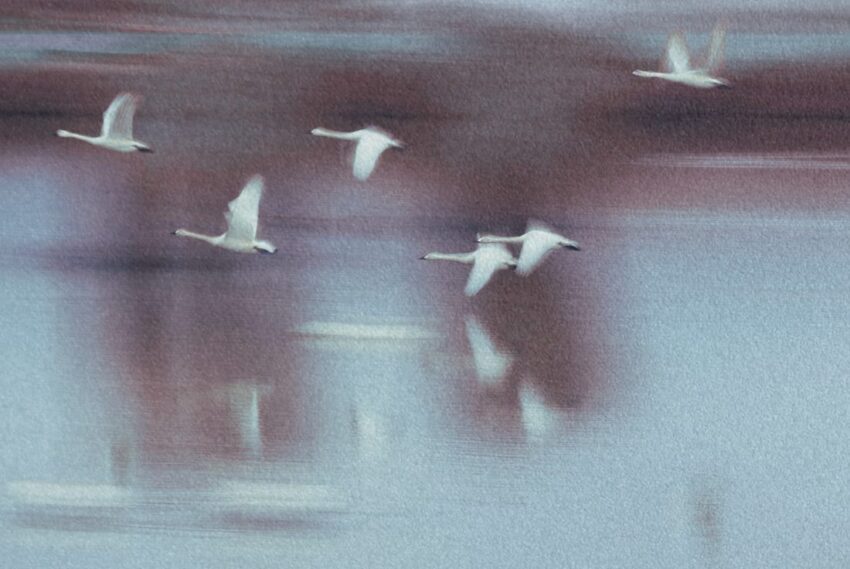
And furthermore don’t you imagine (I just suggest it) that the swans know about as much as we do about the whole business?
So listen to them and watch them, singing as they fly.
Take from it what you can.
— Mary Oliver

Thanks for reading the Sandstone Journal. If you’re interested in writing that deepens connection to people and place, subscribe and share this newsletter.
Subscribe here for more.
