


Recovered fishing gear will inform action to reduce whale entanglements.
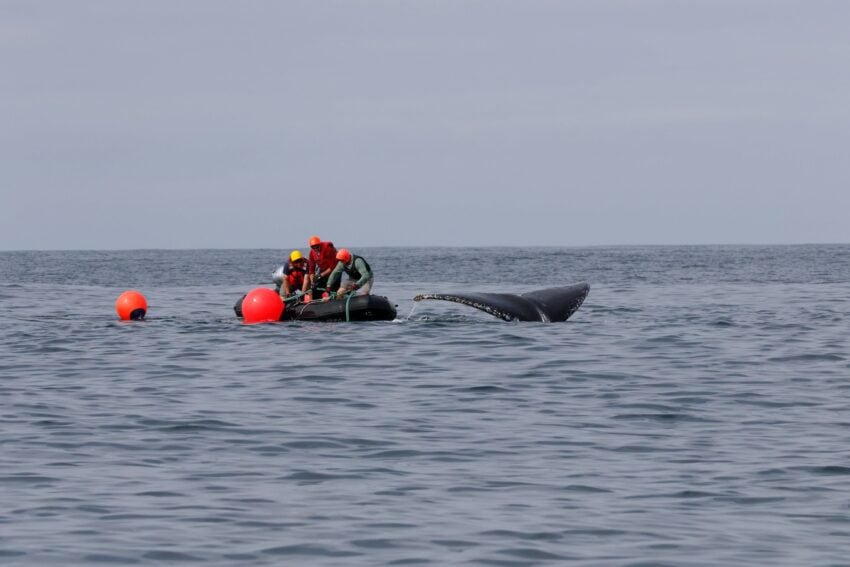
An Oregon team joined by experts from Washington and a local fisherman freed a severely entangled humpback whale about 20 miles off the Oregon Coast on July 26. While the team removed all of the gear from the whale, the entanglement left the young whale’s jaw permanently open, leaving it unable to feed and unlikely to survive.
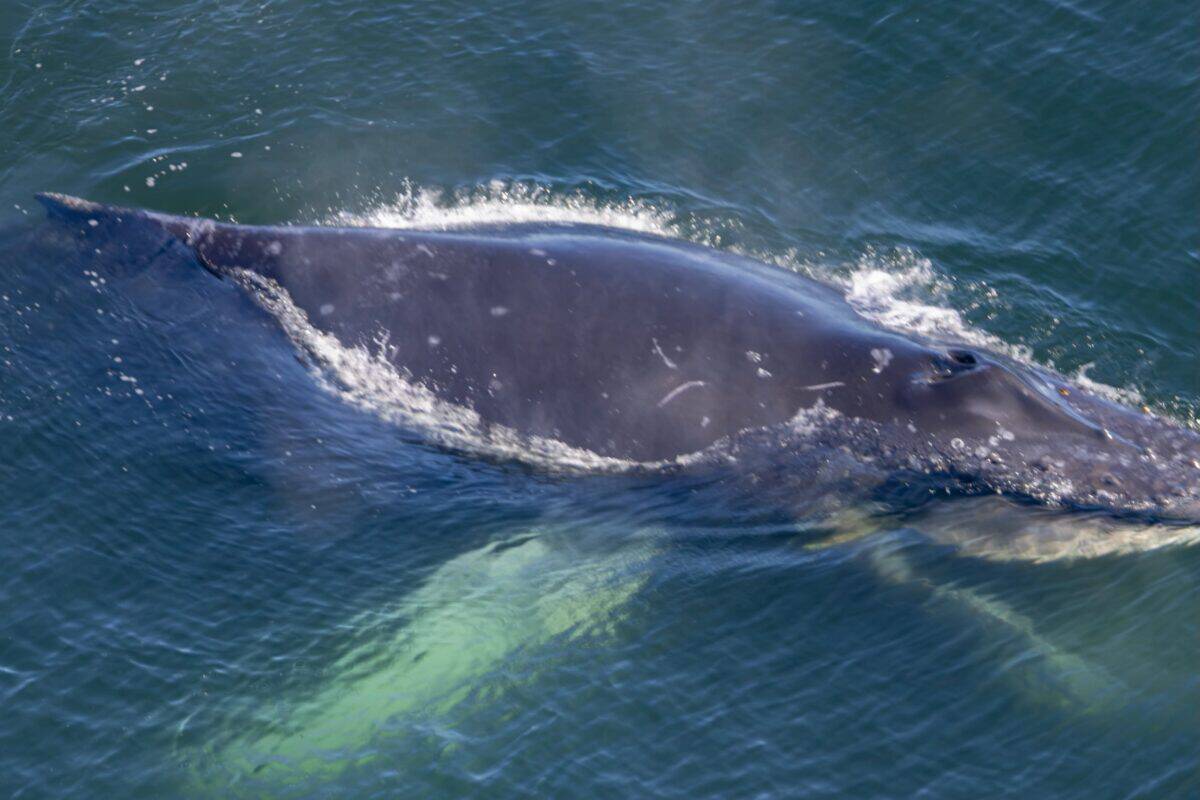
Oregon State University research assistant Craig Hayslip spotted the whale from a U.S. Coast Guard helicopter surveying the coast for whales and fishing gear three days earlier. He reported the whale anchored by heavy fishing gear to NOAA’s West Coast Entanglement Hotline, which activates trained responders across the region.
Responders asked local fisherman Poggy Lapham to join the effort and help lift the gear with the hydraulic winch on his boat, F/V Michele Ann. That gave responders access to free the whale from the gear. An online photo catalog identified the whale as a young humpback previously sighted in British Columbia in 2024.
The fishing vessel recovered a tangle of more than 3,000 feet of line, five sablefish pots, and individual commercial Dungeness crab traps from Oregon and Washington. Responders and the fishermen worked together to analyze the gear and evaluate the entanglement. The condition of the gear indicated that it could be derelict or lost gear. NOAA Fisheries is following up with gear owners for more details.
Lapham said the entanglement should be a wake-up call for the fishing industry to ask, “How can we better incentivize gear retrieval and tracking of lost gear to reduce this risk?”
“This is truly a heartbreaker because of the whale’s injuries, but we will learn so much from this case that can help us prevent future entanglements,” said Lauren Saez, who helped coordinate the response for NOAA Fisheries’ West Coast Region. “We disentangled the whale safely, got all the gear back, and had great collaboration with the fishing industry. Additionally, we got whale DNA samples from the gear to help identify which population it belongs to. All this information is crucial to understand what happened and what we can do to help prevent future entanglements.”

Training Readied Team
The team from Oregon State University’s Marine Mammal Institute and Oregon Coast Aquarium in Newport had recently trained with entanglement experts from Cascadia Research Collective in Olympia, Washington, who also joined the response, said Jim Burke, Director of Animal Care at the Oregon Coast Aquarium, who was part of the team. The group readied their boats and gear for just such an incident. A recent grant from the Oregon Wildlife Foundation funded key safety, documentation, and response tools.
NOAA Fisheries has supported training to expand the capacity of the West Coast Large Whale Entanglement Response Program to respond more quickly to large whale entanglements that have increased over the last decade. Threatened and endangered humpback whales that feed off the West Coast in summer are the most affected species, with more than 30 humpbacks confirmed entangled last year.
Only trained and authorized teams should attempt to free entangled whales.
In 2025, NOAA Fisheries’ West Coast Region convened a West Coast Take Reduction Team of commercial fishermen, Tribal representatives, scientists, fishery managers, and conservation groups to recommend measures to reduce humpback whale entanglements in sablefish pot gear. Agency officials notified members that the group will meet to review the recent entanglement as well as a humpback whale found dead off Oregon July 7 after getting entangled in sablefish gear.
Responders reached the entangled humpback whale exactly where the helicopter team had spotted it the day before shortly after 7 a.m. on July 24. They submerged a GoPro camera at the end of a pole to record video of a line through the whale’s mouth that stretched tightly into the depths and out of sight.
The whale’s jaw was “wide open beyond anything you would expect to see,” said Jim Rice, who manages the Oregon Marine Mammal Stranding Network for Oregon State University and was on the team. “We could tell by the angle it was not natural.”
Experts Joined Response
Doug Sandilands and Jenn Tackaberry, entanglement experts from Cascadia Research Collective, led the response. The line entangling the whale stretched so deep and tight the team could not reach it with cutting tools even after the U.S. Coast Guard brought a smaller inflatable boat they used to get closer to the whale. They could not budge the gear on the sea floor about 400 feet below.
“We realized if a whale couldn’t move it, then we humans weren’t going to move it, either,” said Hayslip, who was also on the team. They returned to Newport to plan another attempt. Rough weather kept them ashore the next day, but the team returned to the whale on July 26.

Responders directed the crew of the Michele Ann as they winched in a line drifting behind the whale that also descended to the gear on the bottom. That lifted the gear enough for a team in a smaller boat to cut the line to the whale, which later swam free.
The crew continued to reel in line and gear, with Lapham and the crew separating the tangled lines, sablefish and crab traps, and smaller gear from other fisheries. Lapham said the sablefish gear could not have been legally set in such shallow waters and may have been inadvertently pulled into the area by passing vessels.
Lapham is a member of the Take Reduction Team working to reduce entanglements in the fishery. While crab traps must carry tags officials can use to identify the owner, sablefish traps are not required to carry tags, he said. That makes it more difficult to piece together what happened in whale entanglements like this one. He said after the entanglement that he ordered tags for his own sablefish traps.
