


“[Trump] should divest. Divest from nuclear fusion, social media and cryptocurrency,” Richard Painter, Bush Administration ethics official.
By Marc C. Johnson
Friends:
I’ve been writing a lot about the new Trump Administration scheme to finally abandon the long-time plan to create a high-level commercial nuclear waste storage site under Yucca Mountain in Nevada.
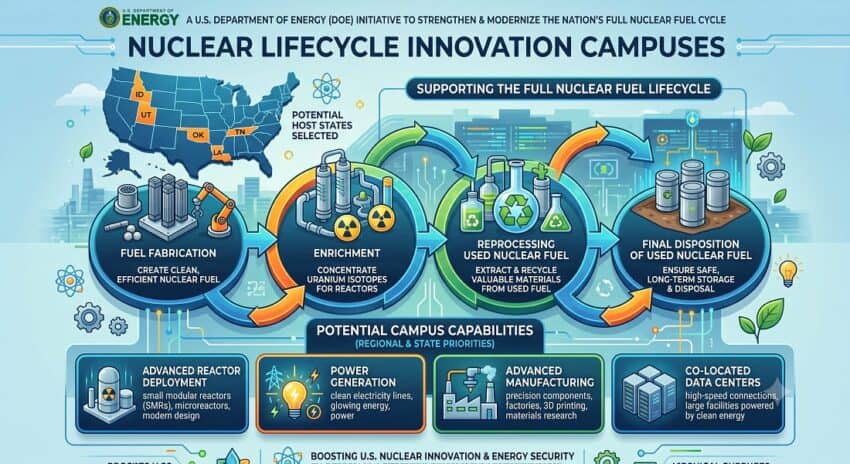
With what has now become a common approach to changing national policy the Trump Department of Energy (DOE) in late July suddenly selected five states as potential sites for what the administration calls Nuclear Lifecycle Innovation Campuses (NLIC). (See DOE Illustration above.)
As I’ve noted here and here and here, the scheme has many, many problems – no congressional buy in; no funding; no public process; little, if any, attention to safety issues – but here we are with Idaho, Utah, Tennessee, Louisiana and Oklahoma in the running for what may be the biggest pig in a poke since Trump University.
The big elephant in the room with all five of these Trump-aligned states is the assumption that the states will accept up to a third of the nation’s large stockpile of high level waste for storage or potential future reprocessing (which has it’s own problems.)
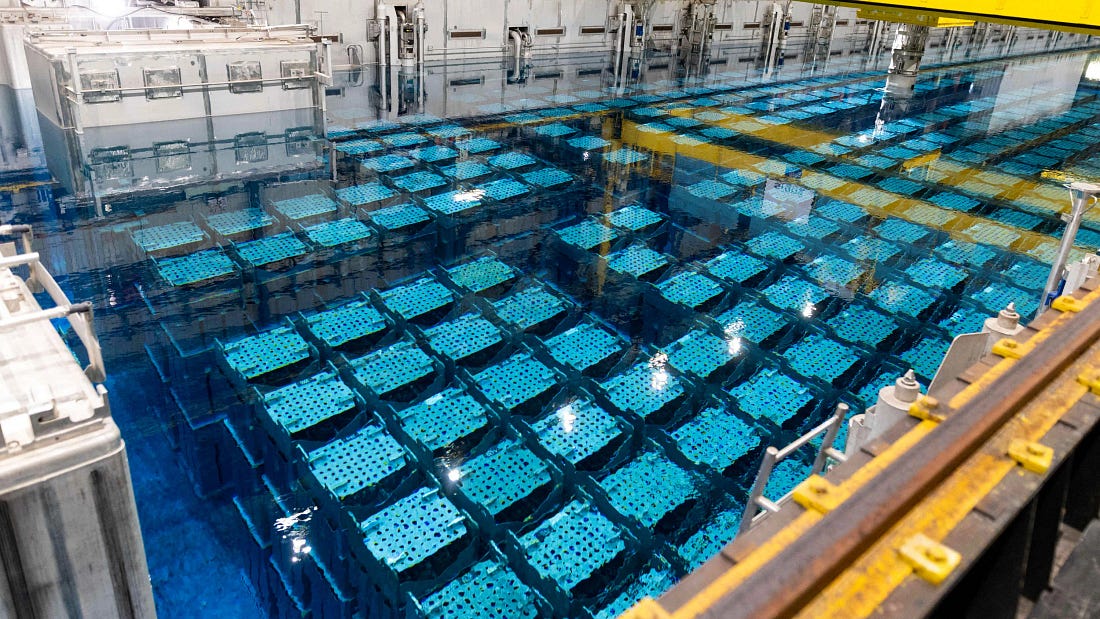 |
High level waste at a French reprocessing facility – Abaca Press/Alamy Live News
This story may well be the most under-reported major story in the country. I continue to find it astounding that such important policy is largely flying under the national media radar.
Guest post
So today I’m turning over the remainder of this post to an old, old friend, Rod Gramer who lives in Boise, Idaho. Rod is my oldest Idaho friend. We met in 1975 when both of us were rookie reporters in Boise. Rod went on to a distinguished career as a journalist and newsroom executive, wrote the definitive biography of Idaho Senator Frank Church, as well as a book about the late Idaho Governor Phil Batt.
Now, Rod is as concerned as I am about the Trump nuclear waste scheme.
Rod does a terrific job of connecting the dots as to why the administration – and Donald Trump in particular – may be so interested in advancing an ill-considered plan that, when all is said and done, only really promises to move high level commercial waste storage from nuclear reactor sites in 35 states to remote places like the sprawling DOE complex in the high desert of eastern Idaho.
Let Idaho decide about nuclear waste storage
Here’s Rod’s piece.
It is very much worth your time.
One of the most critical issues facing Idaho is one that has received little attention but has profound consequences for the future of our state – the agreement that would make Idaho the dumping ground for a third of the radioactive waste generated in our country.
It’s not surprising that Idahoans don’t know much about this issue. Governor Brad Little, who is pursuing this agreement, and Senator Jim Risch have said precious little or nothing about it, apparently wanting to keep it under the radar until they are safely re-elected in November.
Congressman Mike Simpson applauded the agreement, saying it will bring jobs to his eastern Idaho district. “Idaho didn’t become the nation’s nuclear leader by being afraid of hard problems. It became the leader by being the state willing to do the difficult, careful work that others wouldn’t. That’s still the right instinct now,” he wrote.
The Trump Administration will choose three states to create what it calls a “Nuclear Lifecycle Innovation Campus.” The other states in the running for this dubious honor besides Idaho are Utah, Tennessee, Louisiana, and Oklahoma.
The chosen states will each have to receive 33 percent of the radioactive waste generated by the other 47 states.
The public did not know that Governor Little agreed to be one of the states until the Department of Energy announced it in early August. The memorandum of understanding that Little signed in July without informing Idahoans said: “The host agreement shall provide for the acceptance of out-of-state used nuclear fuel, spent fuel, and high-level radioactive waste.”
In its announcement, the Trump Administration promised that the campus will boost manufacturing, create jobs, promote American energy independence, and attract other unnamed financial investments. Of course, we don’t know what this means since Little and our congressional delegation have not told us what’s in the fine print.
Idaho’s history with nuclear waste
To put the importance of this issue in perspective, it is important to understand Idaho’s long and dark history with radioactive waste.
Starting in the 1940s, the federal energy site in eastern Idaho, which is now called the Idaho National Laboratory, became the repository for much of the nation’s nuclear radioactive waste. The issue came to a head in the late 1970s when the press reported that the federal facility had regularly poured low-level radioactive liquid waste down an injection well above the Snake River Aquifer which is the size of Lake Erie and provides much of the water for southern Idaho’s farmers and ranchers. There was also concern about other radioactive liquid waste being stored in containers buried above the aquifer.
I covered energy issues for The Idaho Statesman at the time and reported on the controversy over this waste. There was concern among Idaho’s political leaders because the federal site was also known for its porous volcanic soil and seismic activity. Coverage of the issue made front page news for months.
That same year the General Accounting Office recommended that Idaho become a permanent repository for the nation’s radioactive waste. That proposal came nine years after the federal government promised to remove the existing waste from Idaho.
The GAO report was quickly opposed by then Governor John Evans and even a Republican legislator from Boise who introduced a bill in the Legislature to ban any shipment of radioactive waste into our state. Legislators from eastern Idaho rallied and killed the bill.
Fast forward to 1988 when then Governor Cecil Andrus finally had enough and promised Idahoans that he would block the federal government from transporting more radioactive waste from its Rocky Flats, Colorado nuclear weapons plant. To emphasize his opposition, Andrus stationed a 24-hour State Police detail on one of the shipments that made its way into the state as far as Blackfoot.
A picture of a muscular state trooper standing by the railroad car with his cruiser in the background made the front page of The New York Times and the story was covered by every national TV news outlet. The crisis was averted when the governor of Colorado agreed to take the waste back.
“I’m not a nuclear scientist,” Andrus later wrote, “but I understood on one point from the beginning: Radioactive garbage from the nuclear reservation in Idaho could not – must not – be allowed to come anywhere near the Snake River Aquiver.”
After Andrus left office, Republican Governor Phil Batt took up the issue and negotiated a landmark 1995 agreement with the federal government that would prevent Idaho from becoming a permanent repository for nuclear waste, limit the waste Idaho would take on a temporary basis, and require the federal government to remove all the waste by 2035, a timeline that it is far from meeting at this point.
It is significant that Governor Batt did not just sign the agreement with the federal government. He took the question to the people of Idaho to vote on whether to support his agreement which they did overwhelmingly. “I think the best thing I did was telling (Idahoans) what it meant to them,” Batt told me in a 2019 interview before he died.
Andrus and Batt never gave up on the demand to have the waste at INL removed. They spent the rest of their lives holding the federal government accountable for removing the waste and keeping the issue in front of the people of Idaho.
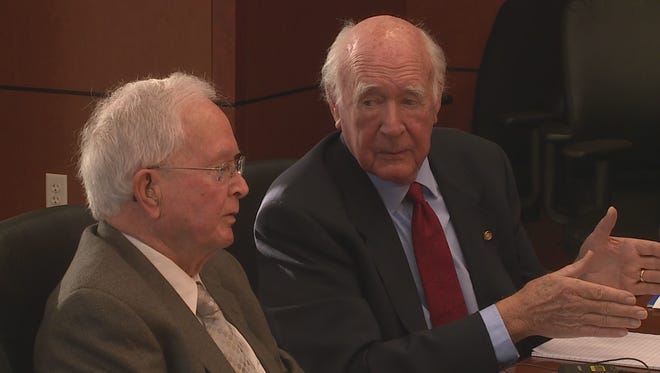 |
Former Idaho Governors Phil Batt and Cecil Andrus
Governor Batt’s agreement demonstrated that the Idaho National Laboratory could conduct much-needed nuclear power research and development while still working toward the removal of all radioactive waste from the site. Idaho did not have to accept waste in exchange for being the nation’s leading laboratory for nuclear research and development.
There is more to this story than meets the eye
There is another twist to this story which has received no attention in Idaho.
Last December, Trump Media & Technology (TMTG) announced that it was merging with the California-based TAE Technologies with an all-stock deal worth an estimated $6 billion. The new company said it plans to find a site and begin construction in 2026 on the “world’s first utility-scale fusion power plant to help power data centers critical to the artificial intelligence industry,” according to the Associated Press.
TAE is currently financially backed by Google and other high-tech investors. Once the merger with Trump Media & Technology is finished, the private company would become one of the first nuclear fusion companies on the American stock exchange.
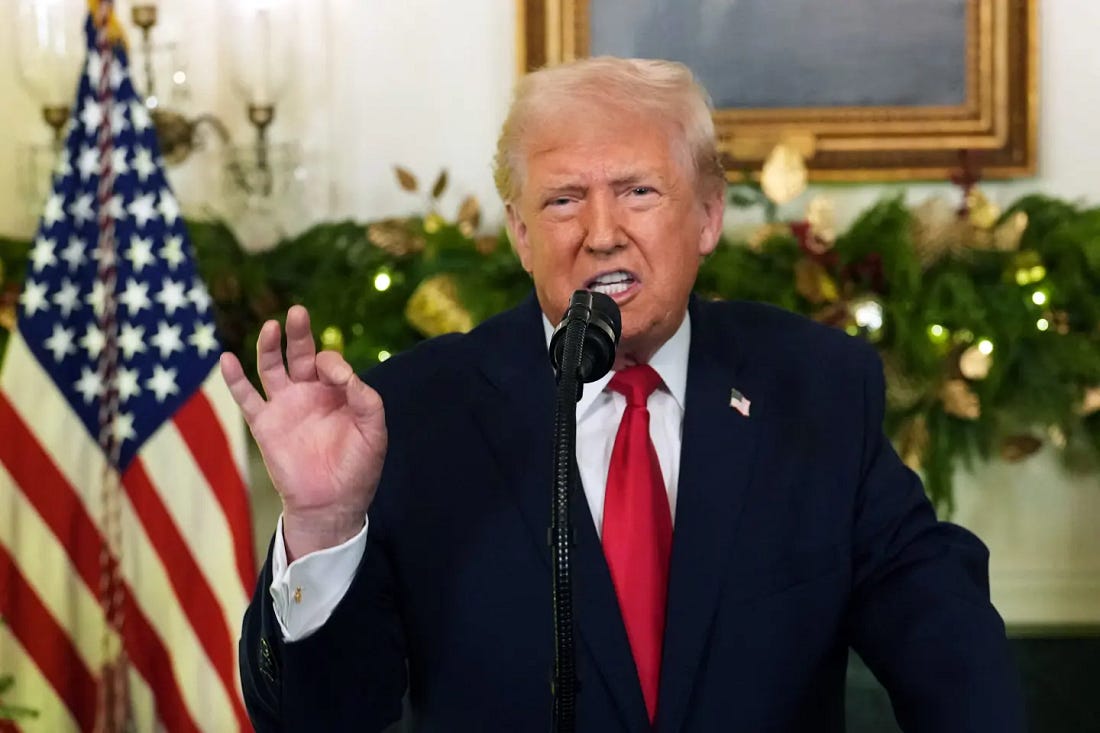 |
Fortune Magazine headlined its story on Trump media company merger with TAE – “Trump Goes Nuclear.” – Doug Mills, Getty Images
Donald Trump’s revocable trust owns 114.75 million shares or about 41.5 percent of Trump Media & Technology. After the merger is completed, Trump’s trust would own about 21 percent of the new company. The president is the sole beneficiary of the trust, although Donald Jr. is a trustee and has voting and investment authority.
Here’s the bottom line: The more money the new company earns building and selling fusion reactors the more money Trump’s investment would be worth. One estimate is that if the value of the new company grows from $6 billion to $50 billion, the president’s investment could be worth more than $10 billion.
“He’s (Donald Trump) jumping into this industry just like he jumped into cryptocurrency a couple of years ago,” Richard Painter, a former ethics lawyer in the George W. Bush Administration, told the Associated Press. “Just as the United States government is gonna get all involved in it. And it’s so obvious that there’s a huge conflict of interest.”
That is an understatement.
Last year Trump Media & Technology lost about 70 percent of its value, but after the announcement of the merger with TEA its stock jumped by 34 percent.
But that’s only part of the story. Trump signed an executive order in May 2025 to have the federal government speed up the development, construction, and deployment of nuclear reactors. He plans to spend taxpayer dollars doing it.
Last week the Army announced that it would spend $2.5 billion to buy micro nuclear reactors for five of its bases as part of Trump’s “Janus Program.” The Army says eventually nine of its bases will buy reactors costing taxpayers billions more.
Alan J. Kuperman, associate professor at the Lyndon B. Johnson School of Public Affairs at the University of Texas and a nuclear nonproliferation expert, told the Associated Press that Trump is using the military’s “deep pockets to provide a hidden subsidy” to help nuclear companies that can’t find private-sector customers for their reactors.
Furthermore, the reactors would be licensed by the Army rather than the U.S. Nuclear Regulatory Commission, which licenses all commercial nuclear reactors. Kuperman told the Associated Press that is “a dangerous scam on many levels.”
Then last month Trump signed a multi-billion-dollar agreement with Saudi Arabia to share nuclear technology so that it can develop a domestic nuclear power program. The agreement gives exclusive rights to American nuclear reactor companies to help the kingdom develop its nuclear power infrastructure.
The Bulletin of Atomic Scientists expressed concern that the deal would allow the Saudis to enrich their own uranium without international oversight and could lead to the proliferation of nuclear armaments in the Middle East.
So, what does this mean for Idaho?
All this means plenty for Idaho.
As more nuclear reactors go into operation, the more radioactive waste will be generated across the country. The more waste generated, the greater amount of waste that will be shipped to Idaho under Governor Little’s agreement to take 33 percent of the commercial radioactive waste generated in the country.
That is, of course, unless Governor Little writes into the agreement that Idaho will only take so much of the country’s waste. But such a change in the memorandum could kill Idaho’s chances of becoming a Nuclear Lifecycle Innovation Campus. Besides, Governor Little isn’t known for bucking Donald Trump.
Historically, one of the biggest impediments to the development of commercial and government nuclear reactors is what to do with the waste that is generated. Efforts to create a permanent repository at Yucca Mountain near Las Vegas was stopped by former Senate Majority Leader Harry Reid, D-Nevada, during the Obama Administration.
Thus Donald Trump, the investor in nuclear power, must find permanent repositories if his dream of manufacturing and selling reactors to utilities, AI companies, to the military and to other countries comes a reality.
If he can’t find permanent dumps for the waste, his investment and dream of turning the United States into a commercial nuclear giant would go from a financial dream to a financial nightmare.
Trump has always been a transactional businessman and president. His plan to create so-called “Nuclear Lifecycle Innovation Campuses” is a way of leveraging states like Idaho into providing the permanent repository that he needs. It’s a quid pro quo that looks like Governor Little, our congressional delegation, and INL supporters are ready to buy.
In two years, Donald Trump will be out of office and can’t leverage taxpayers’ dollars to expand the use of nuclear power plants. Future presidents and congresses may not be as open to spending billions supporting “Nuclear Lifecycle Innovation Campuses.”
But Idaho will forever be stuck taking 33 percent of the nation’s radioactive waste – material no other state wants to accept.
So, what’s next?
If Governor Little insists on accepting the waste, there are several questions he should have answered. What will be the impact on Idaho’s current power grid, how much water will the campus require and where will it come from, and how can the federal government prove that it is safe to dispose of the so much waste over the Snake River Aquifer when its track record hasn’t been stellar.
Most importantly, Governor Little should do the same thing Governor Batt did: Be fully transparent with Idahoans about the deal and ask them if they are willing to make Idaho a radioactive waste dump for a third of the nation’s waste.
When I interviewed Governor Batt for my book, “Lucky, The Wit and Wisdom of Governor Phil Batt,” he predicted that Brad Little would change his nuclear waste agreement as soon as he died. As predicted, Governor Little did amend the agreement shortly after Batt’s death in 2023. Now, if Little accepts the Trump Administration’s quid pro quo deal, the Batt Agreement will be shredded for all intents and purposes.
I asked Governor Batt if he thought the people of Idaho would stand for allowing the state to become a repository for radioactive waste. “Well, I don’t know,” Batt told me. “At one time, they were all excited about not doing things like that, but you don’t hear them (the people) talking about waste leaking into the Snake River and all that stuff like you used to.”
I pointed out that’s probably because the Batt Agreement limited shipments of waste into our state, banned permanent storage, and provided a timeline to get all the waste out of our state. Batt simply replied, “Yeah.”
It remains to be seen if our current governor will include Idahoans in this decision – and whether the people of Idaho still care.
Rod Gramer is an Idaho native, longtime journalist, and author/editor of “Lucky, The Wit and Wisdom of Governor Phil Batt.”
It’s difficult to be an optimist in today’s world and I’m not all that optimistic, but I do focus on realism and try to populate my writing with solid sourcing and not merely opinion. I write these pieces to offer a perspective based on history and particularly American political history since 1900.
These essays are free, but a financial contribution helps support my writing and research, including a new book in progress.
Subscribe to Marc’s Substack for $8 a month or make a pledge. Subscribe here for more.
Many thanks.
