











 EDITOR’S NOTE: Here’s an installment from Tillamook County’s State Representative Cyrus Javadi’s Substack blog, “A Point of Personal Privilege.” Oregon legislator and local dentist, representing District 32, a focus on practical policies and community well-being. This space offers insights on state issues, reflections on leadership, and stories from the Oregon coast, fostering thoughtful dialogue. Posted on Substack, 6/22/26
Why “I have insurance” does not always mean “this is covered”
By Cyrus Javadi
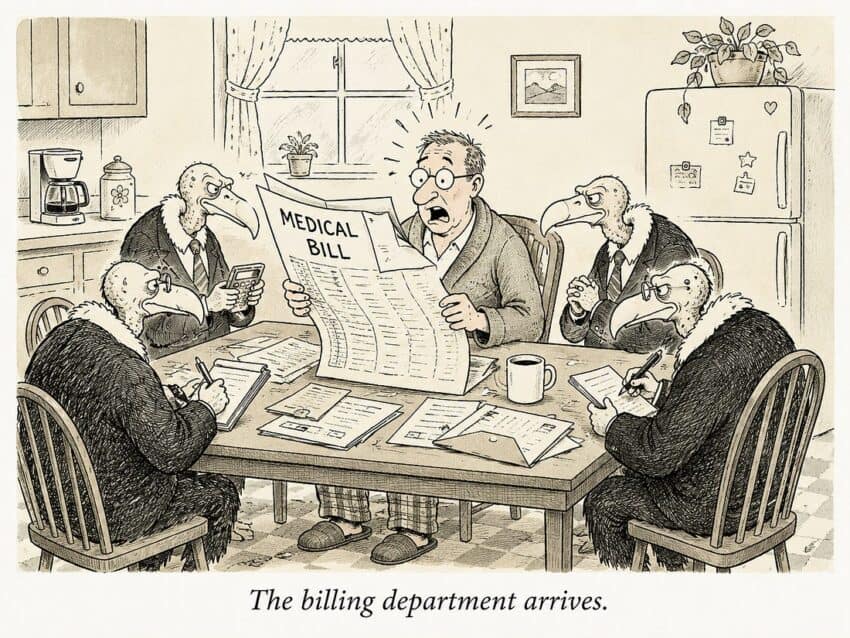
Have you ever sat down at the kitchen table, opened a bill from a doctor, hospital, or clinic, stared at the amount you owed, and said:
“I pay for health insurance. Why isn’t this covered?”
If so, read on.
If not, I don’t believe you. Read on anyway.
Because sooner or later, almost everyone runs into the same maddening truth: having health insurance does not always mean the care you need is covered, affordable, nearby, or simple to get.
Last week during Legislative Days in Salem, I sat through a presentation on the Affordable Care Act, Oregon insurance markets, benefit mandates, federal tax credits, and something called “state defrayal.”
I know. Please try to contain your excitement.
Health insurance minutia is not exactly thrilling dinner conversation. Unless your dinner guests are insurance actuaries, in which case you may have other problems.
But I digress. Let’s talk about benefit mandates.
In insurance parlance, a benefit mandate is exactly what it sounds like. It is when government says a health insurance plan must cover a certain service or treatment.
Why would government do that? Because, it turns out, insurance plans do not cover everything.
That surprises people. It should not, but it does. Most of us think about health insurance in a pretty simple way. We pay premiums every month. Then, when something bad happens, insurance helps pay for care.
That is the promise.
But the fine print is where the promise gets complicated.
Need hearing aids? Maybe covered.
Need a cochlear implant for your child? Maybe.
Need treatment for cancer? Probably, but which treatment? At which hospital? With which prior authorization? After trying which cheaper option first?
Need medication for obesity? Hold up. Does your plan cover it? Your neighbor’s might. Yours might not.
Need help with menopause symptoms? Maybe.
Need a prosthetic limb? Maybe.
Need dental care, dentures, or oral health treatment? That is its own special maze, and I say that as a dentist.
This is where people start to feel like insurance is less of a safety net and more of a guessing game with a monthly subscription fee.
Oregon Has Required Some Plans to Cover More
Over the past several years, Oregon has passed laws requiring some health plans to cover certain services.
Which brings me back to the slide show I saw during Legislative Days. You see, one slide listed several of services that were once optional but are now mandated by the authority of the Oregon Legislature: nurse home visiting, proton beam therapy for certain cancers, bilateral cochlear implants, hearing aids and assistive listening devices, prosthetic and orthotic devices, child abuse assessments, PANS/PANDAS treatment, HIV prevention and treatment, menopause care, non-opioid pain treatment, perinatal doula services, and breast reconstruction.
Be assured. These are not luxury items. They are services people need when life gets hard.
So Oregon had stepped in and said, in some cases, “No. If people are paying for insurance, this should be part of what insurance covers.”
That sounds simple. But again, it is not.
Why?
The State Is Not All-Powerful
Because here is the next thing most people do not know: Oregon cannot regulate every health plan.
That means when Oregon says a service must be covered, it does not necessarily apply to every Oregonian with an insurance card.
Some plans are regulated by the state. Some are controlled mostly by the federal government. Some are public programs. Some are employer plans. Some are self-insured plans run by large employers under federal ERISA law.
Confused by that? Don’t worry. So are most legislators who do this for a living.
That means two people can live in the same town, see the same doctor, pay premiums every month, and still have very different coverage.
Someone who works for a large employer like Nike may have access to a different set of benefits than someone on the coast who works for a small business.
Both are human beings. Both can get sick. Both can have children with medical needs. Both can get cancer. Both can need mental health care, specialty care, hearing aids, prescriptions, or surgery.
But their access to care may depend heavily on who they work for, how their employer structures the plan, whether they are on Medicare, whether they are on Medicaid, whether they buy insurance through the marketplace, or whether their plan is regulated by Oregon at all.
You see, that is not how most people think health insurance works. But it is how health insurance works.
Is this an insane system designed by evil-masterminds? No.
Overly complicated? Yes.
So when we talk about “health insurance in Oregon,” we are not talking about one system.
We are talking about several systems stacked on top of each other, each with different rules.
That is why the answer to “is this covered?” so often begins with the most irritating phrase in health care:
“It depends.”
And that is why unless you read all of the fine print on your plan, have a Ph.D. in health policy, have worked as an executive for an insurance company, an office manager for a dentist’s office, and a large hospital, you will get a bill saying you owe money for something you thought was covered, and you will be confused.
Yes, Coverage Costs Money
Now we have to deal with the harder part.
If government requires insurance companies to cover more services, does that cost money? Yes. Of course it does. There is no magic pile of free health care hiding behind the Capitol.
If a health plan covers hearing aids, cochlear implants, prosthetics, cancer treatments, menopause care, doula services, or HIV medications, somebody pays.
Employers may pay more. Workers may pay more. The state may pay more. The federal government may pay more. But the cost does not disappear. It is shifted around like a hot potato.
And with rising costs, sometimes people delay care. Sometimes they skip care all together. Sometimes they put it on a credit card. Sometimes they drain savings. Sometimes they go without groceries, rent, or other basic needs. Sometimes the untreated condition gets worse, and then the system pays more later.
So yes, benefit mandates can raise premiums. But not covering needed care has a cost too.
So How Much Do Mandates Add?
This is where the numbers matter.
According to DCBS actuaries, all insurance mandates passed by the Oregon Legislature over the last 10 years have added no more than 3% to commercial health premiums.
On the individual market, that equals roughly $9 to $17 per person per month.
That is not nothing.
For a family living close to the edge, every dollar matters.
But over that same period, the average base premium (the part before the benefit mandates) in Oregon’s individual market increased by a cumulative 92%, or $274.
So we should be honest on both sides. Benefit mandates do add costs. But they are not the main reason health insurance has become expensive.
The main drivers are bigger: hospital costs, prescription drugs, provider prices, utilization, administrative costs, geography, age, and the overall cost of delivering care.
So a benefit mandate can move the price. But it is one part of a much larger machine.
The Federal Government Needs to Own Its Part
There is a deeper problem here. The federal government helped create this system.
The Affordable Care Act set up essential health benefits. It created the marketplace structure. It created premium tax credits. It divided authority between states and the federal government. It left employer self-insured plans largely under federal rules.
Then, over time, states like Oregon responded to real needs by requiring certain benefits.
Now the federal government is moving toward a rule that may push more of those costs back onto states.
At the same time, federal premium help has become less stable.
Thousands of Oregon marketplace enrollees are already paying more without enhanced federal premium tax credits. DCBS showed examples ranging from $127 to $456 more per month depending on income.
Older and rural Oregonians get hit harder.
One example showed a 60-year-old and 64-year-old couple in Hermiston paying $25,438 more per year in premiums without enhanced tax credits on most plans.
That is not a typo.
That is someone’s retirement, mortgage, or deciding whether insurance is still affordable at all.
And if people do decide to drop coverage, that means the fewer people who stay enrolled have to cover the same costs. In other words, their premiums go up. And that causes more people to drop. And the cycle continues until the only people remaining are the ones who need the most expensive healthcare the most but don’t have any way to pay for it.
And then they system collapses on itself.
So What Is the Answer?
First, the Federal government should reinstate the tax subsidies for premiums. We need to stop the bleeding of people who are dropping coverage leaving the pool of insured people smaller and smaller with higher and higher costs.
Second, and harder, contain rising medical costs. This is mostly going to happen if we improve the health of Americans and reduce avoidable disease.
Third, make prices more transparent, keep insurance markets stable, protect rural access, and make sure health insurance actually does what people expect it to do.
That last part matters most.
Because when people pay for insurance, they are not buying a plastic card. They are buying a promise.
The promise is that if they get sick, hurt, pregnant, old, disabled, diagnosed, or unlucky, they will not have to face the cost alone.
That promise is under pressure.
Because the question at the kitchen table is simple:
“I pay for health insurance. Why isn’t this covered?”
The answer should not require a law degree, an insurance broker, and three hours on hold.
If this was useful, please subscribe and follow along. My goal is to explain the system in plain English, and not as someone trying to win a cable news argument.
And if you want to support this work, please consider donating. Campaigns take resources. So does serious public communication. Your support helps me keep doing both: listening to people on the North Coast, explaining hard issues clearly, and fighting for practical solutions.
A Point of Personal Privilege is free.
