









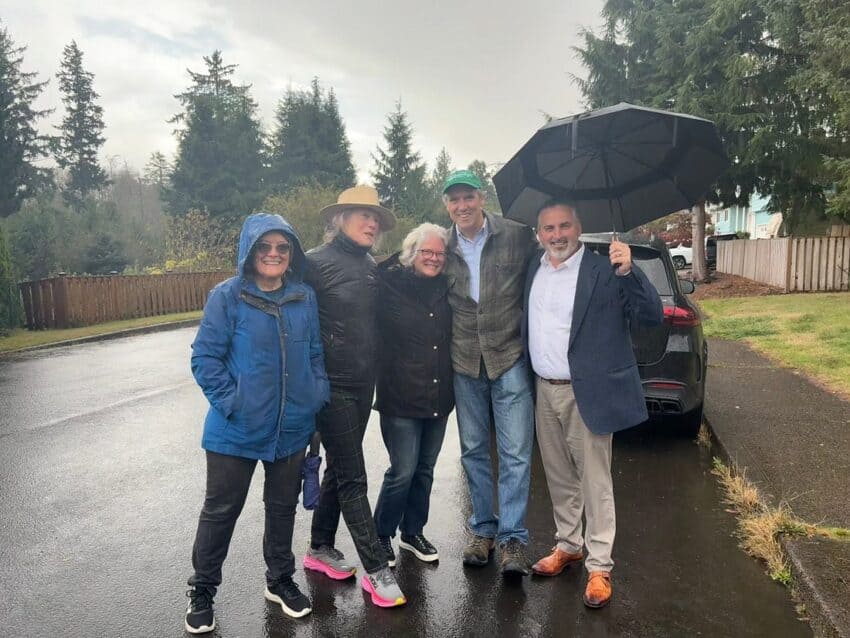
Three members of Congress, one rainy Oregon afternoon, and a side of politics you won’t see in a campaign ad.
By State Representative Cyrus Javadi
Two days until Election Day.
If you’ve turned on the television, watched anything online, or—heaven forbid—opened your mailbox lately, you’ve probably been subjected to a steady barrage of political advertising.
I have this theory about American politics: We’ve become a nation of people who hire plumbers based on how much they hate electricians.
Never mind whether or not they can fix the toilet. What matters is that they’re willing to go on television and denounce the sinister, toilet-destroying agenda of the electrician lobby.
We cheer. We donate. We put signs in our yards.
Meanwhile, the toilet? Yeah, it’s still broken.
This is, more or less, the condition of American politics in 2026.
We’ve confused governing with winning, leadership with performance, and political courage with the willingness to insult someone on the internet.
But last Thursday, in a rainy corner of Astoria, I had a front row seat to something that reminded me that we can still elect leaders who care more about the people they’re supposed to serve than the political enemies they’re supposed to defeat.
So, pop some corn, kick up your feet, and read on.
The Things We Don’t See
Last week, Senator Ron Wyden had organized a healthcare listening session at the Barbey Maritime Center. Senator Jeff Merkley, Congresswoman Suzanne Bonamici, and I joined him.
The subject was “reimagining healthcare.”
Now, “reimagining” is one of those words politicians love. We reimagine education, reimagine transportation, and reimagine government. It’s the sort of word that sounds wonderfully ambitious.
But the people who showed up weren’t interested in buzzwords.
They were interested in getting help.
From the moment the moderator said “Go,” the folks who showed up talked about insurance premiums, prescription drugs, finding doctors, dental care, foster children, and services for people with developmental disabilities.
One woman described her struggle to find not just decent — she would have settled for any—healthcare for her adopted son.
She had the weary expression of someone who had spent too many years navigating a system that seems to have been designed by people who have never actually used it.
When she finished speaking, she returned to her chair.
That’s when Ron Wyden did something interesting.
He stood up, walked across the room, lightly touched her arm, and leaned down to whisper something.
I couldn’t hear what he said. But she could.
I watched her face change.
She smiled. Her eyes brightened. Some of the weight she’d carried back to her chair seemed to lift.
Then Ron returned to his seat.
No announcement. No photograph. No attempt to convert the moment into a fundraising email.
Just one human being comforting another.
It was, in the modern political environment, almost suspiciously normal.
And it made me wonder whether we’ve become so accustomed to politicians behaving badly that ordinary human decency now seems extraordinary.
The Radical Act of Taking Notes
Later, another woman approached the microphone.
She had four suggestions for improving healthcare.
Four specific suggestions.
This, dear reader, is dangerous territory for politicians. Specific suggestions have the unfortunate habit of requiring specific answers, which can lead to awkward moments in town hall meetings.
She started to speak. And Jeff Merkley and Suzanne Bonamici immediately started writing.
The woman explained her first suggestion. They wrote.
Second. More writing.
Third. Fourth.
By the time she’d finished, Suzanne had filled an entire page, and Jeff was writing on the back of his notepad.
Then they began asking questions.
Had they understood her correctly? Could she explain another point? Had they missed anything?
These politicians who had spent hundreds—if not thousands—of hours in policy discussions, and meeting with expert lobbyists, and CEOs of hospitals and insurance companies, were genuinely interested in the ideas of a woman from a city of 10,000 residents nestled in the northwest corner of a state of over four million people.
This shouldn’t be remarkable.
But it is.
Consider what passes for political communication these days.
A constituent asks a question. A politician responds with a rehearsed speech about the other party. The constituent asks again. The politician explains that America is at a crossroads.
Eventually everyone goes home, and the constituent still can’t afford her medication.
There’s an old saying that God gave us two ears and one mouth because we’re supposed to listen twice as much as we talk.
Whoever coined that phrase clearly never attended a legislative committee hearing.
For two hours, I watched these members of Congress listen.
And it occurred to me that one of the most important qualifications for leadership is also one of the least recognized.
Curiosity.
The willingness to consider that somebody else might know something you don’t.
It’s an especially difficult trait to cultivate in politics, where admitting uncertainty is often treated as a confession of incompetence.
Of course, listening doesn’t necessarily mean learning. And learning doesn’t necessarily mean doing anything useful.
Which is why we should be careful not to confuse good manners with good government.
But it’s a pretty good place to start.
The Senator in My Passenger Seat
After the forum ended, and the reporters had asked their questions, Senator Jeff Merkley asked whether he could join me knocking on doors.
I should explain something about Astoria for those readers who haven’t had the opportunity to visit.
Astoria may have been designed by a committee of mountain goats who believed that when it comes to hills, steeper is always better. Sort of like Donald Trump’s approach to gold in the Oval Office: if a little is good, an absurd amount must be magnificent.
Knocking doors in Astoria is less a campaign activity than an unauthorized cardiovascular stress test.
You climb a hill, climb some stairs, knock on a door, and discover that the next house is somehow another three stories above you.
Add October rain, and it becomes an excellent way to discover muscles you didn’t know you possessed.
Nevertheless, Jeff changed out of his sport coat, put on his rain jacket, and climbed into my car.
One Yard Sign Per Block
As we drove through neighborhoods overlooking the Columbia River, Jeff began noticing my campaign signs.
He told me that when he first ran for the Oregon House in 1998, he would jog from door to door, trying to get at least one yard sign on every block.
You read that right. He jogged.
I have knocked on more than my share of doors this election, but jogging between them sounds unnecessarily athletic.
My approach generally involves walking, talking, and hoping the next house doesn’t have a staircase resembling the north face of Everest.
We passed a group of people walking down the street.
“Do you know them?” Jeff asked.
“No.” I said.
“I was about to make you stop and talk to them.” He answered.
I began to suspect that Jeff Merkley sees every human being within a hundred yards as someone he ought to meet.
We parked and started walking.
A woman approached with her dog, Jasper.
She’d lived in Astoria since 1967.
Think about that.
When she moved here, Lyndon Johnson was president, the Beatles were still together, and nobody had ever heard the phrase “Please listen carefully, as our menu options have recently changed.”
She was worried about Washington. She was worried about homelessness. She loved Astoria and wanted it to be better.
Jeff asked how she felt about things in her community.
And he listened.
Then, as luck would have it, the group of people we’d passed earlier came around the corner.
You can bet Jeff wasn’t going to let this second opportunity escape.
He introduced himself, and soon we were discussing healthcare, grocery prices, housing, and homelessness.
Right there. On the street. Just a bunch of Oregonians having a conversation on a sidewalk with a US Senator and a State Representative they didn’t expect to meet when they woke up that morning.
Not a bad day for democracy.
One More Door
We were running short on time, but Jeff wanted to knock on one more door.
We climbed the wet stairs of a house with a car in the driveway.
Knock. Knock. Nothing.
We rang the bell. Still nothing.
Then Jeff noticed something unusual. The electric meter was missing.
“Oh no,” he said. “I think this person’s power has been shut off.”
His expression changed. He sounded genuinely concerned. He was worried about whether somebody could afford electricity.
We started down the stairs, but then the door opened.
A woman stood there. She recognized us.
She was a nurse practitioner. We talked about her patients.
She described the frustration of prescribing medications that people couldn’t afford to buy.
This is one of the great absurdities of American healthcare.
We live in a country capable of inventing miraculous medicines, performing surgery with robots, and mapping the human genome. Yet somehow we’ve managed to make obtaining a prescription resemble negotiating the purchase of a small yacht.
Jeff talked about the influence of pharmaceutical lobbying in Washington and his efforts to lower prescription drug prices. I shared some of the work underway in Oregon.
We didn’t solve healthcare on that porch. And I suspect the woman didn’t expect us to.
But we’d learned something about how the system works—or fails to work—for someone who deals with it every day. Before we left, Jeff asked whether she’d put one of my campaign signs in her yard.
She agreed.
Apparently, the one-yard-sign-per-block strategy from 1998 was still alive and well.
And, in case you’re wondering, Senator Merkley did ask her about the missing power meter.
Of course he did.
The good news? She had electricity. The power company had simply moved the meter to another part of the house.
A perfectly ordinary explanation.
Which, come to think of it, was rather the point.
He’d noticed something that worried him, and instead of assuming he knew the answer, he’d asked.
In the end, people were more important than politics.
I liked that.
Pancakes and Politics
Eventually, we headed to Fort George Brewery to meet volunteers who’d been knocking doors.
During the drive, Jeff offered campaign advice and shared stories.
Before we parted, he invited me over for pancakes sometime.
Pancakes.
I’d imagined members of the United States Senate conducting their private meetings in wood-paneled libraries, surrounded by leather-bound books.
Apparently, in Oregon, it’s breakfast.
And maybe that’s fitting.
Because the more time I spend in politics, the more convinced I become that democracy depends less on grand speeches and heroic gestures than on ordinary people doing ordinary things reasonably well. Listening. Asking questions. Showing up. Occasionally offering someone pancakes.
None of which is particularly glamorous. But then again, neither is the actual work of building a country.
Not all at once. Not without disagreements. And certainly not without making some spectacular mistakes along the way.
But a little bit better. A little more perfect.
Sometimes I wonder whether we’ve lost sight of that.
We’ve become so preoccupied with proving that the other side is destroying America that we’ve forgotten our responsibility to improve it.
Which brings me back to Thursday.
I watched a senator comfort a mother who was struggling to care for her child.
I watched two members of Congress fill their notebooks with suggestions from people who understood the healthcare system’s failures because they were living with them.
I watched another senator worry about whether someone he’d never met had electricity in her home.
None of those moments will show up on a legislative scorecard.
They won’t lower anyone’s insurance premium tomorrow.
And they certainly aren’t proof that every policy those politicians support is a good one.
But they reminded me of something worth remembering.
Behind every public policy is a person.
A mother. A patient. A nurse. A senior citizen who’s lived in the same town since 1967 and wants to see it thrive.
Government has a habit of turning these people into statistics, categories, and budget line items.
Good public servants remember to turn them back into human beings.
That’s where the work begins. Not where it ends.
We still have to make difficult decisions, spend public money wisely, measure whether our policies actually work, and admit when they don’t.
We owe people more than sympathy.
We owe them results.
But if we can’t begin by seeing one another as people worth listening to, I’m not sure how we get very far.
Oregon and the country’s greatest problem isn’t a shortage of solutions.
We have plenty to choose from.
The problem is a shortage of people willing to sit down, listen, and work through them together.
And maybe that’s something the rest of us can help change.
Because the Constitution doesn’t begin with “We the Government.”
It begins with “We the People.”
Which means the responsibility for building a more perfect union has always belonged to all of us.
One imperfect improvement at a time.
And preferably before the toilet overflows.
One More Thing Before You Go…
If you enjoyed this article, consider subscribing to my newsletter. It’s free, and I promise a steady diet of politics, policy, occasional historical detours, and probably more opinions about things nobody asked me about.
And if you believe there’s room in Oregon politics for a little less outrage and a little more problem-solving, I’d be grateful for your support. Campaigns aren’t free, and neither, apparently, are yard signs on every block in Astoria.
Subscribe, share this article with a friend, or chip in to support my campaign. Every bit helps.
And thanks for reading. I really do appreciate it.
A Point of Personal Privilege is free.
