











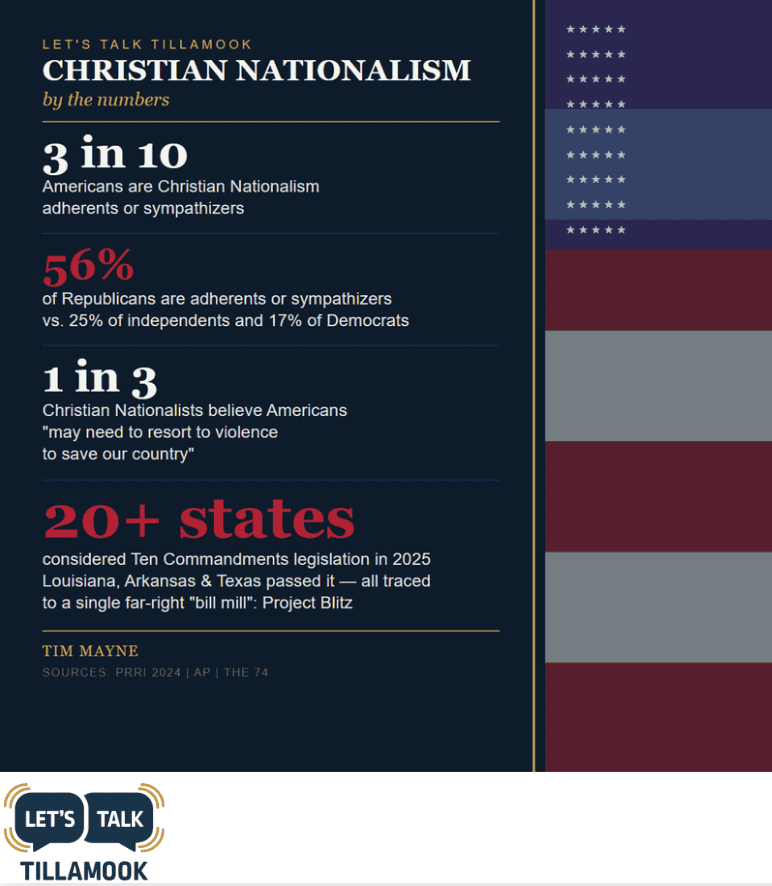
This Q&A is based on an interview by Shaena Peterson with Tim Mayne. Find the full interview on YouTube and Spotify on our Let’s Talk Tillamook channel.
Shaena: Christian nationalism is showing up in Congress, state legislatures, school boards, and pulpits. Tim Mayne, how did you come to speak out on Christian nationalism?
Tim: I have been a Seventh-day Adventist pastor for 42 years. Our church was founded on a strong belief in prophecy and support for separation of church and state. That’s changed over the last few years.
Shaena: Christian nationalism is criticized as using faith as a vehicle for authoritarian politics rather than genuine belief. What does this movement get wrong about Christian values?
Tim: Part of what I think they get wrong is the concept of the Kingdom of God — specifically, whether Christ wanted Christians to establish a kingdom here on earth.
In 1975, a couple men began planning society’s Christian transformation. Lance Wallnau developed the concept of seven mountains: religion, family, education, government, media and the arts, science and technology, and business. The devil exists at the top of these mountains. Through spiritual warfare and practical application, Christians would climb these mountains and take authority over these aspects.
But we divorce the Kingdom of God and replace it with the kingdom of men. Christ clearly said, “My kingdom is not of this world.” In his book Generous Justice, Timothy Keller called the “quadrant of vulnerability” the groups of people Christ was concerned with: widows, orphans, the poor, the foreigner. Today, that includes refugees and immigrants. Today’s new
lepers would be the LGBT community. The Old Testament has a “don’t touch” command because of disease, but in the New Testament Christ touched lepers.
The problem now is this grasping for power through fear and violence. True Christianity has only one weapon: love. When love becomes the motivating factor rather than power, it changes what it means to be a Christian.
Shaena: The military frames conflict with Iran as a holy war, and Christian nationalist language shows up in federal policy. How dangerous is that?
Tim: This is a direct assault on secular society, framed as a holy war. The biblical understanding among some is that we must support Israel as a nation. Not for the sake of the Israelis but to fulfill a misinterpretation of biblical prophecy about end-time events: that Israel must come back into power.
We were told that Project 2025 had nothing to do with the current president, but he installed Russell Vought, the main architect of 2025. Our current administration hides behind Christian nationalism.
I want the ability to be a Christian. But I also want you to have your American freedom to believe whatever you want. That is where I believe there is danger.
Shaena: How do people recognize when a message has crossed from faith-informed into Christian nationalist territory?
Tim: One tactic of Christian nationalism is to adapt the language to the audience. If you are a charismatic Christian, they are far more direct. If you’re a more liberal American Christian, they adjust accordingly.
Key phrases to watch for: traditional marriage, anti-abortion, and the concept of America as a Christian nation in its founding. That signals you are dealing with something deeper than general American politics. Behind “traditional marriage” is the anti-LGBT agenda. At the local level are the trans sports debate and banning books.
My position is if you believe in traditional marriage, then have a traditional marriage. If you don’t believe in divorce, don’t get one. If you don’t want an
abortion, don’t have one. America was founded on compromise, that we can all find a way to get along with each other. You hold to your beliefs, I hold to mine, and we can still be good neighbors.
