


EDITOR’S NOTE: They’re back!! David and Susan Greenberg return to our pages with a wonderful review about the new guest chef at Local Ocean, who will be opening a new restaurant in Tillamook County next year. Read on for more about the delectable dishes at Local Ocean and Chef Jacob Harth’s upcoming Tillamook County venture.
By David & Susan Greenberg
The Strange Inversion of the Oregon Coast
It’s maddening. 90% of Oregon seafood is exported. 90% of the seafood Oregonians eat is imported. How can that happen in a state with 363 miles of coastline?
What’s more, most (not all) Oregon seafood restaurants are content to sling standard dishes. Standard dishes – say, fish and chips or steamed clams – can be outstanding but that leaves an entire realm of culinary possibility left unexplored. The tendency is especially pronounced on the coast, where many restaurants cater to tourists seeking familiar comfort food.
To top this, speaking in generalities, our seafood restaurants get their food mainly from Sysco, many steps removed from the sea. So, their range of seafood is predictably limited: salmon, halibut, cod, rockfish, clams, oysters, shrimp (mainly from shrimp farms in Asia), crab. This may seem like a lot, but it is a scintilla of what’s available.
Bonnie Tyler’s anthem, Holding Out for a Hero, comes to mind. We need a hero chef to counteract this culinary torpor.
Enter the Hero
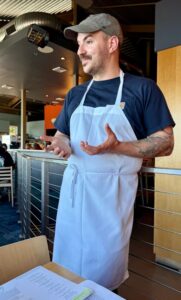
Behold: Chef Jacob Harth, Local Ocean Seafoods, Newport.
After cooking in Michelin-starred kitchens, he arrived at Local Ocean in May 2026, championing overlooked species that most chefs ignore.
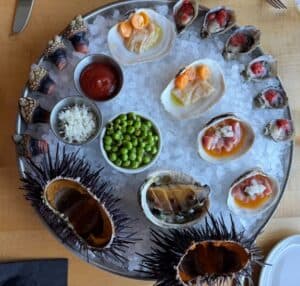 His iced seafood platter illustrates the point: a collection of local (or nearly local) seafoods that rarely, if ever, appear on Oregon menus.
- Uni: Never get in a bar fight with a sea-urchin, a living medieval mace. It sits on the ice, shorn open, its precious, custardy uni there to be scooped.
- Abalone: Actually a sea snail, illegal to pick wild, this is grown on an abalone farm in Monterey. Mild, sweet, and slightly briny, with a firm yet tender texture.
- Geoduck: Raised on a farm in Washington, it’s served raw in a citrusy sauce, much like Peruvian Tiger Milk. Infused with makrut lime leaf oil, it is adorned with split husk cherries. Amazing.
- Barnacles: Harvesting them from churning waters is dangerous. Chef Harth pries them from the Barview Jetty in Tillamook Bay at night (when tides are usually lowest) with a heavy knife while wearing a wetsuit. Related to lobster, he steams the meat which is slightly sweet. We dipped it in cocktail sauce and then flakes of horseradish. We swooned.
- Pink Scallops: These are not imported but plucked from the ocean and served raw atop a savory custard made with clam juice. Grilled fresh peas on top. Risking redundancy, awesome!
- Oysters: With salmonberry ice, salmonberries picked by Chef Harth. Redundancy unavoidable, extraordinary.
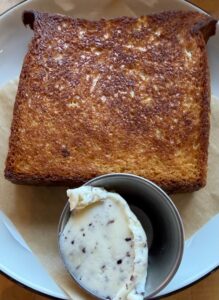
All of this was served with toasted brioche (made by Chef Harth’s wife) and seaweed butter
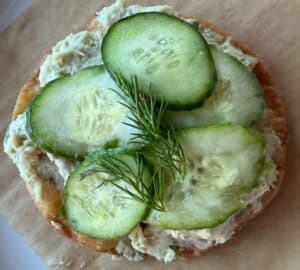 A fresh tuna tostada tasted like a tuna sandwich evolved to its point of perfection.
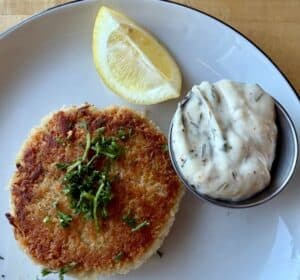 Crab cakes tasted crabesque, not crabby, which we attribute to an overload of bread crumbs. A grilled artichoke was undercooked although we enjoyed its Béarnaise sauce. But these are quibbles.
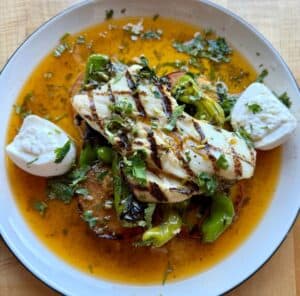 Halibut and Cornflakes
A halibut filet, handsomely cross-hatched with grill marks, was served with grilled peaches (likewise cross-hatched) and shishito peppers in a balsamic vinaigrette which picked up the peach juice. There were two hemispheres of burrata. Why? Because burrata enhances everything, even cornflakes. It may well have been the finest halibut dish we’ve ever eaten.
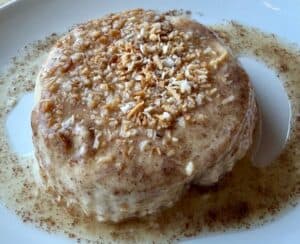
Our low expectations for dessert were upended by their sheer excellence: A cinnamon-nutmeg flan in rum sauce and a strawberry-rhubarb parfait electrified by makrut lime and a spritz of olive oil.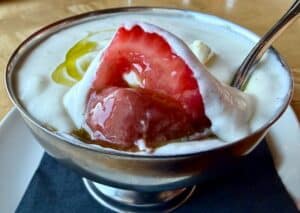
We drank, respectively, a hazy IPA (ideal beer for seafood) and an aromatic white blend, Silas Wines 2024 SBS Blanc from Chehalem Mountains, Oregon.
Tillamook’s Impending Culinary Revolution
Next year Chef Harth is opening his own restaurant, Bayocean Oyster House, just outside Tillamook, Oregon, in a former oyster processing plant cantilevered over the water. Among the fish he’ll serve there will be mackerel which run with – or more accurately, from – the tuna. He’ll also make a point of serving invasive species – deleting them by eating them – including green crab.
Tillamook is about to inherit a culinary revolutionary. Until then, Newport offers a glimpse of what Oregon seafood could become when a chef starts with the ocean instead of the distributor’s catalog.
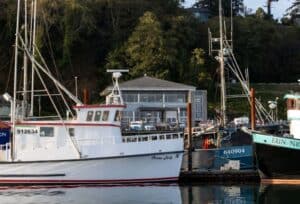 Local Ocean Seafoods
213 SE Bay Blvd, Newport
