










By Jim Heffernan
Here are a pair of new books that talk about Artificial Intelligence (AI) from slightly different perspectives. 63 years ago, (ouch), Bob Dylan told us “don’t speak too soon, the wheel’s still in spin.” AI has been around longer than we think, but it’s still very new and could go either way.
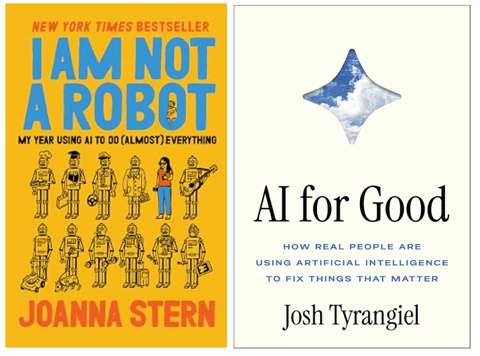
Joanna Stern spent a decade as technology editor for the Wall Street Journal before she wrote her book, I Am Not a Robot: My Year Using AI to Do (Almost) Everything. She attempts to use AI for everything she does in her life. Usually it works pretty well, until it doesn’t. She didn’t use AI to write her book, but she did use for editing and found it useful. I liked her style of writing and enjoyed her book.
Here’s an extract from page 183 that summarizes her conclusions, “That’s why entry-level workers like Tribbitt are right to worry—and not just about journalism, or customer service, or any industry already under pressure. If the next generation never gets those early experiences—never learns how to dig, to listen, to react to the unexpected—then we’re not just automating jobs. We’re hollowing out the pipeline of people who could shape what comes next. Hand that over to machines, and what’s left isn’t a career. It’s a system, running without us.”
Josh Tyrangiel is a journalist who worked for Bloomberg business before writing his book, AI for Good: How Real People Are Using Artificial Intelligence to Fix Things That Matter. He focuses on several large applications that are working now. He starts with Palantir and its role in the “Operation Warp Speed” program that developed the Covid vaccine. He proceeds to talk about the way AI is changing medicine and education. He focuses more on the development/developers of AI systems and takes a deeper, less personal view of the subject. I found his book very enjoyable.
Here are a couple of excerpts from his book, from page 6, “Artificial intelligence doesn’t refer to one thing, but a constellation of overlapping techniques and capabilities. Some AI systems are predictive, trained to forecast behavior from patterns they recognize in data. Others are classifiers, labeling images, sorting email, flagging tumors on an MRI. Optimizers make split-second decisions to improve logistics, pricing, marketing, or financial bets. Looming further out is artificial general intelligence – a (theoretical) synthesis of these powers that might one day (theoretically) surpass human intellect in every domain.”
And from page 241, “Most importantly, stay close to Team Human. This means supporting AI that amplifies human judgment, not replaces it. A teacher using AI to customize lessons for thirty different students is different from a company using AI to eliminate teachers. A doctor using AI to spot patterns in scans is different from an insurance company using AI to deny claims. Support the former. Be vigilant about the latter. The question isn’t whether AI is involved in our daily lives—its utility is undeniable, and the regular improvements are worthy of awe. The question is who it’s empowering.”
Both books were published in May of 2026 and both books are about 300 pages. Both books are available at Cloud and Leaf Bookstore, Manzanita and at Tillamook County Library.
As always, discussion welcome at codger817@gmail.com
