











“On balance, Americans would be better off if they understood themselves, their nation, and their nation’s history better.” – Robert Kagan, author of “Dangerous Nation”
By Marc C. Johnson
Conservatives have long employed “dog whistle” rhetoric to drive home controversial language about race and class and history. Saying the silent part out loud – that federal laws banning discrimination in housing, employment and voting amount to government overreach or coddling minorities – has, until recently, generally been avoided lest the person uttering the sentiment be labeled a bigot or a racist.
Instead of blatant pro-discrimination language conservative politicians needed to use code words to convey the message, or even better coded images that subtly but still unmistakably sent a racial message. ¹
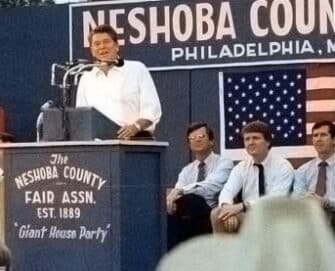
As the Mississippi Encyclopedia notes about one such memorable moment:
On 2 August 1980, with the presidential election heating up, [Ronald] Reagan arrived at the Neshoba County Fair near Philadelphia, (Mississippoi) where thirty thousand cheering people greeted him. His speech for the most part offered standard campaign rhetoric, but he generated a national political firestorm when he announced, “I believe in states’ rights.” Though Reagan had spoken those words for decades and had in fact used them in Mississippi two years earlier, they resonated differently in Neshoba County, where civil rights workers Michael Schwerner, James Chaney, and Andrew Goodman had been murdered during the Freedom Summer just sixteen years earlier. Since the Neshoba visit was the first campaign appearance after the Republican National Convention (though not the official launch of the campaign), the appearance at the fair continues to possess a contested place in Reagan historiography.
The dog whistles are coming from the White House and the Court
A lot of ink has been spilled around the question of whether the once-sainted Reagan was dog whistling to conservative white Southern voters who had voted in large numbers in 1976 for a fellow southerner, Georgian Jimmy Carter.
It’s easy to forget today that Carter won every state in the old Confederacy with the exception of Virginia in defeating Gerald Ford in 1976. That sentence is a measure of how much American politics has changed in the last 50 years.
There really is little doubt, I think, that Reagan was, rather deftly, playing the race card with his talk of “states’ rights.” The former California governor had opposed the Civil Rights Act in 1964 and his political brain trust knew the newly christened Sunbelt represented his path to the White House.
As Rick Perlstein, the great historian of the evolution of the American conservative movement from Dwight Eisenhower to Reagan, has written about Reagan and his use of “states’ rights” at that Mississippi county fair in 1980:
These are the most reliable code words Southern demagogues could deploy to activate their audiences’ most feral rage against African American civil rights. Ronald Reagan, whose unshakable belief in his own purity of motivation was his defining trait, surely got to immediate work persuading himself that in uttering them, he was referring to all federal intrusion into local affairs, from the Occupational Safety and Health Administration to the Department of Ed – the same thing he always excoriated.
Reagan’s most recent biographer, and in my opinion the best and most evenhanded of many who have written about him, is Max Boot. In his outstanding book – Reagan: His Life and Legend – Boot says:
… ever since Reagan’s first campaign in 1966, he had repeatedly used code words such as “jungle paths” and “welfare queens” while constantly denouncing civil rights legislation. In 1980, Reagan added loaded new terms to his lexicon – not only “states’ rights” but also “The War Between the States,” the preferred term for the Civil War among partisans of the Lost Cause, which he used in the South. He told a reporter in 1980 that the Voting Rights Act had been “humiliating to the South.”
I recount this history to make a point that is too often overlooked in contemporary political reporting, and particularly in the reporting of the mad rush now underway to reapportion state legislative and congressional districts in a half dozen southern states. This opportunity, presented to conservative state legislatures thanks to extraordinarily partisan decisions by an ultra-conservative Supreme Court, highlights that race politics, or perhaps more correctly resentment politics centered on race, has been at the heart of American conservatism for generations.
In this context it perhaps shouldn’t be a huge surprise that the John Roberts Supreme Court, the most conservative Court since the 1930’s, has destroyed the Voting Rights Act and effectively declared open season on “majority minority” districts across the South.
This Court is following through on a long-term project to demolish what Reagan’s rhetoric, or Barry Goldwater’s or George H.W. Bush’s never could – remove civil and voting rights as an effective tool to battle discrimination. ²
From Reagan to Trump
Ronald Reagan was considerably more measured in deploying the coded language of race than the current occupant of the White House, but the target for the rhetoric of each man has always been the same – white, mostly rural, disaffected Americans who never have, and perhaps never will, accept that the United States is a multi-racial democracy.
Donald Trump and much of the modern Republican Party has junked the “dog whistle” for much more direct and blatant language.
Trump has repeatedly referred to Black members of Congress, including House minority leader Hakeem Jeffries, as “low IQ individuals,” he’s labeled African nations “shit hole countries” and regularly attacks a Black female ABC New White House correspondent.
“Such a stupid question that you asked,” [Trump] said, addressing Scott directly. “We’re fixing up the reflecting pond to the Lincoln Memorial, the Washington Monument, and you say, ‘Why are you fixing anything up?’ Because you can understand dirt, maybe better than I can, but I don’t allow it.”
“This is one of the worst reporters,” he added, turning to a group of construction workers who had accompanied him. “She’s with ABC fake news, and she’s a horror show … a question like that is a disgrace to our country.”
As far as I can tell no so called mainstream media organization has written about Trump’s attacks on journalist Rachel Scott, but in Trump World we kid ourselves if we believe for a second the president isn’t focused on Scott’s race.
In fact, the White House wanted the exchange detailed above to be widely seen, highlighting it in a social media post.
As thuggish and bigoted as Trump’s language about race has always been, it has not been remotely repugnant enough to disqualify him among his most ardent fans. It’s impossible not to conclude that what is in the man’s heart is also in theirs.
 |
Ronald Reagan during his presidency with a young John Roberts, then a lawyer at the Reagan Justice Department where he argued against reauthorizing the Voting Rights Act
John Roberts mission
Which makes the disastrous bigotry of the conservative Supreme Court helmed by John Roberts all the more harmful to American democracy. Donald Trump, much as he might have liked to, could not destroy the Voting Rights Act. His Supreme Court has.
Even before the final dagger in the heart of the law that sought to bring Blacks, Latinos, Native Americans and other minorities into the mainstream of American political life, Roberts had been on a decades-long crusade, whether he would ever admit it or not, to deny the essential truth of voting being at the very heart of a multi-racial America.
Here’s Pema Levy and Ari Berman earlier this year in Mother Jones:
Democracies are built on the right to vote and choose representatives. The United States finally recognized this right for all people with the Voting Rights Act of 1965. But over the last five decades, Roberts has taken aim at the law, beginning as a young lawyer in President Ronald Reagan’s Justice Department fighting its reauthorization, when he claimed it would “lead to a quota system in all areas.” He lost that skirmish when Congress overwhelmingly voted to strengthen the VRA in 1982, but he won the larger battle decades later as chief justice, helping craft a string of rulings kneecapping the law, starting with his 2013 opinion in Shelby County v. Holder. The decision overruled Congress and freed states with histories of discrimination to change their voting rules, spurring the creation of 115 voter suppression laws in more than 30 states. Many were inspired by Trump’s election lies.
In 2019, Roberts toppled another pillar of democratic governance—if you don’t like a politician, you can vote them out—by writing in Rucho v. Common Causethat federal judges could not even review claims of partisan gerrymandering, deeming them “political questions beyond the reach of the federal courts.” In the decision, Roberts pinkie-swore that courts could still block “racial discrimination in districting,” but now the Supreme Court is on the verge of making that nearly impossible. After October’s oral arguments in a Louisiana redistricting case, observers expect Roberts and the GOP justices to declare that districts drawn to preserve representation for voters of color are either unconstitutional or subject to insurmountable barriers. It’s a decision that would turn the 14th and 15th Amendments—passed under Reconstruction to give formerly enslaved people citizenship and equal rights—on their heads, and turbocharge Trump’s gerrymandering push. Such redrawn maps could shift up to 19 seats to the GOP in 2026 and “really runs the threat of just creating permanent GOP control of Congress,” Doerfler warns.
All that was predicted – dismantling Black represented districts and wholesale partisan gerrymandering – before the Court’s recent decision in Louisiana v. Callais.
Now it has finally come to pass.
Chief Justice Roberts has cultivated a much more sophisticated, scholarly approach to white supremacy than a Strom Thurmond, a George Wallace or a Jesse Helms ever did but Roberts has been vastly more successful that those white supremacists. That much of the press continues to portray Roberts as a conventional conservative, as he famously said “calling balls and strikes” on the Court is not only incorrect, but hideously so.
Ask yourself who beyond Roberts has exercised more effective power in the decades-long conservative mission to destroy equality for minority voters?
Put it bluntly: Under the pernicious guise of protecting democratic institutions and granting deference to state legislatures, Roberts – along with five other ultra-conservative justices – has used his version of the Constitution to weaken American democracy. His Court has become nothing less than a blatantly partisan extension of the American ultra-right political movement.
Roberts’ legacy will be as shameful as that of Chief Justice Roger Taney before the Civil War, and certainly just as damaging to the ultimate moral and Constitutional necessity of empowering minority citizens in a multi-racial democracy. ³
The dizzying speed with which this Supreme Court inspired trashing of minority rights it is playing out is simply stunning.
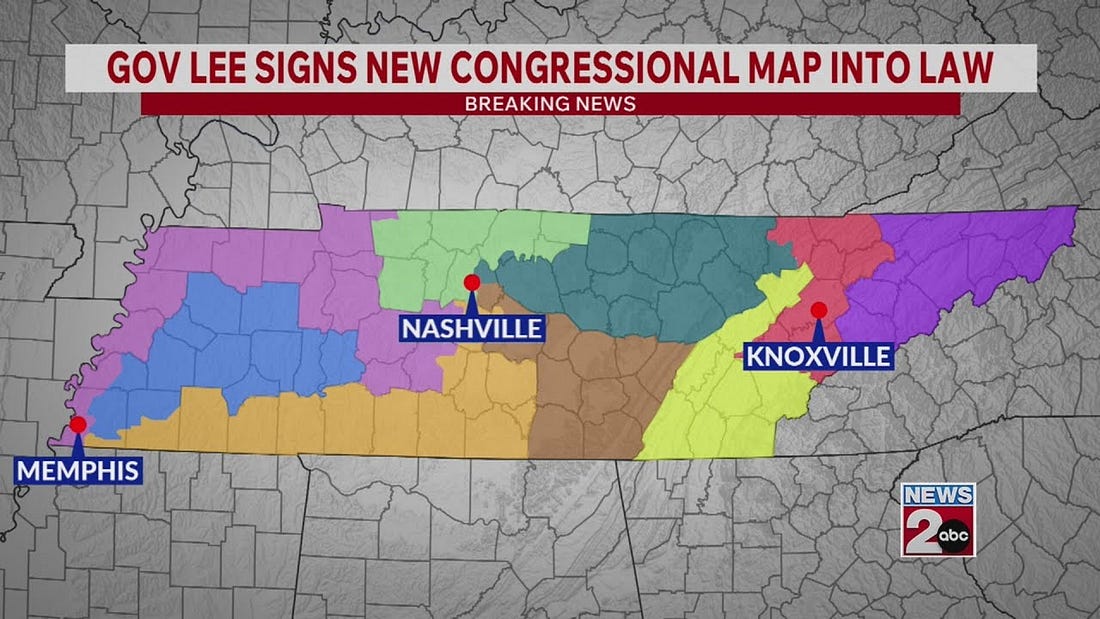 |
The new Tennessee map slices majority Black Memphis into three separate districts that stretch miles into rural western Tennessee
Tennessee
In Tennessee the Republican legislature’s super majority last week wildly gerrymandered the majority Black city of Memphis, demolishing the only congressional district in the state represented by a Democrat. And all of this is happening just three months before a primary election.
As the New York Timesreported:
Democrats, noting that about two-thirds of Memphis voters are Black, said it was a blatant attack on hard-won gains for fair representation in a state shaped by slavery, segregation and the civil rights movement.
“Perhaps the legislature should explain why Memphis should continue to be part of the state of Tennessee,” said State Representative Antonio Parkinson, a Memphis Democrat. He suggested that the city should break away from the state.
“You’re constantly beating on us,” he said. “Allow us out.”
Louisiana
Much the same in Louisiana as my friend Bob Mann wrote on Substack:
So here we are again, watching another round of racial gerrymandering dressed up in the usual Louisiana political costume jewelry: “election integrity,” “traditional districts,” “communities of interest,” and whatever other phrases they workshop between campaign checks from petrochemical executives and private prison lobbyists.
The whole thing would almost be funny if it weren’t so grotesque.
Then, Republican state Sen. Jay Morris of West Monroe decided Louisiana politics needed a little extra seasoning from the Jim Crow pantry.
At a legislative hearing on redistricting, Morris turned toward the audience and snapped at the Black executive director of the Louisiana Democratic Party: “Shut up, boy.”
Boy.
Not “sir.” Not “please be quiet.” Not even the standard legislative “the gentleman is out of order.”
Just “boy.”
In Louisiana. At the state Capitol. To a Black man. In 2026.
Louisiana Republicans are, as Bob wrote, now the party of “shut up, boy.”
Alabama
And Brian Lyman wrote in The Alabama Reflector:
It’s spring in Alabama. But it’s winter for democracy.
And we are left facing some cold truths. We do not live under the clear dictates of the U.S. Constitution. The only laws are the vindictive whims of the U.S. Supreme Court.
We thought we were rebuilding, however haltingly and imperfectly, the multiracial regime lost after Reconstruction. But Alabama is still Alabama. And self-serving, self-justifying power is the state’s only civic virtue.
Reconstruction Ends Again
The First Reconstruction ended in 1877, when thanks to a corrupt bargain, national Republicans got the White House in exchange for withdrawing the last federal troops remaining in the South after the Civil War.
White Southerns, mostly Democrats after the Civil War, pledged to President Rutherford B. Hayes that they would respect Black voting and civil rights, but that didn’t happen.
As the Miller Center says:
… white southerners quickly turned their backs on their pledges, systematically disenfranchising black voters through poll taxes, literacy tests, and intimidation. Democrats in the South created a segregated society that used terror and violence to oppress African Americans.
The era of Jim Crow was ushered in and remained the mostly uncontested law of most of the land for nearly a century, flourishing alongside the Klan, segregation and rejection of a multi-racial America.
The Second Reconstruction came with the protests of the 1950’s and 1960’s that helped produce the Civil Rights and Voting Rights Acts in 1964 and 1965.
People died fighting for the simple right to vote.
The foundation of that Second Reconstruction was shattered with the Roberts Court’s Shelby County decision in 2013, and the foundation gave away entirely with the Callais decision on April 29, 2026.
We should remember that the Supreme Court once unanimously ended racial segregation in public schools and the Justice Department once sent government officials to the South to register Black voters and often went to Court to defend the right to vote.
Today, dominated by ultra-conservatives determined to erase American history, the highest court in the land and the Justice Department – created by Republican Ulysses S. Grant in the midst of the First Reconstruction – have switched sides.
Truly “the only laws are the vindictive whims of the U.S. Supreme Court,” and what passes for fairness comes from a feckless Justice Department that takes its orders from a doddering bigot intent on retribution against his “enemies.”
Defending a multi-racial democracy
We are very much back to a pre-civil rights moment, with White southerners disenfranchising Black voters primarily, despite what they say, because they crave political power more than they value a representative, multi-racial democracy.
We come full circle.
Those white legislators in Tennessee, Louisiana, Alabama and elsewhere profess lofty motives in defense of their privileged majority. They would (almost) never betray, publicly at least, the old racial stereotypes like calling a Black adult male a “boy.” They might mumble “states’ rights” to a partisan crowd, but would take great exception to being called a bigot or a racist, even as they warmly embrace the most openly racist president since Woodrow Wilson. ⁴
This is a long, long story, and we are living in the most recent chapter.
In many ways race and politics and resistance is the essential story of the United States.
I’ll leave you with this.
“Race played a role in every election,” Stu Stevens, one of Ronald Reagan’s most insightful and acerbic aides once said. When Reagan said, “states’ rights” that told the guy in Mississippi or Alabama that we can take care of the n_____.”
As Max Boot writes in his Reagan biography, Reagan, the candidate, had been warned, by among others, his pollster that using the coded language of “states’ rights” would be problematic, especially in a state still raw from civil rights protests and murders.
The language might not register well with suburban white voters, Reagan was told, “but Reagan did not care. This was the dark side of his pragmatism: He was willing to tap into dangerous and disreputable prejudices to win the presidency while insisting to everyone, even himself, that his intentions were pure.”
Sounds familiar, doesn’t it?
As a country, directed from the marble halls of the Supreme Court and shaped by generations of conservative political actors tapping into dangerous and disreputable prejudices, we have taken another profoundly backward step.
Now we will see wholesale partisan and racial gerrymandering, denial of minority representation, and at every level of our politics the hate filled language of bigotry and resentment.
Some will argue “this is not who we are,” but it is what we have allowed to happen.
Reconstruction has ended again. What kind of country comes next?
NOTES:
1 – Republican political consultant Lee Atwater – he advised both Reagan and George H.W. Bush – candidly explained the code word strategy in a 1981 interview that only came fully to light in 2012. “You start out in 1954 by saying, ‘Nigger, nigger, nigger,’” Atwater said. “By 1968 you can’t say ‘nigger’ — that hurts you, backfires. So you say stuff like, uh, forced busing, states’ rights, and all that stuff, and you’re getting so abstract. Now, you’re talking about cutting taxes, and all these things you’re talking about are totally economic things and a byproduct of them is, blacks get hurt worse than whites.… ‘We want to cut this,’ is much more abstract than even the busing thing, uh, and a hell of a lot more abstract than ‘Nigger, nigger.’”
2 – Goldwater, of course, opposed the Civil Rights Act in 1964, saying it was unconstitutional. Most members of his party in Congress supported the act, but he won the GOP nomination not despite, but because of his opposition. Bush the elder’s infamous embrace of a Black Willie Horton, a convicted murderer, was as perhaps the most effective coded racial image ever used in modern presidential politics.
3 – Roger Taney authored the notorious Dred Scott decision in 1857 that “stated that enslaved people were not citizens of the United States and, therefore, could not expect any protection from the federal government or the courts.” Abraham Lincoln criticized the decision and made his opposition a central argument in his 1860 campaign for the White House. Lincoln and Taney later clashed over the chief justice’s interpretation of Lincoln’s suspension of habeas corpus. The Scott decision has defined Taney’s legacy. I suspect Roberts’ legacy will be defined by his opposition to voting rights legislation.
It’s difficult to be an optimist in today’s world and I’m not all that optimistic, but I do focus on realism and try to populate my writing with solid sourcing and not merely opinion. I write these pieces to offer a perspective based on history and particularly American political history since 1900.
These essays are free, but a financial contribution helps support my writing and research, including a new book in progress.
Subscribe to Marc’s Substack for $8 a month or make a pledge.
Many thanks.
 Subscribe