


“I am glad to see the Trump Administration take a step toward acknowledging what Nevadans have known for years: Yucca Mountain is dead.” – Sen. Catherine Cortez Masto (D-Nevada)
By Marc C. Johnson
Perhaps it’s our ever shrinking attention spans or maybe there is just too much noise, chaos and controversy … every day.
For whatever reason the Trump Administration’s plan to remake American nuclear waste storage and disposal policy – read: Junk Yucca Mountain, the long identified site for the nation’s high level nuclear waste – has not, even in a minor way, broken into our news cycles.
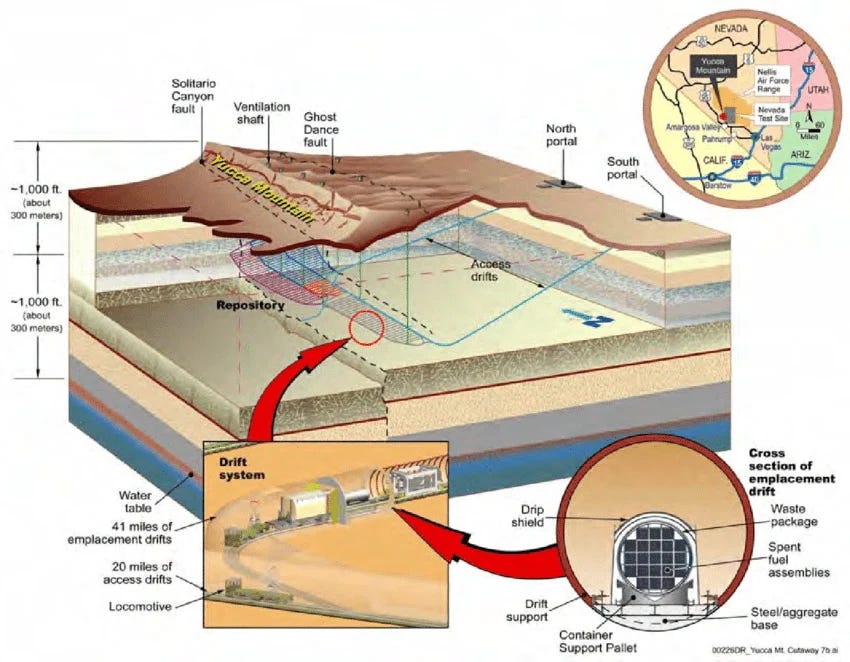 An illustration of the proposed Yucca Mountain high level waste disposal site in Nevada – illustration by Ryan Christopher Graydon
Like much else in Trump World the new nuclear waste policy just appeared in a leaked story in late July, an idea fully baked (or half baked) with Congress sidelined (or ignored).
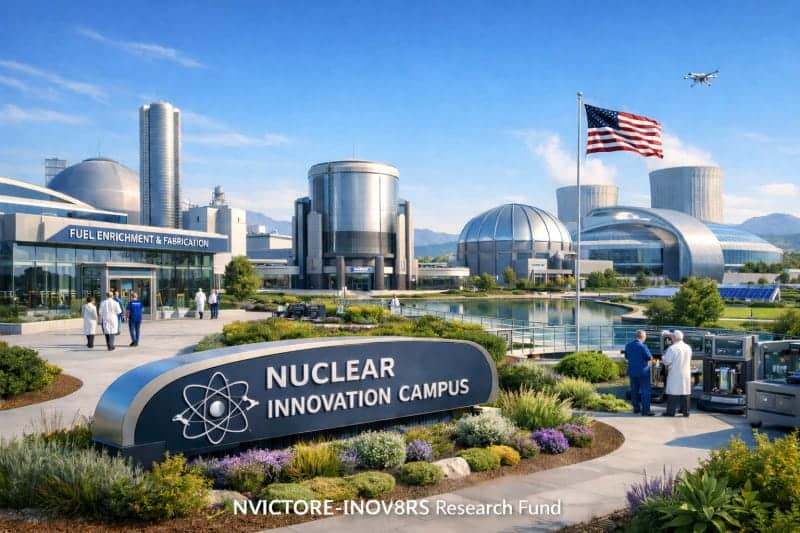
Then the administration with minimal hype – a strange method for this usually hyper-ventilating crowd – announced that five states are in a competition in which three “winners” get to create what the Department of Energy (DOE) calls Nuclear Lifecycle Innovation Campuses.
The image conjured was, as journalist Randy Stapilus noted, of a leafy, academic environment where big thoughts are pondered and huge scientific breakthroughs engineered.
The fine print in the Trump plan, as usual, held the real news.
In exchange for promises of big bucks in new investments (billions and billions) the three “winning” states would agree to take up to one-third of the nation’s stockpile of high level commercial nuclear waste.
I’ve been writing about Idaho being one of the five states in part because I’ve had something like a front row seat on the state’s decades long love-hate relationship with DOE. During most of those decades there was a strong bipartisan consensus that Idaho and its eastern Idaho DOE facility, the Idaho National Laboratory, would never become a designated waste site, even though the site has been “storing” waste “temporarily” since the beginning of the Cold War.
The other states in the running for the entirely dubious distinction of being the host site for around about 30,000 metric tons of spent nuclear reactor fuel are Utah, Tennessee, Oklahoma and Louisiana. You may notice something about those states. Answer to follow.
The Idaho case is particularly curious because of the state’s long history of opposing more waste coming in, as well as the fact that Idaho has a one-of-a-kind, legally binding agreement with DOE to remove waste and clean up problems that stretch back decades.
In order to be a “host” state Idaho would have to junk the solid legal and moral leverage it has against a federal agency that is, at its best, not always entirely on the candid side of its activities.
That Idaho is swimming in this pool is simply a striking reversal of policy led entirely by the state’s Republican governor and congressional delegation.
Why, one wonders, would even MAGA-allied Idaho Republicans take at face value a DOE promise in exchange for big train loads of nuclear waste?
Well, maybe the Idaho elites quietly pushing this scheme have very short memories.
Memories are much longer in Nevada.
The secrecy is very telling
Ten days ago, and after writing two columns about Idaho’s involvement in the new Trump nuclear waste plan, I sent a short email to Emily Callihan, the communications director for Idaho Republican Governor Brad Little.
I honestly didn’t expect an answer, but thought the inquiry benign enough that it just might prompt a response or even a no comment. Here’s what I asked Ms. Callihan, who I have known for a long time:
Could you let me know who is negotiating (or discussing with DOE) on behalf of the state the Host Agreement related to the Nuclear Lifestyle Campus project?
And what role is the attorney general or his staff playing in the discussions? Has Gov. Little discussed the Host Agreement with the attorney general?
Apparently, I’m going to wait for a long, long time for a response.
Just to underscore how objectively odd this whole “host” state business is I will note that the governor of Idaho, the state’s attorney general, the four members of the all GOP congressional delegation have said nothing publicly – zilch – about the proposed enormous policy shift they hope to be part of.
No interviews, no news releases, no op-ed pieces.
They are not even trying to sell the idea of becoming a Nuclear Lifecycle Innovation Campus, and a waste disposal site, to the state’s voters. ¹
One can only conclude these elected officials are trying to tamp down any real public knowledge of the plan before the end of September deadline Idaho has agreed to for finalization of it’s “Host Agreement” with DOE.
And, of course, the politicians almost certainly hope to keep all this imported nuclear waste from becoming an issue in the November election where the governor, attorney general, Senator James Risch and Congressman Mike Simpson are all seeking re-election.
So far the plan is working.
Now, about Nevada
In 2011 – a political lifetime ago – the Obama Administration drove a stake through the heart of the nation’s high level nuclear waste strategy when it refused to fund and then junked the licensing of Yucca Mountain.
Until Barack Obama and his Department of Energy (DOE) weighed in with a thumping veto, the nation’s strategy had been to develop a high level waste repository on public land in southwestern Nevada about 100 miles from Las Vegas. Sin City might have become the gateway not just to slot machines and lounge acts, but thousands of tons of commercially generated nuclear waste that then – and now – is stored at dozens of locations spread across the country.
There is a huge lesson in this not so ancient history for Idaho and four other states now volunteering to accept all that high level waste, the waste that Nevadans, particularly the late Senator Harry Reid, fought for years to keep out of the Silver State.
Reid, a devout Mormon who served two terms in the House and then the Senate from 1987 to 2017 where he became powerful on the Appropriations Committee and eventually majority leader, remains a reviled figure, even after his death, for many Republicans.
The wily, often underhanded, but deviously effective Nevada senator utilized all his cunning to deep six Yucca Mountain.
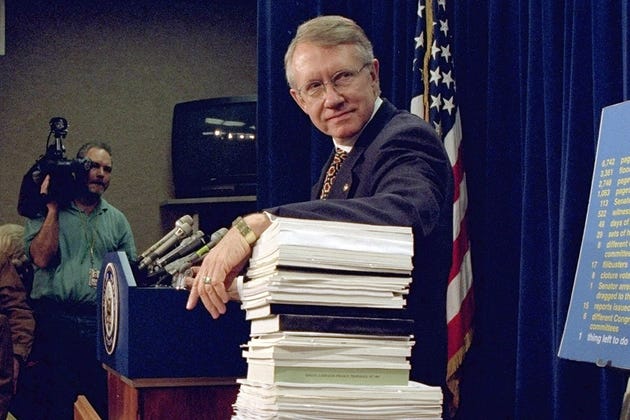 |
The late Nevada Senator Harry Reid
A large part of Reid’s extensive legacy is that he christened the bipartisan 2002 legislation designating Yucca Mountain the “screw Nevada bill,” and then he worked every lever of political power in Washington and Nevada to screw the rest of the country’s nuclear waste disposal plan.
When authorizing legislation for Yucca Mountain was approved by Congress – all members of the Idaho delegation voted to “screw Nevada” – it looked like the toxic zombie of commercial nuclear waste would finally end up tucked underground in a place out of sight and out of mind, in a state that rarely figured in national politics.
Yet, despite the federal government spending $50 billion studying and certifying the safety of the Nevada site it never happened. Politics, power and Harry Reid interceded. Nevada mattered.
Fast forward nearly 25 years and the Trump Administration has quietly walked away from any effort to revive Yucca Mountain opting instead for a five state lottery among deep red, profoundly conservative states that are apparently anxious to have what Reid fought like hell to prevent in Nevada.
In exchange for accepting up to one-third of the national stockpile of more than 90,000 metric tons of high level waste Idaho and four other states are being “promised” unimaginable economic benefits by the entirely transactional Trump Administration.
Were Idaho to win the lottery, Trump DOE’s says the state would see billions in economic benefits, thousands of new jobs and vast potential for data farms, university research and, given this administration, surely a Donald J. Trump Nuclear Research Center in Idaho Falls.
The only hitch: agree to accept all that waste, and in order to accept the waste, eagerly agree to shred the only real leverage Idaho has in dealing with a Department of Energy.
Idaho’s leverage is contained in Republican Governor Phil Batt’s 1995 Idaho Settlement Agreement. That agreement placed strict controls on waste storage in Idaho, imposed financial penalties on DOE and made the agreement subject to continuing federal court oversight. The Memorandum of Understanding (MOU) Governor Brad Little signed with DOE in July explicitly acknowledges that Idaho is ready to discard Batt’s legacy.
The Trump nuclear waste plan that Idaho is embracing has all the certainty of the latest Trump cease fire with Iran or his latest tariff threat. The deal being embraced is as solid at the 2020 election results being “rigged” in Georgia. When it comes to nuclear waste storage, Idaho and the other states are being asked to “trust” the administration of a president who bankrupt a casino, is a convicted felon and has an approval rating in the low 30 percent range.
What could possibly go wrong?
Here is one way this could play out for Idaho.
High level commercial nuclear waste is currently stored in 35 states, most of the 70 or so sites are adjacent to working or decommissioned nuclear power generating facilities. Most of these states and the electric utilities in these states are eager beyond measure to get rid of their waste. They must quietly be celebrating that Idaho, Utah, Oklahoma, Louisiana and Tennessee are effectively saying “bring it on.”
Consider at least two very important political facts
For the Trump Administration nuclear waste scheme to work as advertised, Congress will need to appropriate the billions envisioned to transform the Idaho desert or a Tennessee river bottom into a “Nuclear Lifecycle Innovation Campus.”
Those billions for states willing to accept nuclear waste will face massive competition from many directions, including unprecedented requests from the Defense Department to continue Trump’s war in the Middle East, as well as acquisition of new weapons and other material. New federal spending like that envisioned in the nuclear waste lottery will run headlong into the astronomical sums being spent on immigration enforcement, debt service on an expanding federal deficit and a few presidential vanity projects like a ballroom and a triumphal arch.
And there is this political reality: many of the states currently most invested in storing commercial waste are likely going to be genuinely happy to get rid of that waste but perhaps not so interested in bestowing billions of dollars on Idaho.
Take Illinois for example, the state with the largest amount of commercial waste, or Pennsylvania that ranks second or New York and California, all states with large stockpiles of waste that residents, politicians and utilities would love to see in, well, a place like Idaho.
Imagine a coalition of U.S. senators from these waste storing states banding together and deciding to pull a Harry Reid in reverse.
Senators from the 35 waste storing states – that’s 70 votes in the Senate – might just decide that they don’t even need to “screw Idaho” they can just point to the state’s eagerness to become a waste disposal site. They wouldn’t need to appropriate all the money needed for the promised economic goodies. They could just decree that those states will house the waste. ²
Idaho’s Republican leadership has signed on to a potentially massive bait and switch, predicated on promises from a federal agency and an administration that could end up shafting Idaho because, well, why not?
It’s certainly happened before.
If you think Mike Crapo and Jim Risch are up for this fight, DOE has some waste for you.
Harry Reid must be smiling.
It’s difficult to be an optimist in today’s world and I’m not all that optimistic, but I do focus on realism and try to populate my writing with solid sourcing and not merely opinion. I write these pieces to offer a perspective based on history and particularly American political history since 1900.
These essays are free, but a financial contribution helps support my writing and research, including a new book in progress.
Subscribe Here to Marc’s Substack for $8 a month or make a pledge.
Many thanks.
