











“We hold these truths to be self-evident, that all men are created equal … “
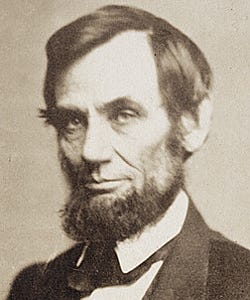
This is as good a day as any, and perhaps better than most, to remember and reflect upon what Abraham Lincoln said about his country and its Declaration of Independence.
“I have never had a feeling politically that did not spring from the sentiments embodied in the Declaration of Independence,” Lincoln told an impromptu crowd gathered at Independence Hall where the Declaration had been adopted on July 4, 1776.
“I have often pondered over the dangers which were incurred by the men who assembled here, and framed and adopted that Declaration of Independence. I have pondered over the toils that were endured by the officers and soldiers of the army who achieved that Independence. I have often inquired of myself, what great principle or idea it was that kept this Confederacy so long together. It was not the mere matter of the separation of the Colonies from the motherland; but that sentiment in the Declaration of Independence which gave liberty, not alone to the people of this country, but, I hope, to the world, for all future time. It was that which gave promise that in due time the weight would be lifted from the shoulders of all men. This is a sentiment embodied in the Declaration of Independence. Now, my friends, can this country be saved upon that basis?”
Lincoln was not sure that this country could be saved.
By the time he spoke in Philadelphia seven southern states had decided they would secede from the Union primarily because a northerner opposed to expanding slavery into American territories and future states had been elected president. These southerners said they were leaving, and risking a civil war, to preserve a southern way of life. But that was euphemistic language to dress up their real fear – that slavery was, sooner or later, coming to an end.
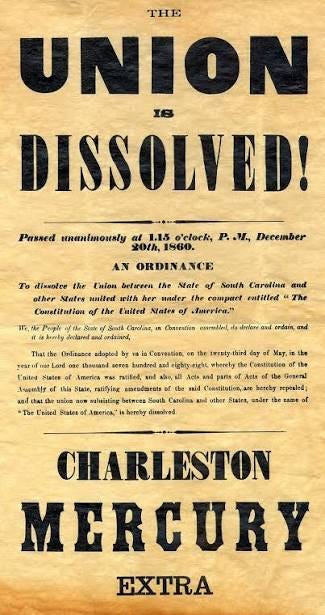 |
The first published notice of South Carolina’s ordinance of secession in 1861
These insurrectionists held a dim view of the Declaration’s commitment to equality and liberty for all, but they comfortably invoked “the Right of the People to alter or to abolish” a government that they found oppressive or simply not to their liking.
This is just one of the more obvious contradictions in the Declaration: is the commitment to equality the document’s important part or is the rejection of a government one finds objectionable the critical point? This question, as vital today perhaps as it was in 1776 or 1861, is at the center of a debate that has animated American politics since the beginning.
As the historian Robert Kagan has written:
“… large numbers of Americans have always rejected the founders’ claim that all men are created equal, with ‘unalienable” rights to life, liberty, and the pursuit of happiness, and they have persistently struggled against the imposition of those liberal values on their lives.”
These Americans, Kagan says, desire to:
“preserve a white, Christian supremacy, contrary to the founders’ vision, and they have tolerated the founders’ liberalism, and the workings of a democratic system, only when it has not undermined that cause. When it has, they have repeatedly rebelled against it.”
Our Civil War was fought over this fundamental question.
The Ku Klux Klan made us reckon with it repeatedly. Those who opposed the Civil Rights and Voting Rights Acts in the 1960’s were rebelling against the founders’ notions of liberty and equality.
An American president today targets Blacks, immigrants and asylum seekers from what he calls “shit hole” countries, while playing off easily exploited fears of “other” people with a different skin color, a different sexual orientation or a language or a religion we don’t understand and therefore dislike.
Many of these Americans, like the Americans of Lincoln’s time who yearned for a dissolved union even if it meant war against their fellow countrymen, seem to have given up on democracy, the very idea that the Great Emancipator celebrated in his rightfully famous Gettysburg Address in 1863.
Most of us remember how that short speech began:
“Four score and seven years ago our fathers brought forth on this continent, a new nation, conceived in liberty, and dedicated to the proposition that all men are created equal.”
Lincoln, properly in my view, saw our Declaration as the foundational, aspirational expression of a new nation fashioned around radical, revolutionary ideals. The Constitution by contrast, while creating a brilliant political structure, was crafted around awkward compromises and expedient tradeoffs that continue to befuddle us today.
The Constitution, as we saw again this week before the Supreme Court, is also a profoundly political document originally designed to placate those Americans who fundamentally rejected the liberalism of the Declaration.
Little wonder we still argue about these founding documents, in part because we have never permanently resolved the contradictions they contain.
Does being an American really mean we endorse equal rights and the many benefits of democracy for every person? Or does being a citizen mean we can pick and choose from a buffet of beliefs that best suit us, favor our ethnicity and religion and confirm our biases about fellow humans who are “different?”
The enduring importance of our 250 year old document is contained in its aspirations, as radical in July of 1776 as they are today. It doesn’t grant any rights, but it promises a system – a way of thinking about a diverse democratic nation – that is based on equality and liberty.
But the Declaration, as Lincoln knew in 1863, was only as good as the citizens who embraced the difficult work, requiring individual commitment and restraint, of building and sustaining a democracy.
In their time the founders knew that no democracy had ever lasted very long, and certainly never for 250 years, and they would likely not be surprised that we’re still struggling with what it means to be an American, living and participating in a complicated democracy, not always – or perhaps ever – working perfectly.
By invoking the promise of the Declaration after the bloody battle at Gettysburg, Lincoln expressed his hope that those who died defending their democracy had not died in vain, and that “this nation, under God, shall have a new birth of freedom – and that government of the people, by the people, for the people, shall not perish from the earth.”
Would that all Americans embrace that notion in our troubled, divided 250th year.
We live with the reality that many of us don’t.
About me: I am a Nebraska native, grew up in South Dakota and migrated in Idaho after college to work in broadcast journalism. In 1986, I joined the “comeback” campaign of a legendary Idaho political figure – Cecil D. Andrus – who eventually served four terms as governor and four years as Secretary of the Interior, not bad for a Democrat in a very conservative state. I had a small role in helping Cece Andrus win his last two gubernatorial terms. I did communication and crisis consulting work, and since “retiring” to the beautiful north coast of Oregon have written three books on U.S. Senate history. I’m working on a new book on another legend – this one a legend in journalism.
You can find my books here:
I write this Substack to scratch my itch to connect history with current politics. I hope, in some small way, to contribute to understanding of this perilous moment for our democracy, for free speech and facts.
