






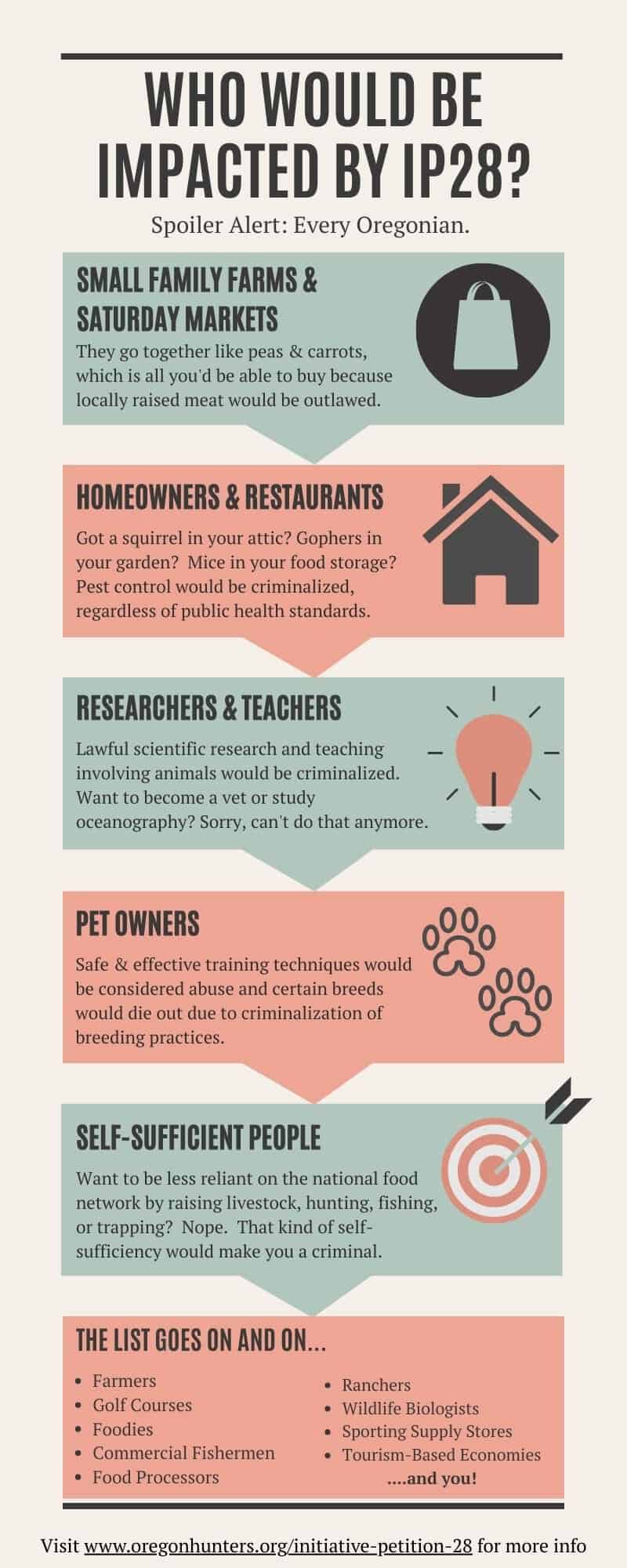
EDITOR’S NOTE: Oregon Initiative Petition 28 — officially titled the PEACE Act (People for Elimination of Animal Cruelty Exemptions) — would eliminate the legal exemptions that currently protect hunting, fishing, trapping, and farming from Oregon’s animal abuse statutes (ORS 167.315–167.333). Under current Oregon law, these activities are explicitly exempted from criminal animal abuse charges. IP28 would remove those exemptions entirely, making all of the following criminal acts under state law:
Yes, they’ve gathered enough signatures, but starting next the signature verification process begins to determin if IP-28 will qualify for the ballot. Here’s an update from the Oregon Secretary of State’s office and Oregon Hunters Assocation about the status of the signature collection for IP-28: Initiative Petition 28 (IP28), also known as the PEACE Act, has submitted over 138,000 raw signatures to the Oregon Secretary of State’s office. To qualify for the November 2026 ballot, the campaign must collect 117,173 valid signatures by the July 2, 2026 deadline
- Required Threshold: 117,173 valid signatures.
- Signatures Submitted: Over 138,335 total raw signatures
By Don Backman
The real danger of measures like IP-28 is they draw attention and make extreme ideas become mainstream ideas, and over time change public perceptions. The idea is that by chipping away, laws get passed, laws get changed. The public accepts things they wouldn’t have accepted when it all began. Eventually, something like IP-28 will become law. It isn’t expected to pass, the author even admits that, but they consider it a victory to see it on the ballot.
We have already discussed the economic impacts in a previous article. Now, we can look at the impact on wildlife.
One of the arguments in favor of IP-28 could be summed up as, “So, IP-28 will damage Oregon’s economy, but it is worth it because it protects Oregon’s wildlife.”
That argument is wrong, IP-28 and any similar measures would devastate Oregon’s wildlife.
“How would that happen?” one might ask. “Don’t hunters kill animals?”
The answer is that since the early 1900’s, hunters have been the ones paying for and advocating for protecting wildlife habitat and ensuring that sizeable populations exist –called huntable populations — which simply means there are enough game animals that the excess can be harvested and the funds raised by that can then be utilized to manage and help protect wildlife. These efforts have created the legal framework that we have today.
According to the Association of Fish and Wildlife Agencies, “the North American Model of Wildlife Conservation is the world’s most successful system of policies and laws to restore and safeguard fish and wildlife and their habitats through sound science and active management”. Developed in the United States and Canada, it is founded on the idea that wildlife belongs to everyone and should be managed at sustainable levels to last forever. Access to huntable wildlife is seen as a democratic process and is managed through funds raised by licenses, tags, and excise tax on sporting arms, ammunition, and archery equipment.
This model is effective around the world. The International Council for Game and Wildlife Conservation (CIC) explains that a key component (in successful wildlife conservation and management in Africa) is the funds raised by hunting in African countries such as Zimbabwe are being used to manage wildlife. Countries such as Zimbabwe and others which utilize hunting have stable and rising animal populations. The CIC goes on the explain that hunting can be used to remove problem animals, thereby reducing risks to the public and improving conditions for the other wildlife.
Up until the early 1900’s, there were few or no restrictions on market harvesting – where people would wipe out the wildlife in and around settlements to sell hides, meat, and other products, or just to get rid of them. Tourists would shoot seabirds along the sea stacks on the Oregon Coast just for fun and let them rot. There was no regulation.
According to Ducks Unlimited, which started as a premier conservation organization in 1912 as the Game Conservation Society, habitat loss was likely an even larger problem across the United States. Railroads opened areas to settlement and prime ground for farming and ranching was also prime ground for wildlife, especially wintering range. In the mid 1800’s, big game was mostly gone from the eastern US, but waterfowl had been spared because they favored wet, swampy undesirable land. However, market hunting entered its heyday as industrialized cities developed and there was demand for waterfowl for food and other products. Also, wetlands were being drained and converted to farmland.
Gradually, the decline became so evident that by 1870’s action was beginning to be taken. Sportsmen who were concerned put a stop to this practice primarily through a series of legislative actions – such as the Lacey Act in 1900, the 1913 Weeks-McLean Law, and in 1918 the Migratory Bird Treaty Act. President Theodore Roosevelt was a strong proponent of stopping the loss of wildlife, as were many others.
Hunting and fishing conservation groups formed and advocated for rules and laws protecting wildlife, and created a system where hunting licenses, tags, and fees plus self-imposed taxes on sporting goods are used to raise funds for wildlife management. This includes hiring wildlife experts to manage wildlife, and law enforcement to protect wildlife. The net result is that people started to see wildlife as positive and worth protecting. People learned they could benefit by purchasing licenses and tags to hunt in a closely regulated season.
The fees that are paid by hunters represent the majority and, in many places, represent nearly all of the funds that go to support and protect wildlife. Around the world in places without this source of funding, wild animals become seen as a nuisance and are perceived as something to get rid of. In those areas, very little money is spent on managing them and maintaining populations. Wildlife populations there have plummeted.
According to the Oregon Hunters’ Association, “Oregon’s wildlife management and conservation programs are funded almost entirely through hunting and fishing license fees, tags, and federal excise taxes on sporting goods (the Pittman-Robertson and Dingell-Johnson Acts). If IP28 eliminates hunting and fishing, Oregon Department of Fish and Wildlife would lose its primary funding source.”
ODFW losing these funds means an end to wildlife management. It is unlikely that replacement tax money would be spent on wildlife in an era of tight budgets and competition between critical services such as education, corrections, public health, and law enforcement for the same dollars.
It is probably safe to say that the more than 330,000 licensed hunters and more than 550,000 licensed anglers in Oregon are opposed to IP-28, as is every major hunting and conservation group. The Oregon Hunter’s Association (OHA) is the state’s largest in-state hunting group with more than 10,000 members. In full transparency — I am a lifetime OHA member and served as the chair of the State Board of Directors for six years and was a state board member for twelve years. What many people don’t realize is that OHA is one of the biggest and most active advocates for wildlife and habitat in the state.
During my tenure with the state board, most of OHA’s activities were centered around protecting wildlife and wildlife habitat in one form or another, and that practice has continued. Habitat loss is one of the most devastating thing for wildlife. For example, OHA weighed in on many development projects that could have destroyed critical wintering habitat throughout Oregon. It should be noted that hunting organizations are often the only advocates for wildlife in these cases, and also some of the first ones to the table when it comes to protecting habitat.
OHA chapters throughout the state have spent hundreds of thousands of dollars and countless hours working hands on protecting and restoring wildlife habitat and are always advocating for wildlife. While huntable wildlife is the group’s primary focus, good habitat for animals such as elk, deer, grouse, among many others — is also good habitat for the other wildlife species not directly addressed. Non-game animals greatly benefit. As a whole, hunters are conservationists with a vested interest in what is good for wild animals.
What happens when wildlife is no longer managed? One simply needs to look around the world and see what has already happened. It is likely in the short term that some species will greatly overpopulate, then the populations will starve and die of disease. Predator populations will continue to skyrocket until their prey species have crashed, then they, too, will crash. Starving animals will become numerous in human occupied areas, resulting in intense conflicts.
Wildlife management routinely and quietly resolves conflicts with wildlife. Currently, when there are problems with animals such as bears menacing people or elk eating rose bushes or damaging crops, wildlife biologists may have the preferred option in some areas to issue damage tags so that hunters will pay for the privilege of harvesting game for their table. Hunters will willingly do all the work and gladly pay for the opportunity. The only other alternative is to use staff, or to hire agents to remove the animals by trapping and/or killing them, all of which cost money. Live trapping may look good on TV, but it is costly and is confounded by the issue of where to release the trapped animal. Currently, there are limited to no places to release the animals where there isn’t already a resident population using up that habitat. For example, releasing a male cougar can set up conflict with the resident male and one of the two animals may be killed. Spreading disease is also a major concern. In many cases, the trapped animal must be euthanized. Under IP-28, none of this is possible.
Measures like IP-28 aim to change human culture and way of life in ways never seen before. They fully intend to replace animal protein with plant protein in everyone’s diet. The strategy behind these measures is to change public perceptions over time. Once again, there is no expectation that IP-28 will pass, but that wasn’t the goal. The goal was to make discussion around extreme animal protection seem less extreme, and more mainstream. Then, gradually, the culture can be changed the way the authors intend.
As stated, IP-28’s originators seek to eventually stop consumption of meat (animal protein – milk — anything), no matter the biological, economic, and cultural impacts, and regardless of it is good for wildlife or not.
Read the measure. It affects everyone. Wildlife will suffer greatly. Instead of “stupid as stupid does”, IP-28 is as stupid as stupid gets, and as such is dangerous.
Part 1 – IP-28
