



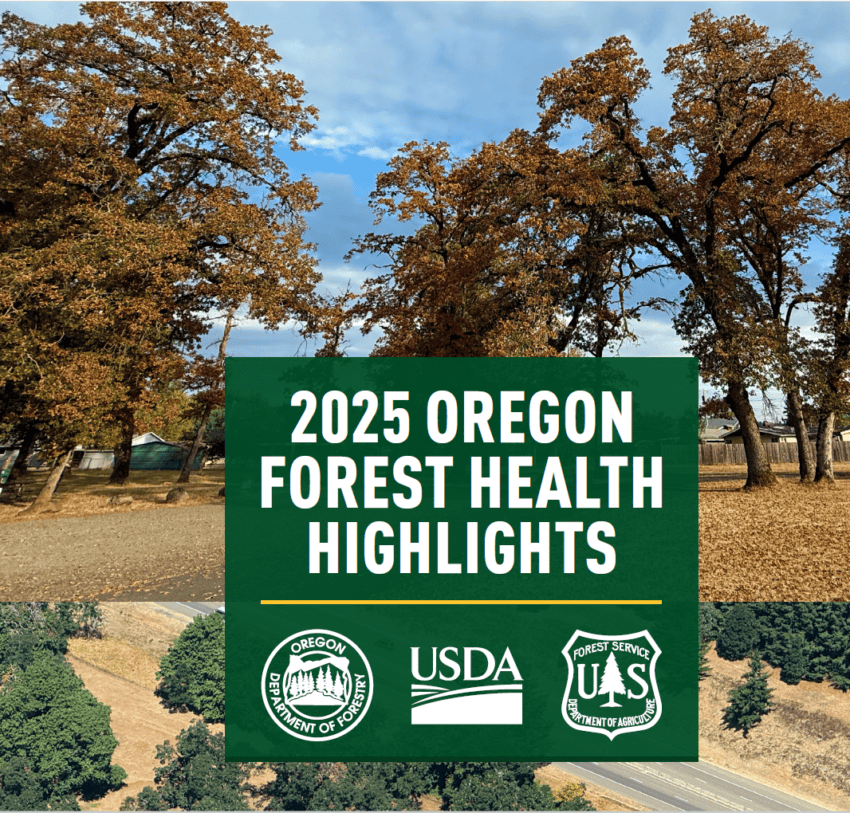
A report on the health of Oregon’s forests has just been released showing a dip in acres showing death and damage.
(SALEM, OR) – A new report on the state of health of Oregon’s forests is now available. Based on an extensive aerial survey of Oregon’s forests completed by the Oregon Department of Forestry and the USDA Forest Service, the report shows that while tree death and damage was lower last year than the 10-year average, drought is still a key stressor of Oregon’s forest trees, making it harder for trees to defend against insect pests.
ODF Forest Entomologist Christine Buhl helped produce the report. She said drought is often paired with rising temperatures. “Together these are often the underlying cause of tree deaths in our state. Drought reduces tree growth and lowers their defenses against insect pests and some diseases, which healthy trees may otherwise resist or tolerate.”
Lower than average death and damage
The report stated that 2025 saw a return to typical precipitation amounts, but spring was the fourth driest on record. A total of 181,500 acres showed death or damage of some kind from one or more causes. The damage was well below the 10-year average and less than half the peak year for damage in 2022. That year, 1.8 percent of Oregon’s 30 million forested acres showed signs of death or damage, compared to 0.7 percent in 2025 and 0.8 percent in 2024.
The highest percentage of damage or death was seen in eastern Oregon. Union County was worst affected, with 2.4 percent of its forested acres showing death or damage. This was followed by Umatilla County at 1.24 percent and Harney County at 1.12 percent. Coastal counties and those bordering the Coast Range had the lowest percent of death and damage in their forests.
Buhl said a majority (78 percent) of the damage seen from the air this year resulted from the interplay of drought and opportunistic beetles targeting stressed Douglas-fir (Pseudotsuga menziesii), true fir species (Abies spp.), and pine species (Pinus spp.).
The report also measures other causes of trees being injured or killed, such as diseases, storms, and wildfires.
Levels of tree diseases remain much the same
The report showed the acreage or incidence of common tree diseases were largely unchanged. Researchers noted that this can sometimes be the result of limits to how well such diseases can be detected from the air. An exception is the water mold causing sudden oak death (Phytophthora ramorum). Since its initial discovery near the California border in 2001, it continues steadily spreading north and northwest in Curry County around the community of Port Orford in southwest Oregon by about three to five miles a year. Sudden oak death infects scores of different shrub and tree species but kills Oregon’s native tanoak trees. The disease is spread by spores blown by the wind to new areas.
The State of Oregon is cooperating with federal land managers to slow the spread by identifying newly infected sites and cutting and burning infested vegetation. Private land is also being treated.
Ground-based observations showed that Swiss needle cast disease remains a problem for Douglas-fir growing in areas with high late-spring atmospheric moisture, primarily in the Coast Range. Despite the name, the disease is caused by a fungal pathogen native to the Pacific Northwest.
“The fungus affects the needles, causing many of them to be shed prematurely,” says ODF Forest Pathologist Gabriela Ritokova. “This produces a sparse crown and 20 to 50 percent slower volume growth, reducing the amount of timber the tree produces.”
Mild temperatures in winter and spring are believed to favor fungal development, worsening its impact. This is especially true in damp coastal areas formerly dominated by Sitka spruce and western hemlock that have been replanted with Douglas-fir plantations.
On the ground collaborators are also important
Buhl emphasized the importance of on-the-ground collaborators to help round out the full picture of forest health in Oregon. “In addition to data ODF and the USDA Forest Service gather, we rely on Oregon State University Forestry Extension staff from across the state, and collaborate with other natural resource agencies, universities, public and private forest landowners, and members of the public to gather information,” she said.
In the aerial survey, trained observers fly over all forested lands in the Pacific Northwest in fixed-wing aircraft and record damage to trees from all sources. Flights are staffed with one observer on each side of the aircraft. Survey flights typically fly between 1,500 to 2,500 feet above ground level, following a systematic grid four miles apart and traveling at 90 to 140 miles an hour.
The aerial forest health survey is the longest continuous survey of its kind in the United States. It started in 1947 and has been flown every year since. The only exception was in 2020 due to the COVID-19 pandemic. Data from the annual survey flights in Oregon can be found at https://www.fs.usda.gov/r06/natural-resources/forest-health/aerial-detection-survey
The full 2025 report is available at https://www.oregon.gov/odf/documents/forestbenefits/fhh-report-2025.pdf
