By Representative David Gomberg, House District 10
7/6/2026
Dear Friends and Neighbors,
The Governor’s “Prosperity Council” has presented their report.
The 15-member group of business, governmental and labor representatives last Thursday released a comprehensive set of recommendations for making Oregon more economically competitive. Predictably, their path to economic success includes lowering taxes on some wealthier residents, slashing regulations, beefing up state assistance to business owners, and making more of Oregon’s protected land available to industry.
Those are among 10 recommendations the council proposed, in a report that drew on dozens of listening sessions around the state, and feedback from more than 1,000 Oregonians.
Other details include overhauling the state’s economic development agency (Business Oregon); cutting some taxes in the near-term while convening a longer-term tax reform work group; revamping a greenhouse gas cap-and-invest program; and increasing Oregon’s investment in higher education. While many would require legislative action, others fall well within Governor Kotek’s authority to tackle.
- Transform Business Oregon into the Oregon Commerce Authority, governed by a board of business and innovation leaders and the Governor.
- Strengthen Oregon’s economic competitiveness with tax policies that are more pragmatic and in alignment with neighboring states, while supporting innovation, business growth, and higher wage job creation and moving the state toward a more balanced system. Near-term reforms should include: Modernize the Research & Development tax credit to expand eligibility and encourage university partnerships, with a key focus on small and medium-sized businesses; Update the Estate Tax with an emphasis on supporting family-owned businesses; Reform the Corporate Activity Tax (CAT) to reduce administrative burdens on small and medium-sized businesses while maintaining overall revenue levels; Reconnect the Qualified Small Business Stock (QSBS) policies to the federal tax code to help Oregon retain and grow emerging business
- Convene a nonpartisan tax reform working group to develop a long-term reform proposal that can be implemented by 2029. The group should consider how to restructure the Corporate Activity Tax, enable local governments to reform property tax funding, and rebalance the personal income tax structure to maintain progressivity and reduce effective rates for all income brackets.
- Establish enforceable statewide permitting timelines and guardrails by requiring agencies to approve or deny complete permit applications within clear statutory timelines, while maintaining environmental and safety standards.
- Reduce regulatory and administrative burdens by 20% by 2029. Remove outdated and duplicative regulations, which will improve government efficiency and should reduce government spending. The state should also establish a regulatory structure to ensure reforms support economic growth while maintaining protections for public health, essential services, and the environment.
- Adopt a market-based Cap and Invest program for greenhouse gas emissions. Upon implementation, the Governor should repeal the Climate Protection Program.
- Establish a dedicated and recurring site readiness and infrastructure fund of $250 million per biennium. Oregon cannot compete for jobs or build enough housing without a reliable supply of development-ready land.
- Modernize statutes and state policies governing land intended for industrial and business growth to reflect site suitability and ensure an adequate supply of development-ready sites to support target industries. Clear standards for industrial site readiness, including site size, configuration, natural features, road and other infrastructure access, power sufficiency, and location should ensure consistent interpretation across jurisdictions.
- Establish a Governor’s Cabinet of Economic & Talent Development to align state agencies around measurable economic, education, and workforce outcomes. Lead and implement a statewide Talent Alignment Strategy to establish ambitious statewide goals tied directly to Oregon’s long-term competitiveness while finding opportunities to streamline and consolidate.
- Strategically align higher education funding with West Coast states to strengthen Oregon’s workforce, research, innovation, and industry partnerships in high-growth sectors. Also, commit $20 million per biennium to the University Innovation Research Fund (UIRF) to leverage federal investment and commercialization opportunities.
I was particularly interested in the tax proposals—the Corporate Activity Tax (CAT), estate tax, qualified small business stock deduction and modernized research and development tax credits. The four proposed changes would cost around $150 million a year, less than 1% of the state’s general fund budget.
Oregon has the most punitive estate tax of the 13 states that levy such taxes. The tax kicks in at $1 million of an estate’s value, compared to $3 million in Washington. I’d like to increase our threshold to $3 million as well. (California, Idaho and Nevada do not have estate taxes.)
We do not have a lot of millionaires across our district. But with unique inflation in our limited housing market, how many of us own homes here that that would sell for more than $1 million? In 2023, four in five estate tax returns filed were for estates of less than $2.5 million. Those estates paid $71 million in taxes—18% of the total amount of estate taxes raised.
The CAT is a gross receipts tax on corporate activity of 0.57%. (That’s just under $6 on a thousand-dollar purchase.) Those funds go to support our schools. Businesses collect the funds after exempting the first million dollars of activity and then deducting one-third of either cost-of-goods or labor.
I voted for the controversial new tax in 2019. But as a small business owner, I also said during debate that $1 million in activity sounded like a lot but was not. I am reticent to reduce any revenue dedicated to education. But I could support an increase in the CAT exemption to $2 million to support our smallest businesses and trust that we’d make most of that money back in corporate income taxes when those businesses grow.
I’d offset the change with a small tweak. Current law allows a business to pass the CAT along to customers and you often see it added to your receipt as a “sales tax”. Technically, that is an inaccurate description. But more offensive to me is the simple fact that the tax on your receipt is almost always listed as 0.57%. Since businesses exempt the first million (or two) and deduct one-third of their major costs, they are clearly charging customers more for the tax than they pay. And that’s just not right.
The council’s report defined the state’s economic ills with a few grim statistics: Oregon ranks 49th in the nation in private sector job growth; workers’ paychecks are growing at half the national rate; and unemployment in Oregon is 21% higher than the national average.
The Oregonian Editorial Board supports the report and says, “Oregon’s tax policies are broadly punitive, including for lower and middle income Oregonians. Those making just $40,000 a year pay a higher effective income tax rate than their counterparts in Washington and California, the data shows. The estate tax, which kicks in at the lowest threshold in the country, hits families whose loved ones left little more than a house whose value has soared over the years, thanks to Oregon’s stingy homebuilding.”
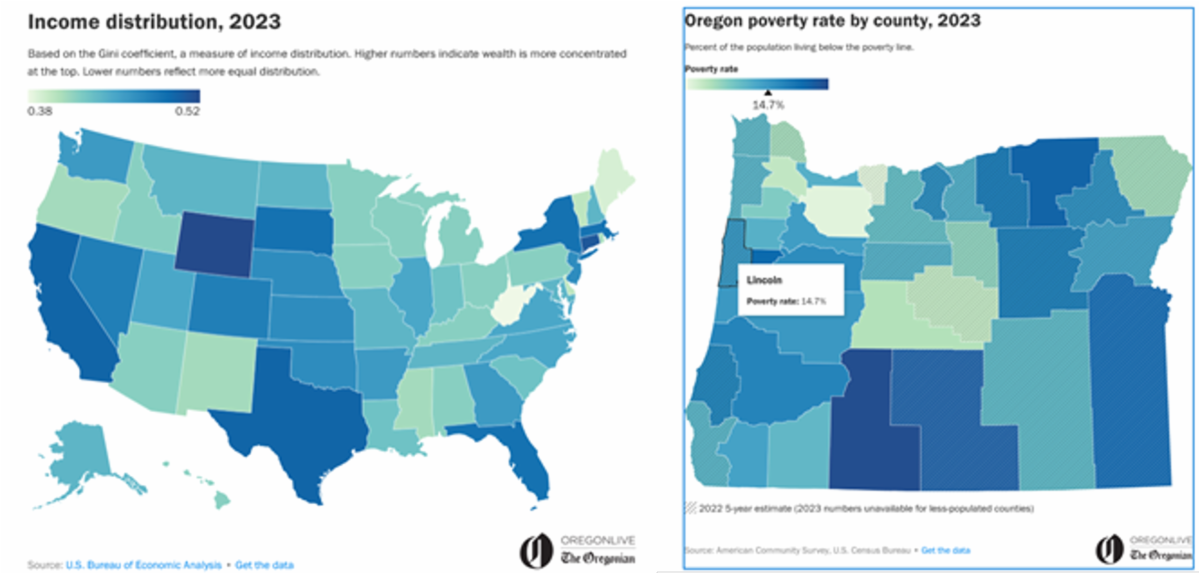
The same day as that editorial, the Oregonian published an interesting story reporting that income distribution here is more equitable than any state west of the Mississippi.
The reasons are uncomplicated they say. Oregon has fewer wealthy residents than other states do. Just a handful of billionaires call Oregon home—two at last count. We have a large middle class and a smaller number of poor people. The number of Oregonians living in poverty remained historically low in 2023. On the other hand, Oregon does have a thriving middle class. Our median personal income, which once lagged far below the national average, was right in the middle in 2023 at $95,629.
All that adds up to a relatively equal income distribution, at least compared to other parts of the U.S.
| Before I leave this subject, I wanted to highlight another interesting article.
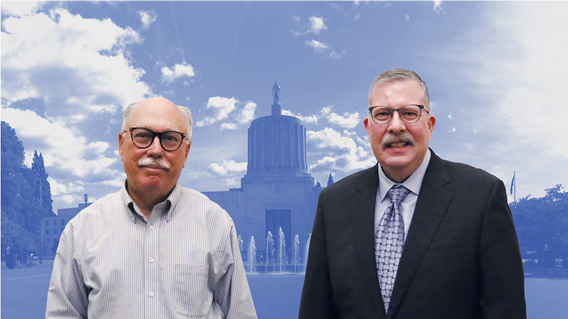
The Oregon Journalism Project interviewed two economists who have sharply different takes on the Prosperity Council recommendations.
Joe Cortright says Oregon is in better shape than you think. Over the last 15 years, we’ve had the fifth-fastest growth in income per capita of any state. We’re one of the leading states for exporters. Our median family income is above the national average. The economy is cyclical and, the past couple of years, we’ve been in a down cycle. But there are some idiosyncratic forces that are specific to Oregon. The worst thing is, the state’s two biggest firms, Intel and Nike, have both had the worst years that they’ve had, probably in the last quarter century. Collectively, they have laid off about 7,000 employees.
Cortright takes issue with the gloomy view of Oregon and proposes an alternative to the Prosperity Council’s plan, captured in a white paper “The High Road to Growth for All Oregonians,” which pushes for greater investment in public services like education and transportation. |
| Joe Cortright (left), a liberal, and Eric Fruits (right), a conservative. Both, in their prolific writings and public commentary, have sketched out different views of the state’s economy and its future. |
| Eric Fruits argues Oregon’s economy is languishing. We’ve lost something like 30,000 jobs over the past two or three years and population growth statewide is pretty flat. It took Detroit 40 years to go from starting its decline until it finally essentially went into receivership—we’re on the same path because we have so many fundamental problems. The biggest is the underfunded Public Employees Retirement System, which costs public sector employees about 27% of payroll. Those pension deficits are just an anchor that’s hanging around our necks.
Meanwhile, did I mention that Oregon’s minimum wage went up on July 1?
The standard minimum wage will increase from $15.05 to $15.55 per hour. Minimum wage in the Portland Metro area will increase to $16.80, and the non-urban minimum wage will increase to $14.55. That translates into an average annual increase of $573 for a full-time, year-round worker in Oregon. |
|
| The point of this lengthy and detailed explanation of the Prosperity Council recommendations is that there are plenty of ideas on how to improve our economy, almost all of them are controversial, and at a time when costs are going up and revenues down, it will be hard to legislate any tax reductions or increased investments.
Meanwhile, the Transportation Vision Workgroup is trying to navigate the same pothole strewn pathway toward improving and maintaining our highways, bridges and roads.
Since Oregon voters rejected a gas and payroll tax increase to pay for roads and transit services, the 12-member workgroup has been meeting and has set goals to find a sustainable solution for funding the state’s transportation needs while also keeping drivers safe, supporting transportation systems that strengthen the state’s economy, investing in transportation for all Oregonians and recognizing the unique transportation needs of rural and urban Oregonians.
There are no legislators in the workgroup, but I am one of six that has been asked to monitor their discussions.
Oregon’s Department of Transportation (ODOT) faces a structural funding crisis: traditional gas tax revenues are declining as vehicles become more fuel-efficient and electric vehicles multiply, while the cost of maintaining the state’s aging multi-billion-dollar transportation network continues to grow. The task force will be working to develop a sustainable funding proposal for the 2027–2029 legislative cycle.
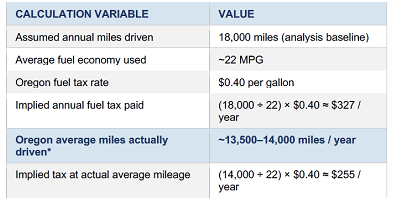
The average Oregon internal combustion vehicle driver is taxed approximately $255 to $327 per vehicle per year. Each funding option can be compared for adequacy and equity to that number. (EV and owners currently bypass gas taxes entirely.) |
|
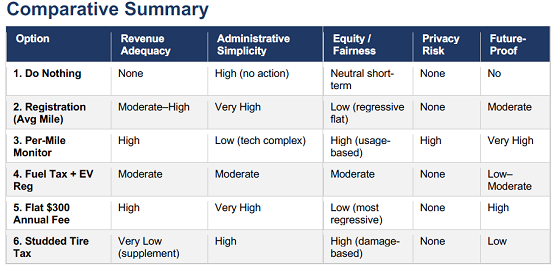
| There are few options available and while 80% of Oregonians said they didn’t want a gas tax increase, I fear that they will like the alternatives even less. Here are some options:
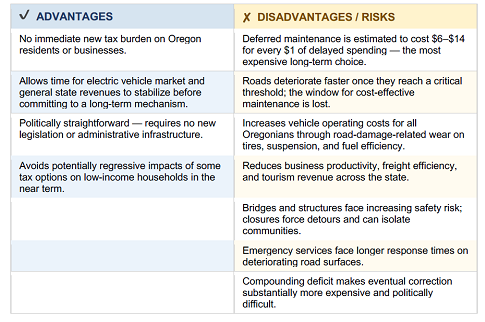
1. Do nothing and accept the consequences. Roads, bridges, and other infrastructure would receive only whatever maintenance current constrained budgets allow, with no new revenue. That’s not a good option. Deteriorating road surfaces directly increase accident rates. Potholes, crumbling shoulders, faded markings, and structurally compromised bridges create measurable safety hazards for drivers, cyclists, and pedestrians. Bridge closures redirect heavy truck traffic to roads not designed for that load, accelerating deterioration of the secondary network.
Emergency response (police and fire) is impaired. Tourism revenue is at risk. Freight and logistics costs rise. And vehicle operating costs increase. The American Society of Civil Engineers estimates that poor road conditions cost U.S. drivers an average of $600 or more per year in additional vehicle wear, fuel consumption, and tire damage. For Oregon motorists, this is a hidden ‘pothole tax’ that falls on individuals—not the state budget. |
|
| 2. Eliminate the gas tax and increase vehicle registration fees. This option increases the annual vehicle registration fee to reflect a fair share of road-use costs, calculated on the assumption that the average Oregon driver travels approximately 18,000 miles per year. The fee applies equally to all registered vehicles—gasoline, diesel, hybrid, and electric—and is collected through the existing DMV registration renewal process.
At the current 18,000-mile fuel tax equivalence, this implies a fee of approximately $327 per year. Using the Oregon actual average of approximately 14,000 miles, a proportionally adjusted fee would be approximately $255. |
|
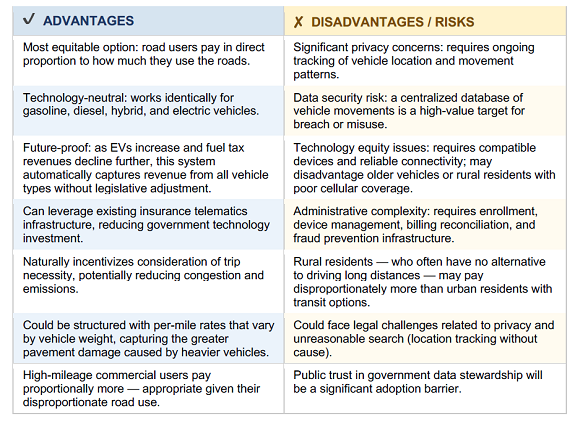
| 3. Assess a per-mile charge via third-party vehicle monitor Road User Charge or RUC. This option charges vehicle owners a flat fee per mile driven, verified through an in-vehicle monitoring device or a third-party program (such as those already operated by auto insurance companies for usage-based insurance: Progressive Snapshot, State Farm Drive Safe & Save, etc.. Drivers pay only for the miles they actually drive, making this the most usage-proportional of all the options.
This option is widely regarded by transportation policy experts as the most sustainable long-term replacement for the fuel tax. Oregon has already run a successful OReGO pilot program for road usage charging and has relevant institutional knowledge. Strong privacy protections—including opt-in consent, data minimization requirements, and third-party data handling—would be essential to public acceptance. |
|
| 4. Increase fuel taxes and increase registration fee for EVs. This option preserves the familiar fuel-tax model for internal combustion engine vehicles while creating a parallel registration fee increase for electric vehicles, hybrids, and other vehicles, based on the 18,000-mile average. Gas powered drivers pay more per gallon at the pump; EV and hybrid owners pay an increased annual registration fee calculated to approximate their equivalent road-use contribution.
This is likely the most familiar option and but has proven unpopular in recent elections. Significantly, it does not resolve the fundamental structural decline of the fuel tax base. It merely buys time while adding a parallel mechanism for EVs.
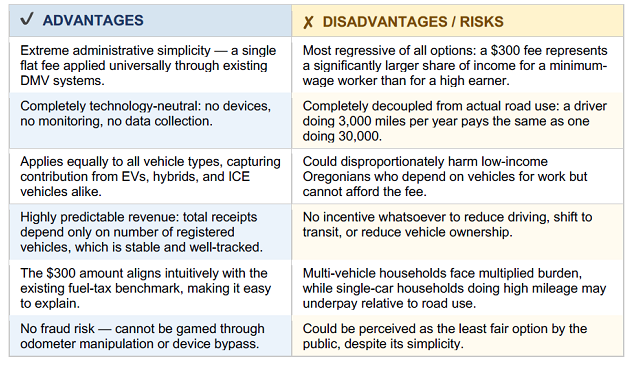
5. Charge a Universal Annual Vehicle Fee—$300 Flat Rate. This option establishes a flat annual fee of $300 per registered vehicle (plus DMV administrative costs), applied uniformly to all vehicles regardless of type, fuel source, or actual miles driven. The fee is collected through the existing vehicle registration renewal process and requires no additional technology. The $300 figure closely approximates the $327 benchmark cost derived from the 18,000-mile/22 MPG fuel tax calculation, providing a clear equivalence argument to the public.
To address the regressivity concern, this option could be paired with an income-based waiver or reduced-fee tier for households below a defined income threshold. An exemption or 50% reduction for low-income drivers would preserve the simplicity of the mechanism while reducing the burden on the most vulnerable Oregonians. |
|
| 6. Studded tire surcharge. This option imposes a seasonal surcharge or annual fee on the purchase and use of studded snow tires, which cause disproportionate pavement damage relative to non-studded winter tires. Oregon already restricts studded tire use to specific seasonal windows (typically November 1 through March 31, with extensions in certain mountain zones). A dedicated studded tire tax would directly align the cost of road damage with the users causing it. This option is best understood as a supplemental revenue measure and damage-deterrent, not a standalone solution. |
|
| I received an analysis from a thoughtful constituent who paired it with a provocative suggestion. Rather than the legislature select and approve a single solution, or return to voters with a proposal to be picked at, criticized, and likely rejected, instead offer voters several refined suggestions including the “do nothing” status quo—and let them select the best.
A multi-option ballot respects voter intelligence and generates more comprehensive public discourse than a single-measure campaign. Done well, a multi-option ballot approach transforms a difficult fiscal problem into a civic moment: Oregonians choosing together how to invest in the infrastructure that connects them.
For my own part, I’m looking for a solution that will maintain and improve our transportation infrastructure, fairly charge all road users for their roads, includes voters in final decisions, keeps ODOT accountable and addresses concerns about unnecessary spending, and is easy to collect.
I’m also concerned that all of these models land squarely on Oregon drivers. In a district where one-in-four cars has an out-of-state plate, I want to make sure everyone on our roads helps pay for them.
Oregon’s roads, bridges, and community infrastructure are the foundation on which everything else—commerce, safety, access to services, quality of life—depends. The funding crisis facing ODOT is real, urgent, and compounding. I look forward to the continuing conversations and being a meaningful part of it. |
|
| I’m running long this week but this is important and detailed news. And I have one more item to share.
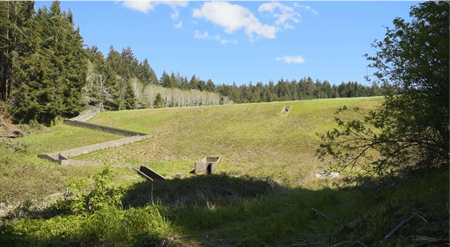
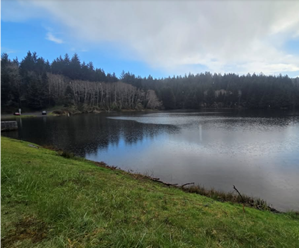
The Newport Big Creek Dams provide water for residents, visitors, the fishing industry and our Southbeach science hub. But those dams are the most seismically vulnerable in the state. Collapse of the 50-year-old earthen dams would threaten lives downstream, cut Highway 101, and devastate livability and the economy of the area for a generation.
The city has been fervently pursuing options, and I’ve worked to support them. Five years ago, I secured a $14 million state commitment to the $80 million cost of a new dam. I also travelled to Washington DC to help pursue promises of $60 million more.
Those Federal promises have been slow to arrive and in the intervening time, the estimated cost has climbed from an estimated $80 million to $150 to $230 million to more than $300 million. The city has been forced to consider alternatives.
The problem was that state dollars being held in reserve for a “replacement dam” could not be used for other purposes. Newport was at risk of losing hard won dollars.
I reached out to the Chief Financial Officer, the Department of Administrative Services, to the State Department of Justice, and to the Legislative Fiscal Office. I argued that there was no meaningful difference between a “replacement dam” and “dam replacement”.
And this week I prevailed. We’ve now been informed the $10 million still in Newport’s account will remain there. It won’t solve the dire dam problem. But it will help. So let’s call that a win and keep working on a resolution. |
|
| Newport’s seismically vulnerable earthen dams. |
|
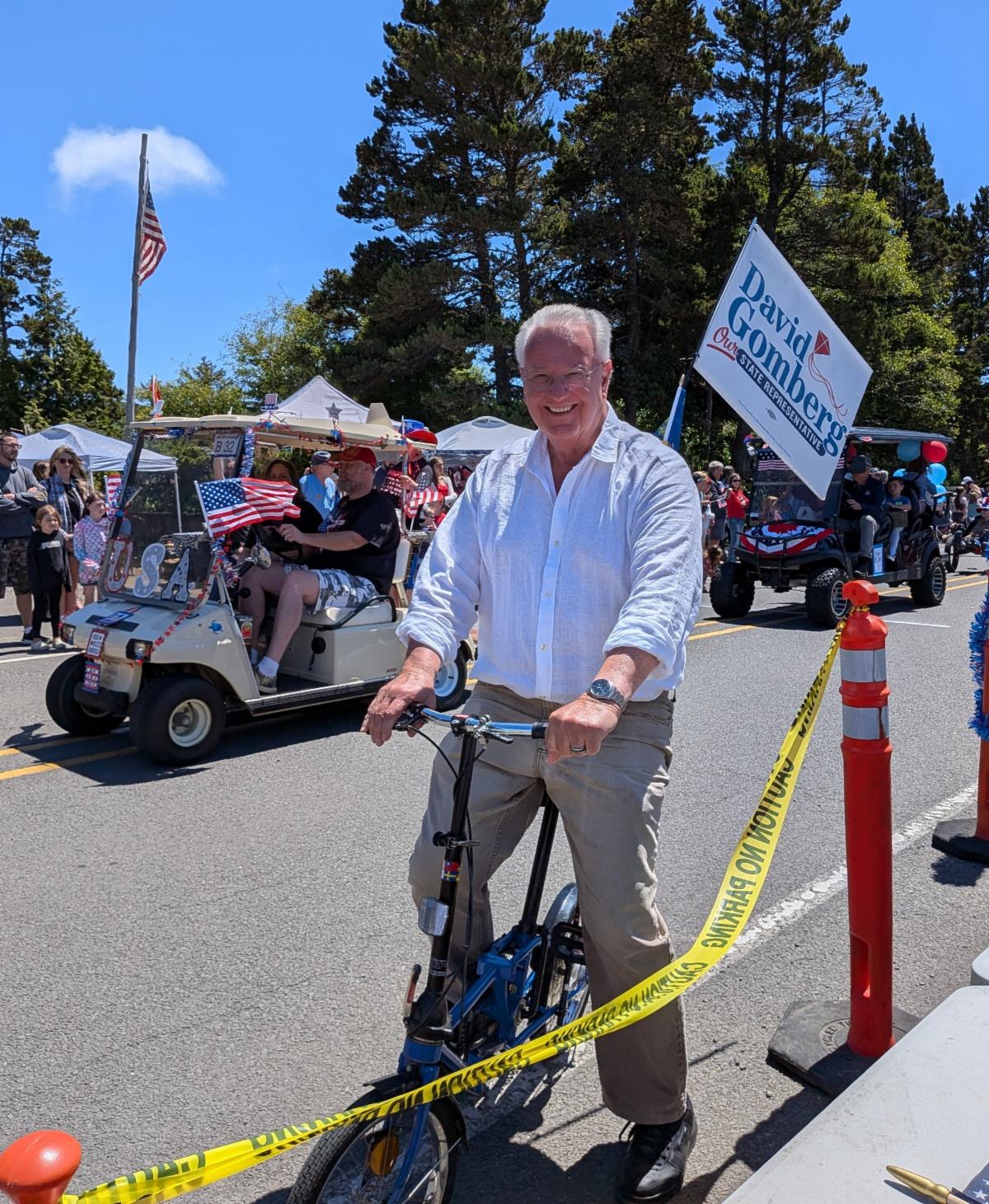
| Saturday was a glorious day to celebrate the Fourth!
This year I joined the Gleneden Beach parade and then braved holiday traffic to enjoy the Newport Symphony holiday concert, which I was pleased to help sponsor. |
|
| For the coming week, I’ll be meeting with the Department of Transportation, discussing wildfire tax relief, attending a meeting of the Transportation Vision Workgroup, sitting down with leadership of our Samaritan Hospitals, and joining a Central Coast Business Social in Waldport. Susan and I will also be at the lovely Candlelight Concert in Newport Thursday evening.
Thanks for reading this far and please have a productive and sunny week yourself. |
|
| Representative David Gomberg
House District 10 |
|