By Representative David Gomberg, House District 10
Dear Neighbors and Friends,
Sensitive electronic equipment and salt air don’t always go well together. So for the most part, our district has been spared the political and economic debate raging across Oregon regarding data centers.
A year ago, most people could not tell you what a data center is. And chances are you’re relying on one right now, without giving it a thought. Data centers suddenly seem to be everywhere. A surge in AI and cloud demand has made them one of the most talked-about and fought-over pieces of modern infrastructure.
A data center is a purpose-built building that runs large numbers of computers reliably, securely, and around the clock. Inside are the servers, storage, and networking gear that do the work, plus the heavy-duty cooling, backup power, and physical security that keep them running. One can be as small as a server room or as large as a windowless campus the size of several stadiums, wrapped in cooling, batteries, generators, and high-capacity links to the internet and the grid. Software runs the show, spreading out the workload, flagging failures and handling security.
Data centers store data and run the software behind the services people use all day. Stream a show, send an email, tap a card at checkout, back up a photo or ask an AI a question, and somewhere a data center does the work and sends data back almost instantly. The core jobs are storing data, processing it, and moving it across networks. They host the cloud platforms companies rent instead of running their own servers, and they stream video, clear payments, keep business systems online, and now train and run AI models. They also handle quieter work, from corporate databases to the cybersecurity systems that guard them. As AI has grown, much of the new capacity goes to the specialized chips it depends on.
- An enterprise data center is built, owned, and run by a single organization for its own use. Banks, hospitals, and government agencies often keep their own so sensitive systems and data stay under their direct control, usually on their own property.
- A colocation data center rents space, power and cooling to many customers, who bring their own servers. Think of it as the commercial real estate of computing: the operator supplies the building, power, cooling, and network access, and tenants own the gear inside.
- Hyperscale data centers are the giants: enormous campuses run by a handful of tech companies to deliver cloud and AI at massive scale. The “big three” are Amazon Web Services, Microsoft Azure, and Google Cloud, and a single site can cover millions of square feet. These are the ones driving today‘s building boom, and they carry some of the biggest power demands of any type.
Data centers are controversial because they can be a tax windfall and a grid headache at the same time. They bring construction work, tax revenue, and fresh infrastructure, but they also lean hard on electricity, water, and land while employing relatively few people once they’re running.
The local upside is years of construction work, a handful of skilled permanent jobs, and infrastructure that a small town might never fund on its own. But, the costs land elsewhere. The largest campuses can draw hundreds of megawatts, enough to rival a small city. That strains the grid and raises an awkward question about who pays for the upgrades, the developer or everyone else through their utility bill.
Read more in this Forbes article.
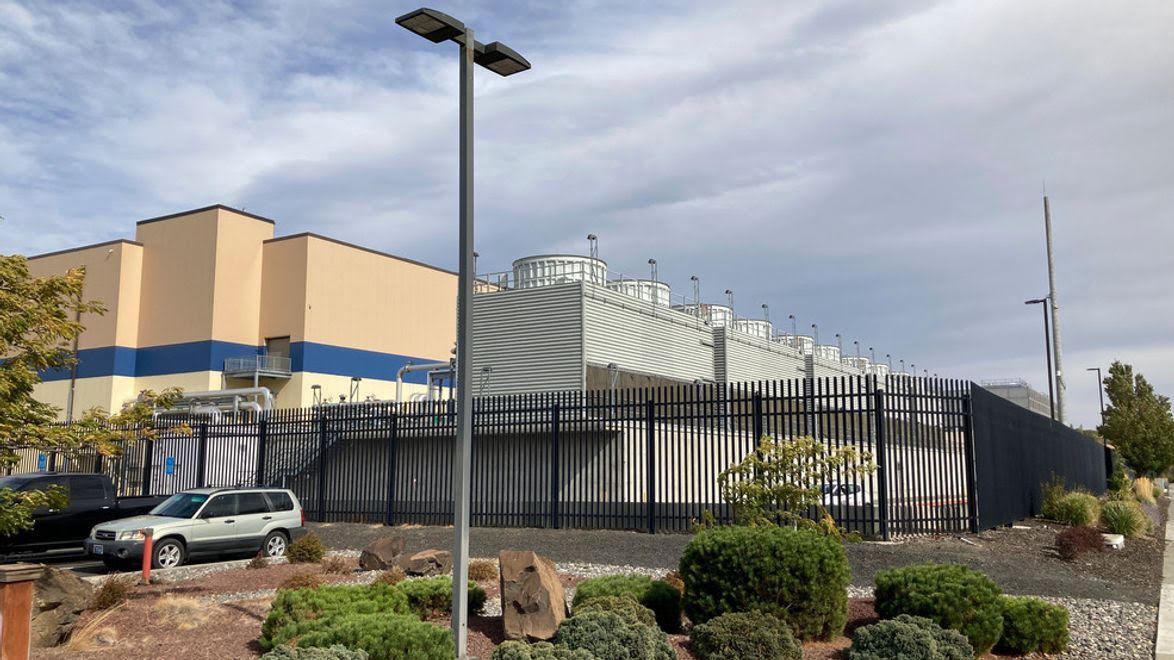
| This photo shows the exterior of a Google data center in The Dalles, Oregon. As demand for cloud computing grows, the world’s biggest tech companies are building more data centers, including in arid regions even though they use vast amounts of water per day. (AP Photo/Andrew Selsky) |
|
| Today in Oregon, 111 data center facilities consume nearly one-quarter of the state’s power, according to a new report.
ECOnorthwest and the University of Virginia have quantified basic yet hard-to-find data. That includes how many data centers the state currently has (111), what’s in the pipeline (32), their employment impact (2,630 direct workers), footprint (approximately 22.1 million square feet of gross building space), and their energy use (about 23% of retail electricity sales statewide in 2025).
Data centers tend to have few direct employees. Instead, data centers often look to third-party contractors to build facilities and service equipment. In total, data center employees represent about 0.2% of the state’s roughly 1.97 million person workforce. However, of the 2,630 direct data center employees, 2,205 of them are in Eastern Oregon and, in Morrow County, the hyperscale data centers directly employ more than 10% of the local workforce.
Researchers sought to quantify how data centers impact the property tax landscape in Oregon. Unlike most other states, companies do not pay a sales tax on materials purchased for construction of facilities. Instead, local governments collect property taxes—but also offer tax abatements as incentives to develop in that community. Companies paid $60.2 million in property taxes for operating data centers in Oregon in 2025. Researchers found discrepancies when it came to analyzing properties that take advantage of tax exemptions, which likely range from $230 million to $450 million. |
|
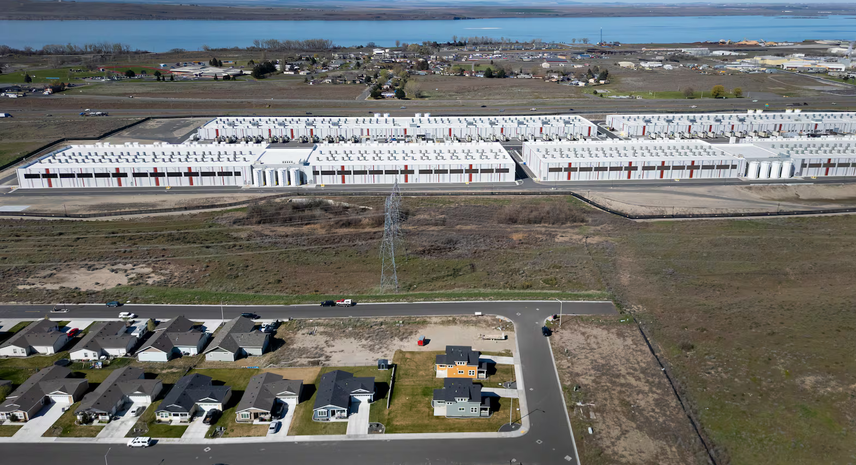
| An Amazon data center in Boardman. Saskia Hatvany / OPB |
|
| We all rely on data centers. But, that doesn’t mean we should subsidize their power costs, exempt them from land use rules, or provide tax incentives.
Earlier this year, the legislature passed House Bill 4084 which would expand the state’s Enterprise Zone program and allow local property tax breaks to businesses when they make new investments in the state. My budget committee approved a change that would block new data center projects from receiving enterprise zone tax breaks until the summer of 2027.
More significantly, we passed House Bill 3546, or the POWER Act, short for “Protecting Oregonians With Energy Responsibility.” The bill aims to require large energy users like data centers and cryptocurrency businesses to pay their share for electricity use rather than pass costs along to residential ratepayers.
And finally, a statewide moratorium on new data centers has come front-and-center in the November election.
Polling by Lake Oswego-based DHM Research found extreme skepticism toward the facilities, with 66% of Oregon voters favoring a moratorium on data centers, and nearly 75% opposing tax breaks to attract them. And now, there is an opportunity for you to comment.
Governor Tina Kotek’s Data Center Advisory Committee is asking the public to weigh in on a 20-page “preliminary learnings and questions” report. Although the report does not include distinct policy recommendations, the group seems to have found consensus around a need for more responsible oversight of the data center industry and a more centralized information repository about Oregon data centers’ type, their water and energy use, and the tax breaks they receive each year through state incentive programs.
The committee has fielded more than 700 written comments, along with nine hours of verbal comments, since it first met in February. Roughly 90% of commenters expressed opposition to data centers. The public comment period will remain open until 5 p.m. on October 24. SUBMIT A COMMENT HERE. |
|
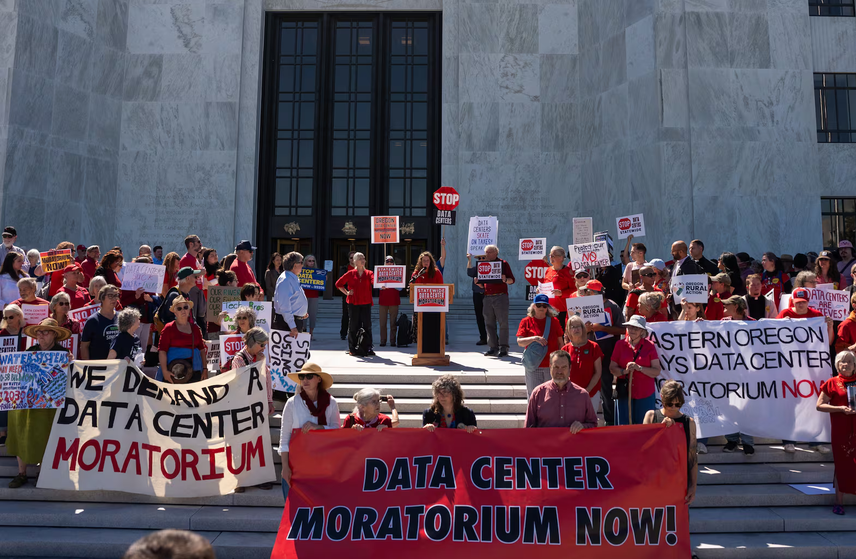
| People gather in front of the Oregon State Capitol, advocating for a statewide data center moratorium, in Salem. Eli Imadali / OPB |
|
| Last week, I met with Governor Kotek and a group of businesspeople who often do the work of sustaining or improving our construction projects that range from water and sewer to roads and bridges. As I detailed to newsletter readers last week, we have reduced ODOT funding $428 million in the past three sessions with $200 million more in cuts anticipated in 2027. Staffing is at the lowest level in more than 25 years. Administrative positions have been cut. But Oregonians are still skeptical that their road taxes are being spent well or that new revenue is needed as gas taxes decline.
One of the problems, I told the group, is that we are doing well with the reduced resources we have. We’re prioritizing maintenance and safety, filling potholes, and plowing snow. People are not seeing problems. And one problem they are not seeing is the structural maintenance and repairs we are delaying.
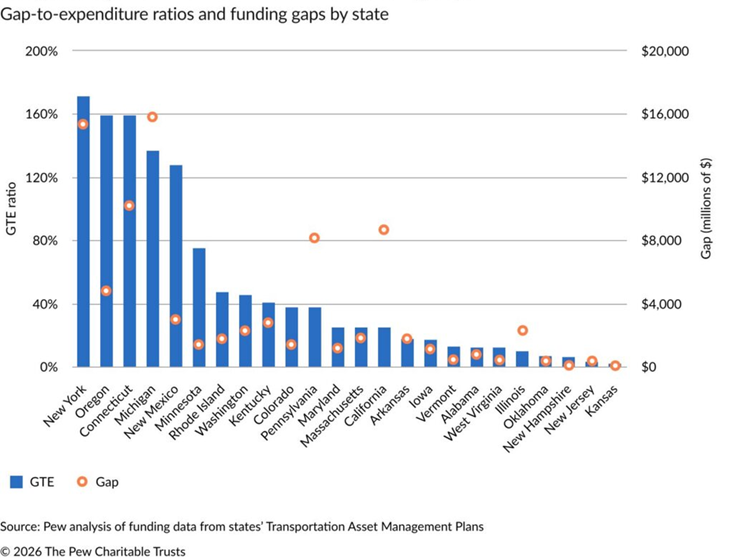
Oregon has one of the largest gaps in the country between its highway and bridge maintenance needs and what it spends on addressing them.
Oregon is falling behind on transportation maintenance, a recent study from The Pew Charitable Trusts shows, and Oregon also lags most other states in what it needs to invest in its roads and bridges.
In 2022, Oregon reported having over $7 billion in maintenance needs in order to make its highways and bridges in a state of good repair. However, it only planned to spend $2.8 billion in maintenance over that time period, according to documents it submitted to the federal government—placing the state at one of the highest gap-to-expenditure ratios. |
| Out of more than 8,300 total bridges in the state, over 400 are categorized as structurally deficient, meaning at least one key component (like the deck, superstructure, or, substructure) is in poor condition. Along heavily traveled coastal corridors like U.S. Highway 101, approximately 16% of bridges are rated in poor condition, requiring constant monitoring to avoid weight restrictions or emergency closures.
Local public works directors note that delaying full replacements in favor of minor fixes drives up long-term costs, forcing counties to triage repairs only on the busiest commuter paths while neighborhood or rural structures decline further.
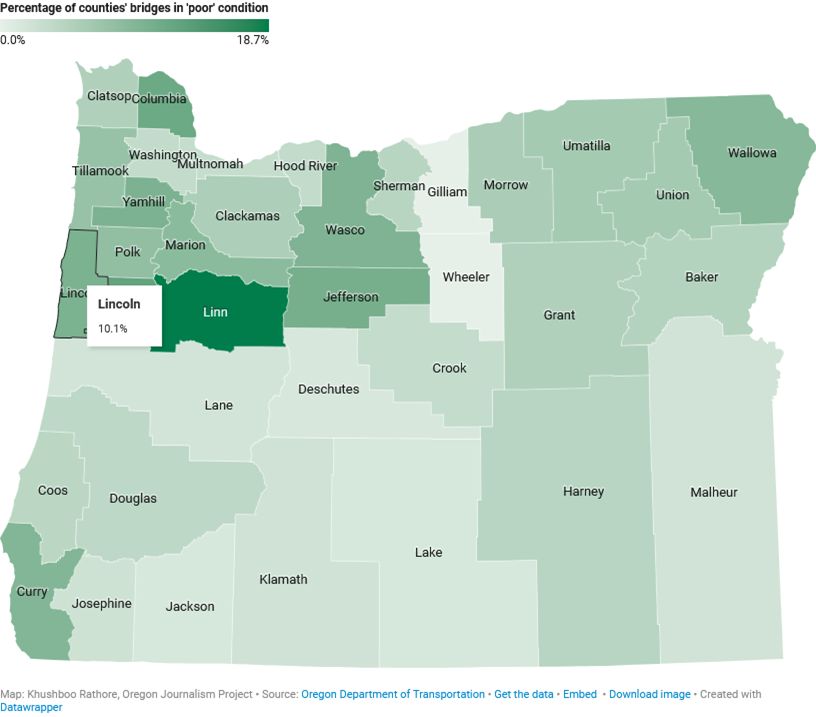
Of the state’s 36 counties, Linn has the highest rate of poor bridges, about 1 in 5 (18.7%). Benton County has the second-highest rate of poor quality bridges, at 12.4%.
See an interactive map of Oregon counties here. |
|
| My work as chair of the Blue Economy Task Force will continue between now and the start of the 2027 legislative session. Meetings are scheduled for Salem, Coos Bay, and Seaside. The larger group will then take a formal break for six months while smaller subject-matter work groups meet. Then, we will reconvene and work toward a set of proposals and recommendations.
As I detailed two weeks ago, at its core, the Blue Economy refers to the “business sectors that rely on the sustainable use of ocean resources for economic health, improved livelihoods, jobs, or ecosystem health.” We’ll be looking at sustaining and supporting jobs in fishing and processing, science and innovation that lead to new opportunities, and the workforce training necessary to prepare workers for new and well-paying jobs.
A story in the Register-Guard last week caught my attention. “Why Oregon seafood is hard to find at local markets?”
In 2025, the Oregon commercial fishing industry generated $369 million in income, which was “modestly high,” in comparison to the previous five years, according to a report by The Research Group for the Oregon Coast Visitors Association. Despite the industry’s high activity, Oregon still imports more seafood than it exports. In a 2022 report, The Research Group, reported about 90% of seafood consumed on the Oregon Coast was imported. In addition, Oregon exports much of its seafood to the same countries it is importing from.
Let me say that again. We are importing seafood from the same countries we export to.
In some cases, it is more cost-effective for large processors to send seafood to Asia for processing and packaging before returning to the U.S. markets as ready-to-distribute products, which is known as “re-importing.” Dungeness crab, for example, is often shipped to China, where it is processed into picked meat, frozen, and sent back to the U.S. Lower Chinese labor costs and more lenient regulations make re-importing crab more cost effective than processing here at home.
About one-third of U.S. seafood exports are destined for China, and around 57% of that seafood is re-imported, which doubles the carbon footprint. |
|
| Increasing local sales of local seafood by just 10% would have a $100 million benefit to our fishing fleet. But, we have several problems.
The first is population. Towns along the Oregon Coast are spread out and sparsely populated, tallying about 115,000 residents, according to U.S. census data. The lack of dense population means fewer buyers compared to larger cities elsewhere. Even with an influx of tourists, the coast has limited demand for Oregon-caught seafood.
A second problem is consistent supply. Visitors want fish and chips year-round. But the availability of fresh local seafood is dependent on the season and weather conditions, and market prices can vary widely. Most of the restaurants serving seafood in Oregon want “portion-controlled, frozen and consistent,” meaning year-round seafood products. Large processors provide that, delivering consistency in both products and prices.
The Oregon Coast lacks much of the infrastructure needed to help small seafood businesses process and distribute their products, and doing so requires substantial financial resources.
Central Coast Food Web is a nonprofit designed to support local, independent food producers. CCFW created the Yaquina Lab in Newport, which provides forklifts and blast freezers for distribution and storage. Small businesses can rent the space at a low cost, which minimizes risk.
According to The Research Group’s 2025 report, there is “huge potential” for local seafood suppliers to enter local markets through an increase in infrastructure, like cold storage; branding and labeling; and marketing the traceability of local catch.
Finally, you and I can help by being thoughtful about what we buy and where we buy it. Stores and chefs can help create the demand necessary to motivate distributors to keep more seafood in-state by making substitutions, promoting “buy local”, and amending recipes to feature Oregon’s seafood.
That can be as simple as substituting that Mahi-Mahi filet for an Oregon albacore. |
|
| With only a few weeks left before ballots arrive in your mailbox, you can look forward to candidates on your doorstep and mailers in your mailbox. I don’t think I will ever get over that feeling the first time I went to the Neotsu Post Office and found the recycle bin filled with pictures of my smiling face staring back at me…
This week, I’ll be watching (but not speaking) at the Lincoln City Chamber Candidate Forum. I’ll also be at the Newport State of the City address Tuesday evening.
Wednesday, I’m meeting with Samaritan Hospitals to discuss emergency water storage. While we urge coastal families to be two weeks ready, most of our coastal hospitals have only three days supply of water and generator fuel. I’m looking at how we find the millions of dollars needed to be better prepared. Wednesday night, I’m moderating a candidate forum at the Atonement Lutheran Church in Newport.
Friday, I’ll be joining the Oregon Ports Association annual conference in Astoria. And Saturday, I hope to imbibe at Garlicpalooza in Toledo. Yum! |
|